

[비즈한국] “While K-content has grown significantly, the recent climate is not easy. Merely increasing production cost support has its limits. Now, we must change the very way the content industry grows.”
Kim Yoon-ji, president of the Korea Creative Content Agency (KOCCA), held a press conference marking her 100th day in office to unveil her policy direction. Moving forward, the agency will focus its support on increasing profitability by expanding single content IPs (Intellectual Property) across various genres and industries. To dismantle barriers such as one-year national treasury projects and genre-specific budget silos, she is also pushing to transition the agency into an endowment-based organization during her term.
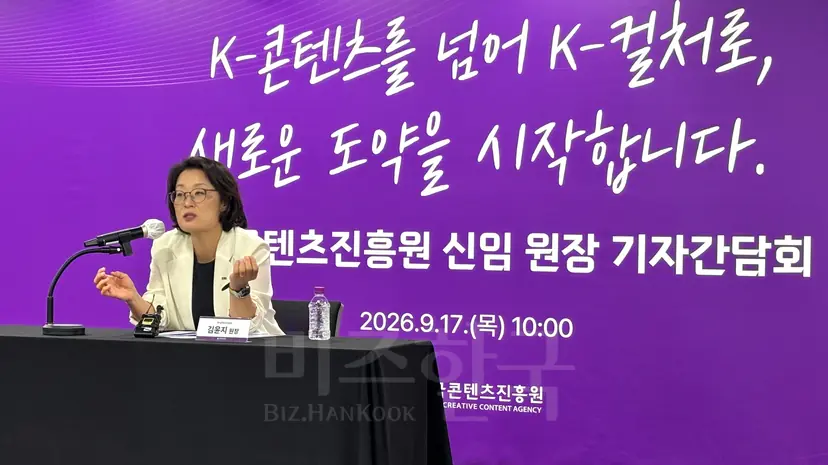
At the press conference held at the CKL Corporate Support Center in Jung-gu, Seoul, on the 17th, President Kim stated, “KOCCA will go beyond being a simple support agency and leap forward as a key agency that connects the success of K-content to the growth of the entire K-culture industry.”
The new strategy consists of four pillars: re-emerging as a leader in the K-culture industry, realizing a content IP powerhouse, strengthening the content industry’s growth engine, and building an on-site-oriented organization and future response system. While maintaining existing genre-specific support and production-stage policy projects, the agency will expand and reinforce its support direction by adding new initiatives.
The background for KOCCA’s restructuring of its support system lies in the slowing growth of the content industry. According to KOCCA, the average annual growth rate of content industry sales and exports was 4.78% and 6.61% respectively from 2018 to 2022, but this dropped to 1.68% and 3.01% from 2022 to last year. The judgment is that simply expanding existing support projects is insufficient to achieve the government's goals of a 400 trillion won K-culture market and 110 billion dollars in content exports by 2030.
Expanding Webtoons into Dramas, Animation, and Games… Focusing on Boosting Profitability
In this strategy, KOCCA focuses on increasing profitability by expanding a single IP across various genres and industries. Instead of stopping at supporting the production of a single webtoon, the approach involves creating multiple revenue streams from one IP by expanding it into dramas, animation, and games, or connecting characters to other industries such as food, fashion, and toys.
President Kim said, “The demand we hear most in the field is for more production funding,” adding, “Looking at the rising level of production costs, simply increasing production support funds little by little cannot be a solution. We need a business system that creates powerful content IPs and forms lasting fandoms to increase the profitability of the IP.”
She continued, “Even if you secure an IP, if you cannot sell or utilize it in various places, you won't generate profit,” explaining, “A single drama must be able to expand into web novels, webtoons, or games to generate various auxiliary revenues.”
With the content distribution structure being reshuffled around global OTT platforms, the traditional method where production companies sold the same content to multiple broadcasters and platforms to generate revenue has also changed. KOCCA’s assessment is that even if one holds an IP, it is difficult to create additional revenue if it cannot be expanded into follow-up projects or other genres.
Accordingly, the agency will strengthen its role in connecting small and medium-sized production companies and content firms that have difficulty expanding their own IPs. Unlike large corporations, it is not easy for small webtoon, animation, and game companies to find partners or investors in other genres directly; thus, the plan is for KOCCA to bridge these existing genre-specific support projects and networks to assist in business expansion.
The internal silos between genres will also be addressed. The agency plans to consider an organization in the form of a ‘Content IP Strategy Council’ that connects the strategic functions of various divisions—such as games, broadcasting, and animation—to link support projects across different genres.
“We will become the bridge between creators and platforms”
As a concrete method, she proposed a ‘Korean-style Production Committee (tentative name).’ This is a model where KOCCA acts as a bridge between creators, production companies, investors, platforms, distributors, and manufacturing firms to expand a single IP into other genres and businesses.
However, the production committee is a method used in Japan, where it is common for multiple companies to jointly bear production costs and share rights. Critics point out that as the number of participating companies increases, rights relationships become complex and decision-making slows down, which can hinder the further utilization of the IP or global expansion.
Regarding this, President Kim said, “It is difficult to call Japan’s production committee a highly successful model. Because rights relationships were defined too precisely, there were cases where they could not expand overseas and were trapped inside,” adding, “We intend to take the positive aspects and remove the negative ones.”
She continued, “We will start by creating even just one or two instances where an IP expands into other genres,” explaining, “We will develop a Korean standard model by reviewing contract relationships and rights issues together, and expand it bit by bit.”
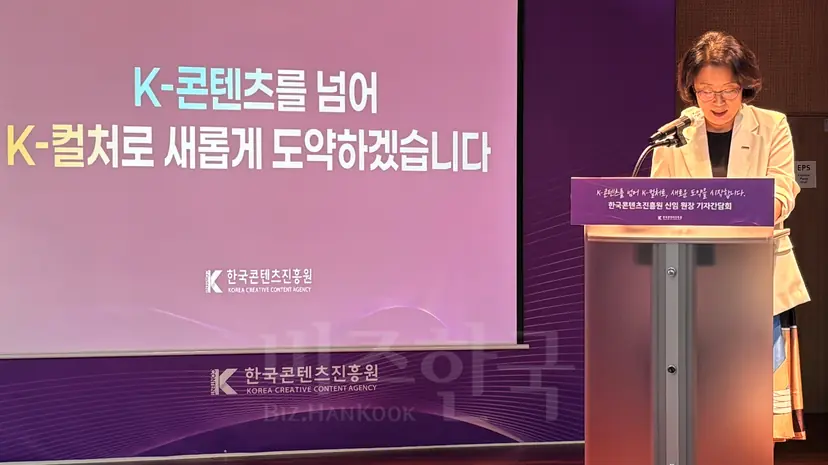
Pushing for Transition to an ‘Endowment-Based Organization’ During Her Term
In addition to support methods, the budget structure will also be revamped. Currently, most KOCCA projects are operated as national treasury subsidy projects where the government dictates the usage. Allocated budgets must be executed within that year, and the usage is fixed by genre. President Kim explained that there are limitations in combining genres or changing project details based on market conditions.
To improve this, she is pushing for a transition to an endowment-based organization during her term. The endowment system offers relatively greater discretion than subsidies where usage is fixed for individual projects, allowing for more flexible budget management according to industrial demand and project timing. However, an actual transition requires consultation with relevant ministries, including the Ministry of Culture, Sports and Tourism and financial authorities.
President Kim added, “If we become endowment-based, we can operate projects much faster and more flexibly according to the needs of companies,” and added, “I hope to definitely make the transition during my term so that we can change support policies to be more industry-friendly.”
The Korea Creative Content Agency had been without a leader for about 1 year and 8 months before President Kim Yoon-ji took office this past June. President Kim is an economics and finance expert who has researched the economic ripple effects of the content industry and the Korean Wave, including her time as a senior researcher at the Export-Import Bank of Korea’s Overseas Economic Research Institute. She is emphasizing a support system from an industrial perspective that goes beyond simply increasing the scale of content production support and links IPs to profitability, investment, and exports.