

[BizHanKook] Sushi was a gift of overtime. In dramas aired in the mid-1990s, corporate executives would habitually bring sushi to their significant others working late nights. Neatly arranged in a rectangular styrofoam (PSP) container with a wood-grain pattern, sushi was a "premium" token of appreciation for the exhaustion of pulling an all-nighter.
For a cartoonist who works regardless of day or night, sushi holds a special meaning. A plate or a container filled with a diverse array of sushi pieces served as a self-congratulatory toast to their creative passion and a reward to soothe the hunger that comes with meeting a deadline. On a day when rain hurried the farewell to autumn, I met with artist Kim Han-jo at a sushi restaurant in Paju.
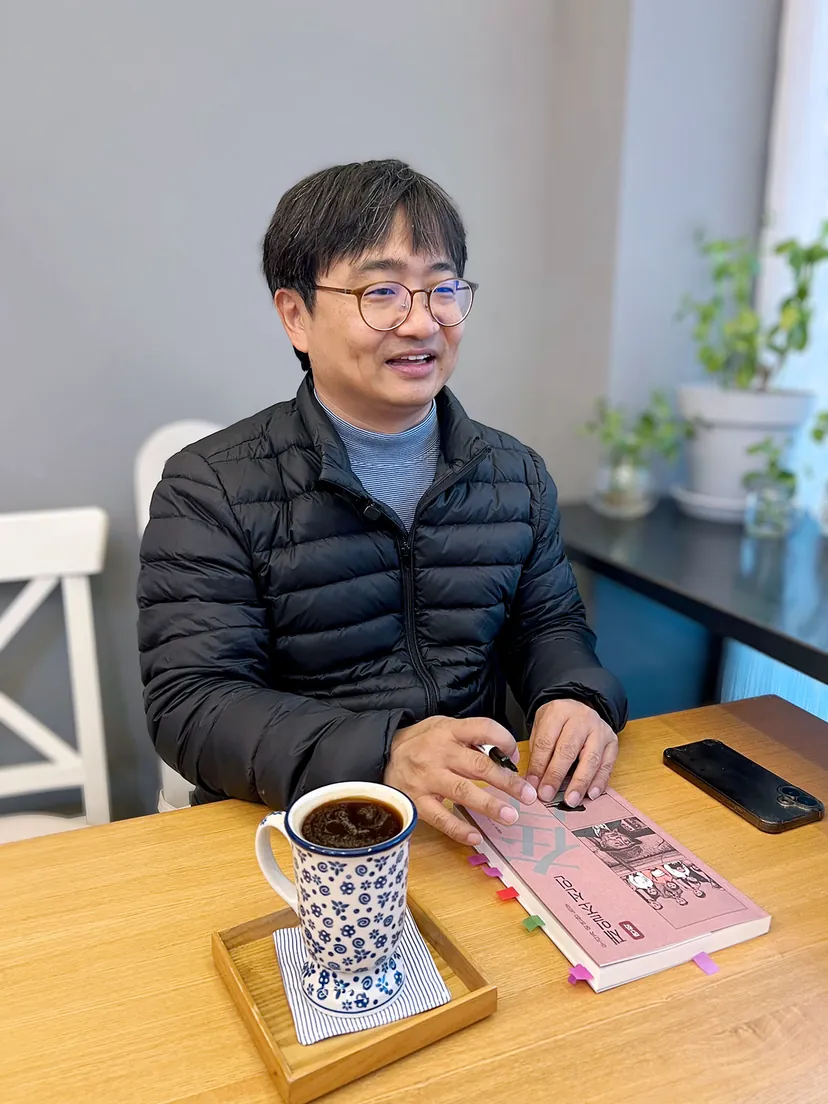
The First Sushi of Life, Jeju Midori
Artist Kim Han-jo’s registered hometown is Jeju. Born in Seoul as the younger of twins, he was separated from his brother just 40 days after birth and sent across the sea to his grandparents' home. He lived in "Seomuntong," the intersection in front of the West Gate of the old Jeju Eupseong, until he was about four, when he grabbed his father’s trousers during a brief visit and begged to be taken back to Seoul. Even after that, he traveled to Jeju—his "big house"—several times a year; given that he explored the stories of "Zainichi Koreans," including his great-grandfather, in his book Zainichi Koreans: Compatriots We Have Ignored (2019), Jeju holds a significance for him that goes beyond a mere registered address.
The first sushi restaurant the artist visited, around his 4th or 5th grade of elementary school, was a Japanese restaurant in Jeju called "Midori (緑)." He remembers being startled by the unfamiliar wasabi, yet even after the pungent sensation faded, the taste of the sushi kept coming back to him.
A Reward for a Productive Day
After graduating from college, Kim lived in Sillim-dong for a while and would often visit his alma mater's library to draw comics. While he usually ate at affordable student cafeterias, on days when his work felt satisfying, he would visit a nearby sushi place to enjoy a 10-piece assorted sushi set. The sushi, featuring tuna, flatfish, salmon, scallops, and shrimp, was a reward for successfully overcoming a hurdle in his creative process.
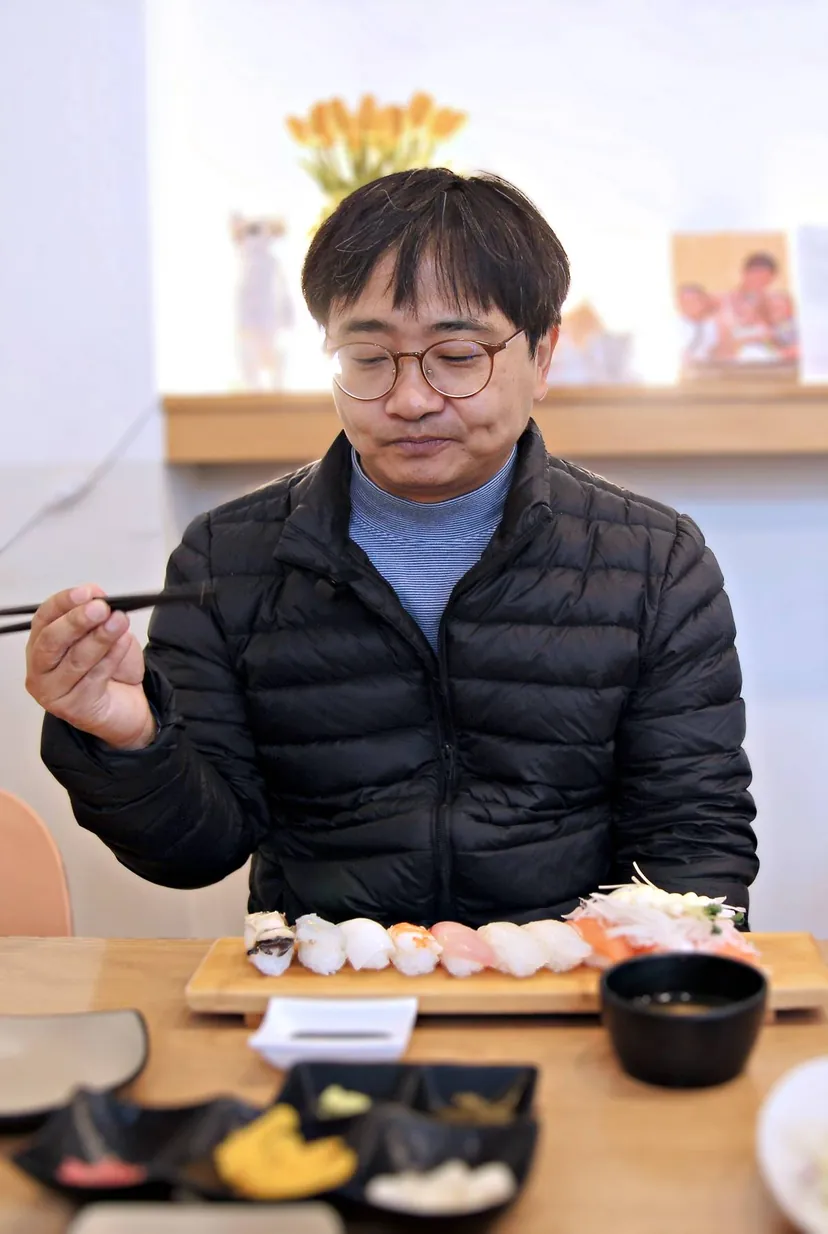
While the sushi that cost 6,000 to 7,000 won back then has more than doubled in price over the last decade, the composition of the assortment—once dominated by flatfish and croaker—has also become much more vibrant with the inclusion of tuna, shrimp, and salmon. Although the landscape on the sushi plate has changed with the times, the destination for the artist's chopsticks remains the same. He enjoys all types of sushi, but is particularly fond of short-arm octopus and cuttlefish for their chewy texture and subtle sweetness, and flatfish for its firm, savory umami.
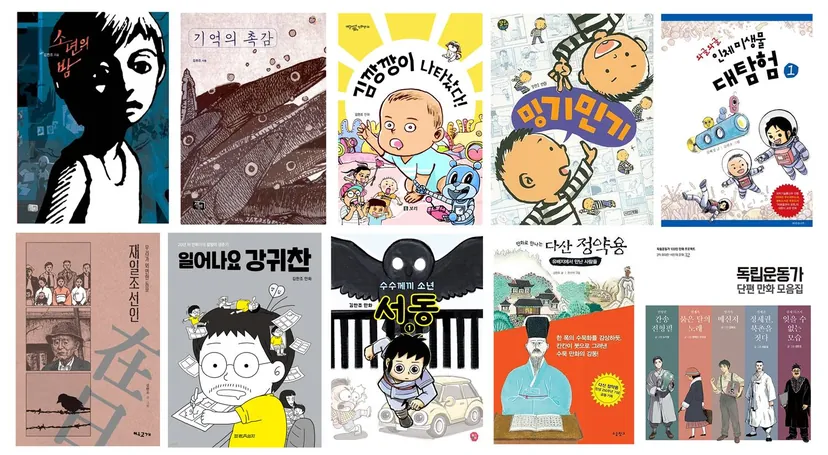
In a pre-interview, the artist specifically named the 10-piece assorted sushi as his soul food. Reflecting on the works he has published while preparing for this interview, it occurred to me that his career trajectory is much like an assorted sushi plate. From the psychological and experimental comics of his early debut to historical (fantasy) comics, educational comics, children's comics, and his recent autobiographical humorous comics dealing with the joys and sorrows of a middle-aged artist, he has shown a diverse creative range. Counting the standalone books he has published so far, it happens to be exactly 10.
Deep Valleys Make High Mountains
The artist majored in Western painting at Seoul National University. During his time at a general high school, he went through a period of adolescent lethargy. Encouraged by an art teacher who recognized his talent, he studied entrance exam art at an academy in Sillim-dong and entered a nearby university. However, by his junior year, the lethargy returned, and he struggled to keep up with his classes.
Looking back, he suspects he suffered from depression; he spent that time unable to focus on anything, eventually graduating as if pushed by circumstances. After wandering for a while post-graduation, he happened to see a notice for the professional publication comics course at the Hankyoreh Culture Center (now Hankyoreh Academy) and applied. Since its inception in March 1995, the course has produced many artists including Yang Young-soon, Hong Yoon-pyo, Ha Min-seok, and Song A-ram. Kim was a student of the 3rd cohort (1997-1998). It would be a heartwarming ending if I could say the boy who grew tired of waiting for comic magazines and started drawing his own comics finally became a successful artist, but for him, comics were an "escape" he dove into because he was cornered. Like the line from "Berserk"—"There is no such thing as a paradise to arrive at after fleeing"—there was naturally some lingering regret. "Because I started so early, I felt like I lacked experience. Then, at some point, I realized I was in a situation where I couldn't turn back."
As the saying goes, "Deep valleys make high mountains." As his regrets deepened, his achievements as an artist grew. After debuting with Inquiry Life, serialized in "OZ" in 1999, he drew the short film Eel with support from the Seoul Animation Center that same year, and was active in various fields, including serializing Sportsman in a sports newspaper.
In 1998, Kim joined "BACAS," a creative group formed by 3rd-cohort students of the Hankyoreh course. Artists like Song Dong-geun, Im Deok-young, Kim Sung-hee, Ma Young-shin, Jung Song-hee, Ha Min-seok, Kim Dae-joong, and Jeon Ji-sun were members, and they continue to produce meaningful work today that captures unique inner worlds and social messages. During this period, Kim created works such as Utopia and Animal Farm, engaging in activities categorized as "independent comics" or "experimental comics."
In 2005, he drew Persephone, a project supported by the Seoul Animation Center, which was published by Saemanhwachae as Boy’s Night (2008) alongside Cain and Opera. Kim Dae-joong of Saemanhwachae once reviewed his works from this period, which are imbued with interests in dreams, the subconscious, and obsession, in an interview for the Comic Museum, saying: "From Utopia to Opera, his comics seem to have a subject, but actually drift slightly away from it. And in that space, you can catch a glimpse of him hesitating and agonizing between obsession and lethargy."
While the artist focused on projecting his inner self in works like Boy’s Night or Texture of Memory (2012)—which explores memories and emotions that remain in people’s hearts—he also simultaneously rode the trends of the outside world. When character-based Flash animations like "Mashimaro" or "Ubi Boy" gained popularity in the early 2000s, he produced educational animations like "Number Song" for software companies like Arisumedia, and worked on historical and educational comics like History Opening the Future for Children. Around the time the format of newspaper comics changed with the appearance of Park Kwang-soo’s Gwang-soo’s Thoughts in 1997, he serialized Sportsman in a sports newspaper, just before artists who emerged from online communities became a hot topic in the print media.
At a time when Korea's media environment was undergoing drastic changes, Kim actively reflected the changes in the comics ecosystem and the social demands of the era in his work, spanning various media and formats including newspapers, publishing, and online platforms. In 2009, he co-curated the 100th-anniversary exhibition "Manhwa, Manhwa (Infinite Stories)" with artist Park Geun-woong to mark the opening of the Korea Manhwa Museum. Since then, he has published children's comics such as Kim Kkang-kkang Appeared (2017), Ming-gi Min-gi (2018), and Puzzle Boy Seo-dong (2024), as well as Zainichi Koreans: Compatriots We Have Ignored, which deals with issues related to Koreans in Japan.
The artist expresses regret at every turning point in his creative career. He ruminates on past choices, wondering if he should have held on to print media longer regardless of economic pros and cons had he foreseen the growth of webtoons during his time at "OZ" or sports newspapers—"I was young enough to do that back then," he says. He also carries the realistic burden of having to continue working to support his family, having traversed various fields rather than accumulating work in just one. To this, he adds a confession that, unlike his days studying for art entrance exams, he has a tendency to endlessly fix even the smallest details until he is satisfied, which—as he learned while working on the Zainichi Koreans project—has made his working speed interminably slow.
However, his trajectory is immensely valuable in that it was a process of endlessly exploring and challenging various domains. Much like the plate of assorted sushi encountered after hard work, the time spent passionately agonizing across genres and media is a fine achievement worthy of self-congratulation.
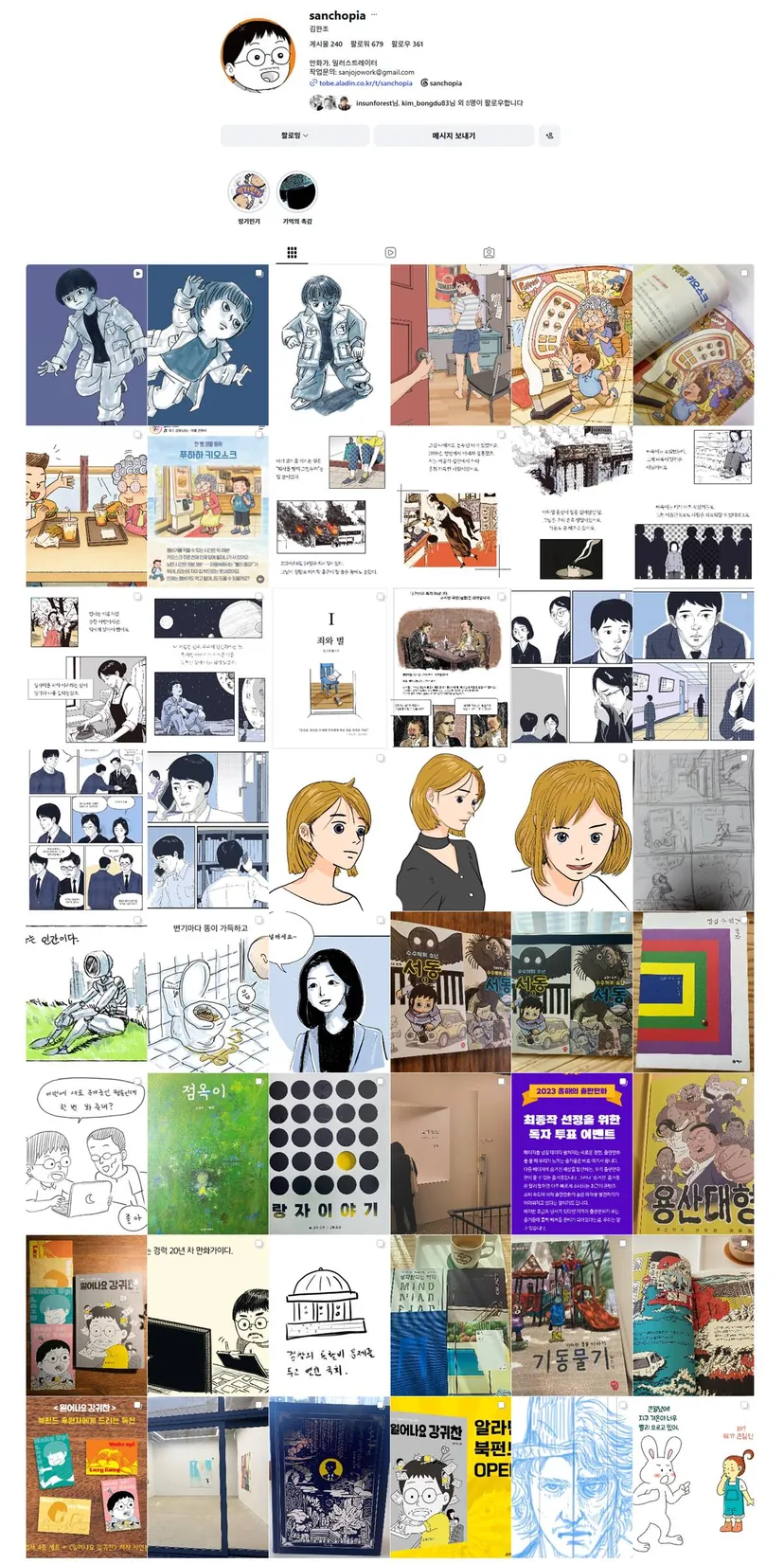
Wake Up, Kang Gwi-chan, which can be called an autobiographical comic, depicts the life of a middle-aged cartoonist having to make a living amidst his long-standing worries, experiences, regrets, and frustrations. It is interesting to note that this work was first released on Instagram. A veteran who started in "OZ," the very medium where the term "webtoon" first appeared, and has experienced all sorts of trials and tribulations with diverse media, he experimented with the 6-cut comic format on Instagram—the frontier of non-portal online comics in the 2020s.
Looking Forward to a 12-Piece Assorted Sushi
When asked about his future plans, Kim expressed his intention to serialize a webtoon. However, given his work style, a general long-form webtoon series poses difficulties, so he is exploring ways to complete the manuscript first through a creative support project, serialize it briefly as a webtoon, and then release it as a book. On the other hand, he is also contemplating whether he should return to graphic novels.
Fortunately, as portals have recently reduced the proportion of studio-produced large-scale school or romance fantasy genres, there is a trend of renewed attention toward diverse formats of comics that had lost their footing for a while. In fact, there have been cases where fellow artists selected for diversity comic production support projects have serialized on Naver Webtoon. Also, as Instagram now allows up to 20 images per post and permits 4:5 aspect ratio images in addition to the traditional 1:1 square, he says it has become possible to attempt more dense, dramatic directing styles.
While it is not yet decided what choice the artist, standing once again at an inflection point of comics, will make, I am already looking forward to his next plate, which he will surely fill with a more diverse composition of twelve pieces, or perhaps even more, beyond the scale of ten pieces. I hope he meets a time of richer and more solid achievement that he can willingly congratulate himself for, beyond the solitude of drawing and erasing countless worries.
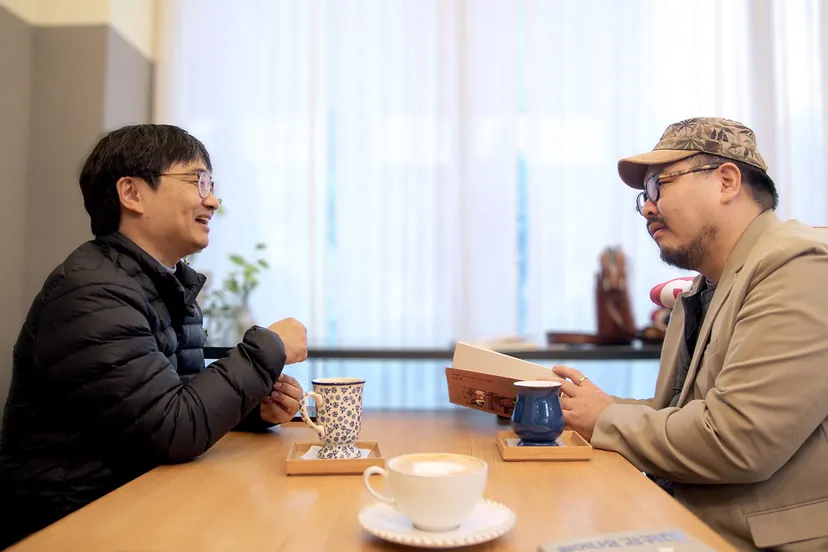
Debuting with Inquiry Life in the comic magazine "OZ" in 1999, he has since drawn collections such as Boy’s Night (2008), Texture of Memory (2012), as well as Kim Kkang-kkang Appeared! (2017), Ming-gi Min-gi (2018), Zainichi Koreans (2019), Wake Up, Kang Gwi-chan (2023), Puzzle Boy Seo-dong (2024), and Expedition into Human Microbes (2021, illustration).
Since his debut, he has showcased diverse comic forms such as graphic novels, children's comics, educational comics, and Instagram cartoons. He has also been broadly active in comic story writing for projects like Dasan Jeong Yak-yong in Comics, animation production like "Number Song," and picture books. In 2009, he co-curated the 100th-anniversary exhibition "Manhwa, Manhwa (Infinite Stories)" at the Korea Manhwa Museum with artist Park Geun-woong, for which he drew the Raipai segment. His collection Texture of Memory was translated and published in France under the title La mémoire du corps.