

[BizHanKook] The detailed development plan for the KF-21 electronic warfare (EW) aircraft, known as the Escort Jammer (EJ), has been revealed for the first time. While the existence of the KF-21EJ was made known during the rollout ceremony of the first mass-produced unit last March, this time, the design blueprints have surfaced. Bizhankook confirmed that the presentation material consists of 16 out of a total of 19 pages. Although most performance specifications are redacted, the configuration, mission systems, and how the training systems will be integrated have been revealed.
The first mass-produced KF-21 was delivered to the Air Force on September 22, and the KF-21EJ concept aims to convert this airframe into an electronic warfare platform. The most notable feature is the composition of the jamming pods. One low-band jamming pod is mounted under the fuselage, while two medium/high-band jamming pods are attached to the wings. The low-band pod targets early warning radars, while the medium/high-band pods target fire-control radars; in addition, two anti-radiation missiles (ARM) and two external fuel tanks are added. Carrying three pods and two tanks simultaneously increases drag and weight burden. Korea Aerospace Industries (KAI) plans to reinforce the airframe structure to handle this.
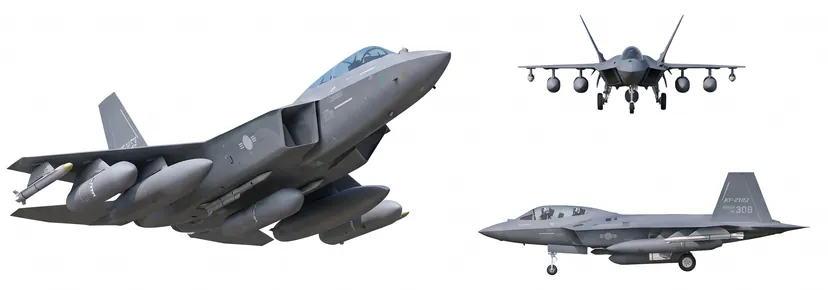
The airframe structure will also be modified. Weapon hardpoints will be remodeled and reinforced to mount the jamming pods, ARMs, and fuel tanks. Once the electronic warfare mission is complete, the pods can be detached and replaced with air-to-air or air-to-ground weaponry. In effect, the same aircraft functions as a multi-role fighter. The direction is to increase both fuel and weapons payload capacity. Instead of building a dedicated electronic warfare aircraft from scratch, the approach is for a single airframe to take on two roles.
Electronic warfare equipment is also evolving. AI-based information fusion software integrates sensors and jamming equipment. A Communication Interference Cancellation System (CICS) and a Communication Countermeasure Set (CCS) are also included. The EW phased-array antenna and AESA electronic warfare enhancement (ES/EA) process detection and attack as a single package. It is a structure where Electronic Support (ES) and Electronic Attack (EA) are handled by a single antenna. A Distributed Aperture System (DAS) for 360-degree all-around surveillance is also included.
So, what is the core of this system? The answer lies not in the output of the pods, but in the electromagnetic design of the entire formation. The KF-21EJ is not just a fighter with jamming pods attached, but an electronic warfare platform that integrates sensors, fusion, jamming, and survivability equipment into one body.
A mission system for the Electronic Warfare Officer (EWO) has also been designed. The EWO establishes mission plans and monitors the electromagnetic spectrum. They create the Electronic Order of Battle (EOB), assess threats, and select the optimal jamming technique. It is also the EWO’s duty to share the situation with the attack formation. Jamming is not about firing as much as possible; it is about choosing which threats to handle with which techniques and when. To this end, 7 display items are placed on the Pilot-Vehicle Interface (PVI): Threat Assessment, Situational Awareness, Electronic Support, Jamming Effect, System Status, Communication Link, and Mission Planning.
Effect analysis has also been released. KAI compared four combinations using the MACE simulator: Formation only, Formation + SOJ, Formation + EJ, and Formation + SOJ + EJ. An SOJ is a remote support jammer that jams from outside the enemy's air defense network. The conclusion is that "approach to the target is limited with SOJ alone, but adding the EJ allows for reaching the desired area." However, input assumptions such as jamming output, distance, and threat performance were not disclosed. Since simulation results are dependent on input assumptions, a sensitivity analysis must follow to accept this conclusion as operational truth.
The required capabilities are summarized into 5 capabilities across 5 environments. A complex, multi-layered air defense network is countered through forward infiltration and suppression. Multi-wideband threats are met with Wideband Electronic Support Measures (ESM) and multi-response. Short engagement times are addressed through high-speed EW processing, and formation collaboration is resolved through real-time information sharing. Threat evolution is handled through a modular, open architecture. Training is also designed in tandem. Through the Electronic Warfare Training System (EWTS) and an integrated training room, roles are divided among friendly attack formations, EW aircraft, and C2 versus enemy fighters and air defense networks.
The development feels slightly delayed. The Air Force plans to secure modified KF-21 electronic warfare mission aircraft in the mid-2030s, and the core technology research for the escort jammer is scheduled for 2027–2031 with a budget of 25.9 billion won. It has been a long time since our military began reviewing the need for close-support EW aircraft. At one point, the introduction of the EA-18G was even discussed. Electronic warfare equipment centers on the threat library—that is, signal intelligence of enemy radars and missiles—so even the U.S. does not easily hand over core software. Pushed by such information-sharing issues and priorities, the remote support EW aircraft (SOJ) was pursued first.
The foundational technology for the KF-21EJ is significant. The KF-21 is already equipped with an internal EW Suite developed by LIG Nex1. The problem is the weapon configuration. The current shape mounts 2 air-to-air missiles for self-defense and 2 ARMs. Three jamming pods and two fuel tanks are also attached. It is a configuration similar to the EA-18G, but if enemy air defense networks become decentralized and mobile, the number of simultaneous strike targets is limited to two. If the enemy turns off their radar power and moves, the ability to respond with only 2 ARMs becomes narrow.
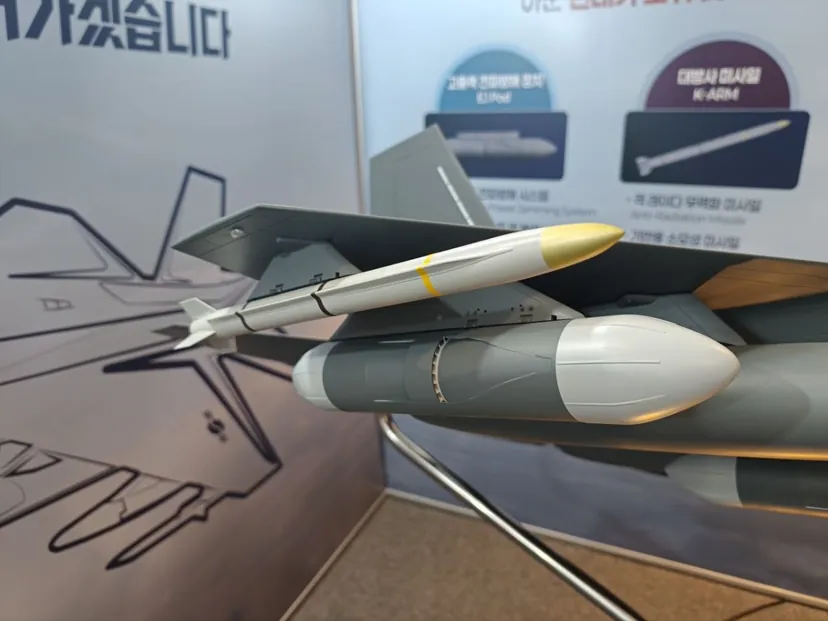
Which ARM to carry has not yet been finalized. Development is underway based on a domestic supersonic ARM (also known as the Korean AARGM), and the AARGM-ER is a missile with increased range due to a new rocket motor and a shortened fuselage. The author questions the reliance solely on two AARGM-ER class long-range ARMs. I believe a "multi-target package" mixing lightweight jammers and strike munitions is necessary. While the guidance for an ARM weakens when the enemy turns off their radar, a small jammer can force the radar to stay on or deceive it, opening up targets for other strike munitions. A model to refer to is the SPEAR family from MBDA; the SPEAR-EW is a small jammer/decoy weighing less than 100kg and under 2m in length. The Eurofighter proposes a configuration of up to 12 units, mixing 3 SPEAR-EWs and 9 standard SPEARs. For the KF-21EJ, a method of mixing 2–3 jammers with 3–4 strike munitions is realistic.
How to organize project management efficiently is also important. Since the foundation already exists, it is faster to expand the capabilities of the internal electronic warfare equipment outward rather than starting the KF-21EJ from scratch. The internal and external systems should not be operated separately but integrated into a single system. Reusing already-developed software and threat databases can reduce testing time and costs.
The utilization of unmanned aerial vehicles (UAVs) should also be considered. Candidates include not only decoy UAVs but also stealthy unmanned wingmen (LOWUS) and unmanned wingmen that will carry the HAF4500 engine. Two prototypes of the LOWUS have been delivered to the Agency for Defense Development, with a first flight targeted for December. The HAF4500 is an engine from Hanwha Aerospace that produces 4,500 lbs of thrust and 100kW of power. It should be possible to arrange missions where the manned aircraft carries the jammers and the UAV carries the missiles, or vice versa. If jammers are moved to UAVs, the manned aircraft can focus on armaments, allowing for a division of labor where the risky electronic warfare missions are handled by the UAVs.
The KF-21EJ is not simply a project to create an external electronic warfare pod. It must be carefully coordinated: what weapons and how many to carry, how to integrate internal and external electronic equipment, and what kind of formation to build with UAVs. If prepared well, the KF-21EJ will become a hunter of North Korean anti-aircraft missiles and a flagship product for new K-Defense exports.