

[BizHanKook] Five days after the massive personal data breach at the Korea Electric Power Corporation (KEPCO) came to light, it has been confirmed that two "critical" security vulnerabilities had been identified in the e-procurement system—one of the affected systems—during a prior security assessment. Although KEPCO stated that it had immediately addressed these vulnerabilities, its failure to prevent the large-scale data leak is raising concerns about the effectiveness of its security assessments and follow-up measures.
According to the "Report on Information Security Level Assessment Consulting for the Sales and Distribution Information System" obtained by BizHankook through the office of Representative Lee Yong-woo of the Democratic Party of Korea, a member of the National Assembly's Climate, Energy, Environment, and Labor Committee, KEPCO conducted a 90-day security assessment from April 21 to July 19, carried out by an external firm, Secure Polis Co., Ltd. The cost of the contract was 89 million won (excluding VAT).
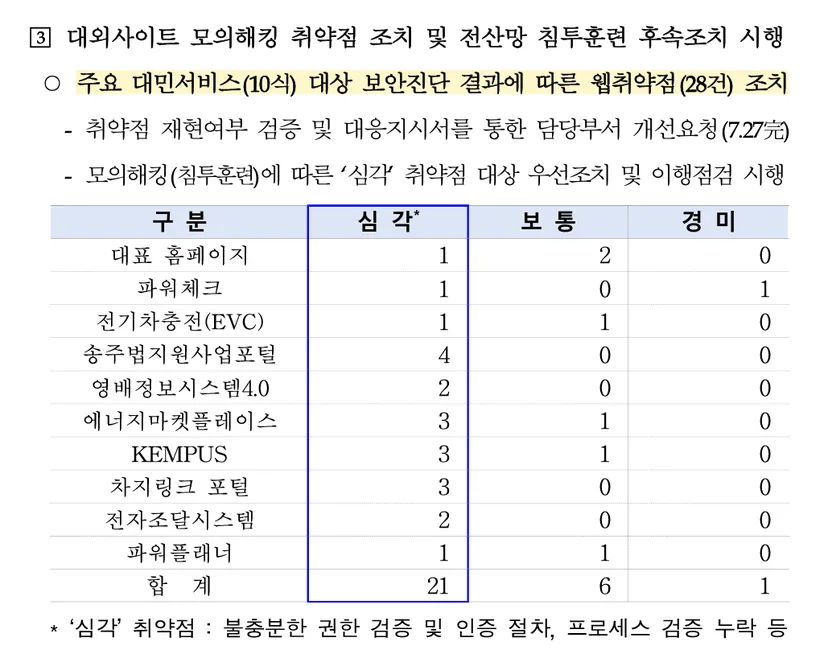
The report indicates that KEPCO performed security assessments in four areas: account diagnosis, server checks, penetration testing, and development security. The results revealed a total of 218 "critical" security vulnerabilities, including 197 found during security checks on 291 servers and 21 identified during penetration testing on 10 major public-facing services, including the e-procurement system involved in this data breach. Among these, two critical vulnerabilities were found in the e-procurement system.
Based on the assessment results, KEPCO established a follow-up action plan. It planned to prioritize the remediation of critical vulnerabilities in external services by August, with normal and minor vulnerabilities to be addressed by September. Subsequently, a comprehensive compliance audit for the remediated vulnerabilities was scheduled to be completed by October.
In response to BizHankook's inquiry on the 27th, KEPCO stated that it had immediately addressed the two vulnerabilities found in the e-procurement system. Furthermore, it explained that other critical vulnerabilities found in external services had been addressed as planned, and the comprehensive compliance audit was completed last October. It added that all 218 critical vulnerabilities identified in the report had been resolved prior to the breach.
However, KEPCO explained that the number of vulnerabilities was 41 when excluding duplicate vulnerabilities of the same type across the 291 servers.
Nevertheless, a personal data breach occurred in the e-procurement system despite these remediation efforts. KEPCO announced that 869,761 individuals were affected by the breach in the e-procurement system. Because it is difficult to determine the exact extent of the leak, KEPCO is operating under the assumption that the personal data of all system users has been compromised.
However, a link between the vulnerabilities identified at the time and the recent data breach has not yet been confirmed. KEPCO stated that it is currently investigating the detailed causes of the incident in coordination with relevant agencies, including the National Intelligence Service, the Ministry of Climate, Energy and Environment, and the National Police Agency.
It was also determined that KEPCO ON, another service affected by the data breach, had undergone a security assessment prior to the incident. KEPCO stated that it had conducted a separate security assessment on KEPCO ON earlier this year and had completed the remediation of the vulnerabilities identified at that time. KEPCO explained that it conducts security inspections hosted by higher-level agencies and self-inspections at least once a year in accordance with relevant regulations.
Based on KEPCO’s explanation, both the e-procurement system and KEPCO ON failed to prevent the data breach despite having undergone security assessments and vulnerability remediation. With the number of affected individuals across the two systems totaling approximately 1.52 million, questions are being raised about the effectiveness of the existing security inspections and follow-up measures.
Regarding BizHankook's query on whether there were any shortcomings in the existing security assessment and follow-up process, KEPCO responded that it is conducting periodic security assessments and follow-up measures in cooperation with relevant agencies, and is seeking fundamental countermeasures against new types of hacking resulting from technological advancements such as Artificial Intelligence (AI).
Meanwhile, KEPCO issued an apology for the data breach on the 25th and announced a three-stage customer protection plan to prevent secondary damages.
KEPCO President Kim Dong-cheol stated, "I once again deeply apologize to the customers who must feel anxious due to the leak of their information," adding, "We will do our utmost until the end to provide practical help in preventing secondary damages to our customers by utilizing all available measures, from providing information on damage prevention services to offering compensation support and collaborating with the financial sector."
KEPCO plans to provide guidance on services such as financial transaction blocking and the prevention of unauthorized mobile phone account activation. It will also provide users with free access to credit inquiry and identity authentication blocking services, as well as insurance that covers financial fraud damages up to 10 million won according to the terms of the policy for customers notified of the data breach.
Coordination with financial institutions is also being strengthened. KEPCO stated that it concluded discussions with 12 credit card companies on the 24th for intensive monitoring of unusual transactions for customers whose information was leaked and is currently in discussions with 45 other financial institutions, including banks.