

[비즈한국] Kasa (operated by Kasa Korea), the nation's first real estate fractional investment company, has terminated its services. Even after being incorporated into Daishin Financial Group, the company continued to record losses and ultimately exited the market after failing to obtain a license for the beneficiary certificate investment brokerage business. With the institutionalization of token securities approaching in 2027, eyes are now on the future strategy of Daishin Financial, which had aimed to take the lead in the token securities market through the acquisition of Kasa.
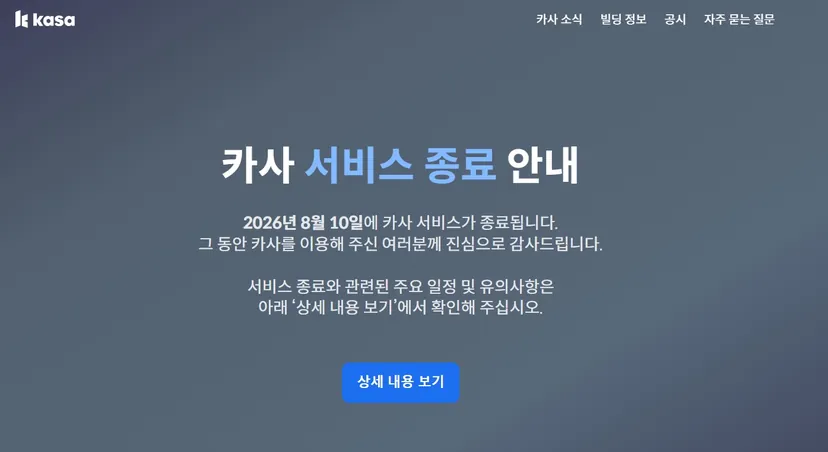
Kasa, the nation's first digital asset-backed securities (DABS) exchange for real estate, ended its services as of August 10. Kasa stated the background for the termination, saying, "We provided experimental issuance and trading services for beneficiary certificates of small-to-medium commercial real estate after being designated as an innovative financial service by the Financial Services Commission. However, following the expiration of our innovative financial service designation, we were unable to obtain a license for the beneficiary certificate investment brokerage business as we could not meet the institutional requirements set by the newly established laws."
Although Kasa announced the service termination on July 10, the winding down of the business had been signaled earlier. As Kasa did not conduct any new public offerings in the first half of this year, it had sold off its held properties one by one, such as the Bukchon Wolhajae, Seocho Giwell Tower, and Sangam 235 Building. It has been confirmed that Kasa Korea employees have moved to Daishin Securities depending on their area of expertise.
Kasa was designated as an innovative financial service in December 2019 and launched its services in September 2020. Kasa is a service that allows easy access to fractional investments in commercial real estate that is otherwise difficult for individuals to invest in. Investors holding DABS can receive rent generated from the property and, if the building is sold, earn a profit proportional to the amount of DABS held. Starting with the Yeoksam London Ville building in Gangnam-gu, Seoul, in 2020, Kasa proceeded with several public subscription offerings, including the Korea Technology Center, Yeouido Excon Venture Tower, and the TE Logistics Center in Cheonan, South Chungcheong Province.
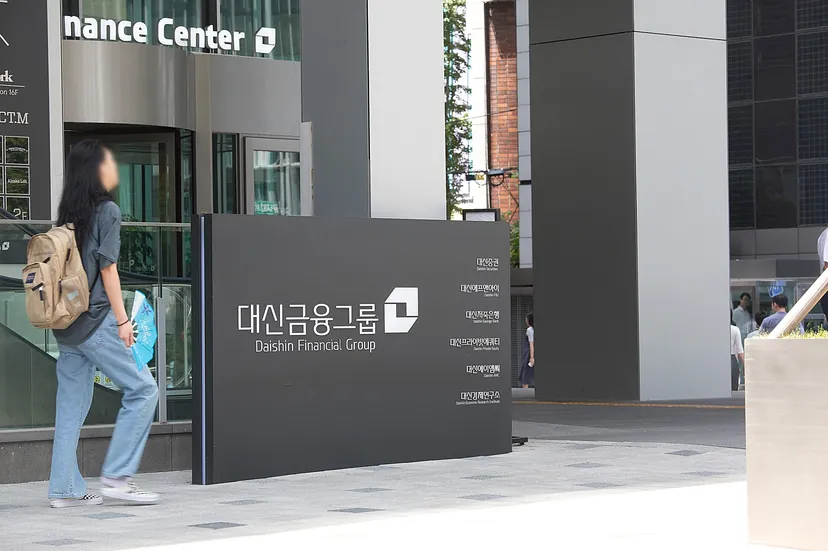
Daishin Financial Group secured the real estate fractional investment business and aimed to establish a foundation for entering the token securities (blockchain-based securities) market through the acquisition of Kasa in 2023. However, with Kasa failing to obtain the beneficiary certificate investment brokerage license, a modification of strategy became inevitable.
After Daishin Financial Group acquired the management rights and the Korean business division of Kasa in March 2023, Hong Jae-geun, head of the New Business Promotion Division at Daishin Securities, took on the role of CEO. Given Daishin Group's strength in real estate investment and the ability to promote the token securities business through Daishin Securities, the meeting of the two companies was expected to create synergy.
However, even after being incorporated into a traditional financial group, Kasa could not overcome the regulatory wall. In 2025, the financial authorities separated the issuance and distribution of new types of securities, such as fractional investments, and prohibited the concurrent operation of both. A "small license" (beneficiary certificate investment brokerage business) was created for securities issuance. Companies that obtain this license can issue fractional investment securities, recruit investors, and broker one-on-one trades between investors in the over-the-counter market.
For the over-the-counter brokerage license for the distribution of beneficiary certificates, the authorization conditions were set strictly to ensure stable order and settlement processing. Unlike the issuance license, which has a minimum equity capital requirement of 1 billion KRW, the distribution business required conditions comparable to a large-scale exchange, such as a minimum capital requirement of 6 billion KRW and the employment of 8 specialized IT personnel.
Kasa, which had been extending its innovative financial service designation, applied for a preliminary license for the beneficiary certificate investment brokerage business in June 2025 but failed to obtain it, leading to difficulties in business operations. It is reported that meeting the licensing requirements, such as equity capital, internal control systems, and investor protection schemes, was challenging. This move is similar to that of Funble, another first-generation real estate fractional investment firm. Funble ceased platform operations this past May after failing to receive the beneficiary certificate investment brokerage license and was declared bankrupt on July 3, about two months later.
Instead of directly acquiring an over-the-counter brokerage license to distribute fractional investment products, Kasa participated in the KDX consortium. It joined the KDX consortium, where Kiwoom Securities, Kyobo Life Insurance, and Kakao Pay Securities are the largest shareholders and the Korea Exchange is a shareholder with a stake of over 5% among the two consortia (KDX, NXT) that received preliminary approval.
The NXT consortium is a fractional investment over-the-counter exchange consortium with the alternative trading system Nextrade participating as the largest shareholder. According to the status of preliminary license applications released by the Financial Services Commission, Shinhan Securities, Musicow, I&F Consulting, Hana Securities, Hanyang Securities, and Eugene Investment & Securities are listed as shareholders with a stake of 5% or more.
However, as the formal approval process for both consortia dragged on, Kasa could not hold out any longer.
An industry insider commented, "As distribution and issuance were separated, real estate fractional investment firms that operated under the innovative financial service designation could no longer maintain their existing business structure. The human and material conditions required to obtain the license are at a level that is difficult for small companies to meet. Since they cannot facilitate secondary trading of beneficiary certificates, they have no choice but to downsize their services, and their profitability has deteriorated."
Meanwhile, as Kasa shuts its doors three years after being acquired, eyes are also on Daishin Group's token securities business. Regarding the direction after the Kasa service termination, a Daishin Securities official stated, "Nothing new has been promoted or decided." Regarding the liquidation of the corporation, they replied, "We are in the process of organizing assets, but a decision on permanent closure has not been finalized."
As the limitations of the real estate fractional investment revenue structure have been exposed, it appears that the M&A strategy will also change. Even after being incorporated into Daishin Group, Kasa failed to turn a profit. In 2023, the first year of acquisition, it recorded 200 million KRW in revenue and a net loss of 6.7 billion KRW. In 2024, it recorded 300 million KRW in revenue and a net loss of 5.9 billion KRW. Furthermore, in 2025, when normal operations were difficult due to licensing issues, revenue remained at just 54 million KRW, with a net loss reaching 5.9 billion KRW.
The cooling of enthusiasm in the token securities market due to the prolonged institutional arrangement is also an issue. However, there is expectation that the atmosphere will change once token securities officially enter the institutional fold starting in February 2027, following the revision of the Act on Electronic Registration of Stocks, Bonds, etc. (Electronic Securities Act) and the Capital Markets and Financial Investment Business Act (Capital Markets Act) earlier this year. This is because various types of securities, including stocks, bonds, and beneficiary certificates, can be issued as tokens (Security Token Offering, STO). There is also a trend among securities firms to build their own STO platforms.