

[비즈한국] Daangn is rapidly increasing its brokerage commission revenue by successfully converting users, initially gathered through free person-to-person (P2P) trading, into users of its paid payment services. However, complaints are emerging that in mobile gift voucher transactions, buyers are forced to pay a transaction fee while the ability to chat with sellers is restricted, effectively narrowing the options for how transactions can be conducted. A major challenge for Daangn moving forward will be how to continue expanding its brokerage fee revenue while minimizing dissatisfaction among users accustomed to free transactions.
According to the Financial Supervisory Service on the 17th, Daangn's brokerage revenue, which includes "Safe Payment" and agricultural/marine product commerce, grew from approximately 313 million KRW in 2024 to about 2.127 billion KRW last year. In the first half of this year alone, it recorded a rapid surge to approximately 6.842 billion KRW.
Overall performance has also grown. For the first half of this year, Daangn reported consolidated revenue of 170.3 billion KRW and an operating profit of 20 billion KRW. These figures represent a 39% and 54% increase, respectively, compared to the same period last year, marking the company’s highest-ever half-year performance. In the second quarter alone, the company posted 91.9 billion KRW in revenue and 15.8 billion KRW in operating profit, up 42% and 127% compared to the same period last year.
In its earnings announcement on the 31st of last month, Daangn stated that the nationwide expansion of its "Buy Now" feature and the increased use of its Safe Payment-based services contributed to the diversification of its revenue base. The company explained that the increase in brokerage commission revenue was driven by the rise in Safe Payment usage for second-hand transactions combined with the nationwide rollout of the "Buy Now" service.
However, critics point out that this revenue expansion simultaneously increases the cost burden on users and limits their choices. In particular, for mobile gift voucher transactions, users are essentially forced to use Safe Payment and have difficulty negotiating alternative transaction methods with sellers.
Safe Payment mandatory for e-coupons, chat also disabled
Since January, Daangn has mandated the use of the "Buy Now" method for gift icons and mobile vouchers that contain barcodes or PIN numbers. "Buy Now" applies Safe Payment, where Daangn holds the purchase funds and releases them to the seller upon confirmation of the transaction. Buyers are charged a 3.3% service fee, though a promotional 2.2% rate is currently being applied.
In fact, if you search for a "Baedal Minjok 100,000 KRW Voucher" on Daangn today, you will see a "Buy Now" button attached to the e-coupon listings. When you click the purchase button, the Safe Payment service fee is displayed separately from the product price. It is difficult to message the seller first to propose other payment methods, such as a bank transfer, before completing the deal.
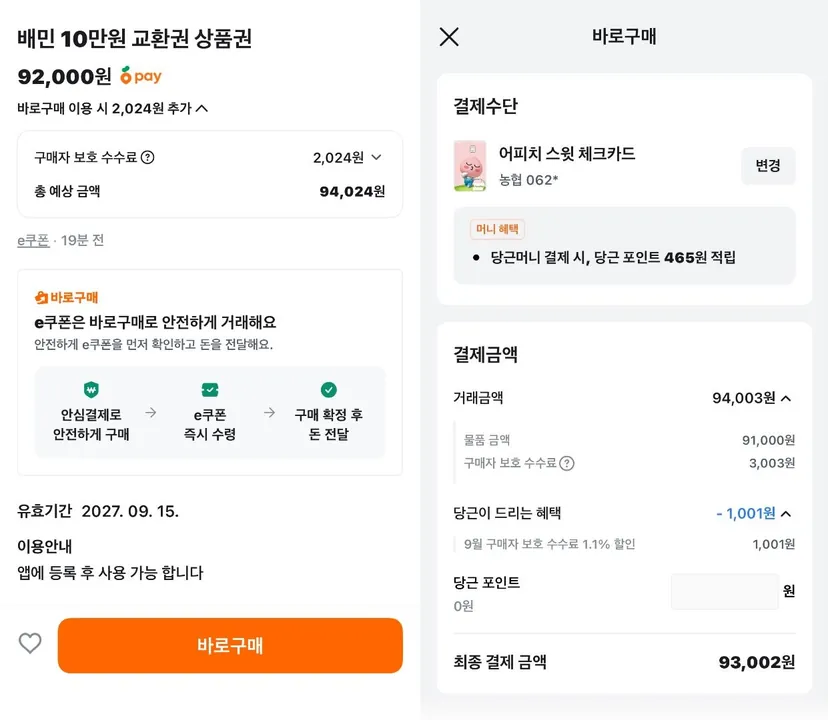
Based on the current 2.2% rate, purchasing a 100,000 KRW voucher incurs an additional fee of up to 2,200 KRW on top of the product price. If the original 3.3% rate is reapplied, the fee will rise to as much as 3,300 KRW. For users looking to buy vouchers at prices lower than the face value, a portion of the discount benefit from the second-hand deal can be offset by these transaction fees. Daangn stated that there are no set plans to increase the fee rate.
Daangn is not the only second-hand trading platform expanding its proprietary payment services. Bunjang unified its in-platform transactions with "Safe Payment" starting two years ago. However, it does not charge buyers a separate Safe Payment fee. Joonggonara charges 2.5% to the seller and 3.5% to the buyer when using Safe Payment, but chatting is still permitted. Daangn is the only second-hand platform that both blocks chat and imposes a fee.
A Bunjang official explained, "Due to the structure where buyers send money first in second-hand trades, there were cases where buyers risked not receiving the product or receiving a different item. We reduced this risk for buyers through Safe Payment." They added, "We maintain the chat function because there are cases where communication between the seller and buyer regarding the product is necessary."
“Risk of limiting consumer choice” VS “To reduce transaction risks”
The expansion of Safe Payment is a means for second-hand platforms to reduce risks in the transaction process while securing a new source of revenue. However, because the process has shifted to one where chatting or negotiating transaction methods is restricted and only fee-based payment methods are allowed, there is significant frustration that consumer choice and convenience have been overly curtailed.
Lee Jong-woo, a professor of Distribution Marketing at Namseoul University, said, "From the platform's perspective, there is an incentive to increase profitability by boosting the use of their own payment services," but added, "By even restricting chatting in e-coupon transactions, there is less room for sellers and buyers to coordinate deal terms. While it may increase the safety of the payment process, for consumers, it can create problems where transaction convenience and choice are reduced."
Kim Dae-jong, a professor of Business Administration at Sejong University, explained, "If a platform essentially forces only fee-incurring payment methods and prevents the negotiation of other transaction methods, it has the potential to excessively limit consumer choice. There needs to be a distinction between recommending a payment method for transaction safety and forcing it upon all users."
Daangn responded, "Since transactions are possible without separate negotiations, we do not provide the chat function in these cases to improve user convenience and reduce confusion or risks that may occur during the chat process."