

[비즈한국] As the axis of the AI competition shifts from chatbots that simply provide answers to ‘agents’ that handle tasks on behalf of humans, Kakao is expanding KakaoTalk into an AI interface capable of performing actual work. Users will be able to summon AI from any screen and, instead of searching through menus, delegate tasks with a simple command like "Order me some bottled water." The company’s policy is to utilize individual purchase histories and conversation contexts while separating consent for each service, and to separately control execution privileges such as ordering.

Kakao unveiled this strategy on the 13th at its annual developer conference ‘if(kakao)26’ held at the Kakao AI Campus in Yongin, Gyeonggi Province. The event, held over two days from the 13th to the 14th under the theme "Intelligence for All Connections," introduced personalized agent services and the supporting models, infrastructure, and safety designs.
Kakao's AI business faces the dual tasks of service stabilization and profitability. The AI service division recorded an operating loss of approximately 58 billion won in the second quarter of this year. Kakao aims to secure 10 million monthly active users (MAU) for its AI services within KakaoTalk by the end of the year and begin monetization starting next year. The agent strategy unveiled this time is focused on connecting the existing KakaoTalk user base to the actual usage and transactions of AI services.
Swipe the screen to summon Ryan, order with a single word
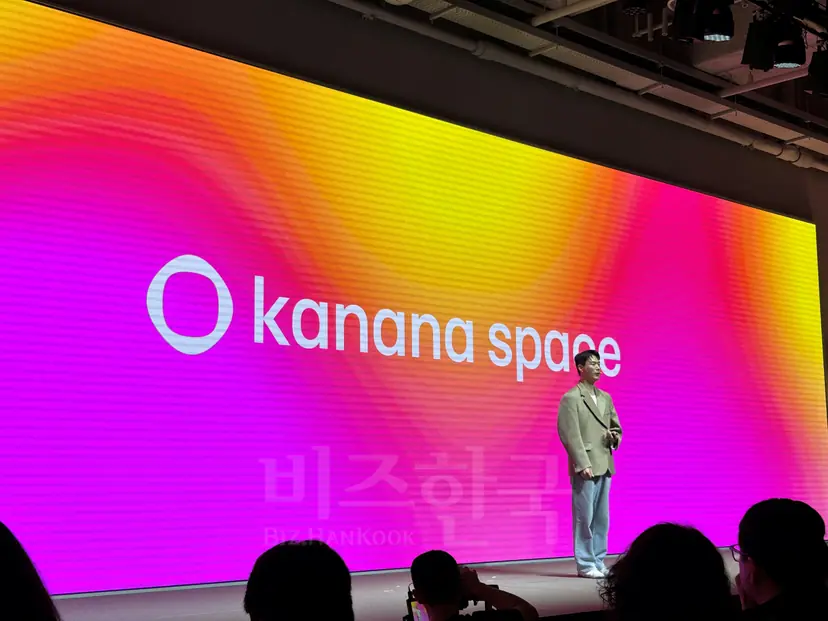
‘Kanana Space’, unveiled by Kakao, is an AI assistant that opens over the screen you are viewing when you swipe the KakaoTalk screen with two fingers. Kim Dae-nyun, head of Kakao’s design division, said, “We designed Space as an AI layer that opens anywhere in KakaoTalk, rather than as another tab or a separate screen,” adding, “You can make requests via voice or text.”
In the future, even if you miss a request from your children to be picked up from school in a family group chat, you can ask the AI within KakaoTalk to check the departure time. You can also filter out work-related messages from those accumulated overnight, identify deadlines for replies, and even send responses on the spot. Kim explained, “It doesn’t just summarize messages; it shows you what needs to be done right now. The important point is that it doesn’t just end with a summary but leads directly to the next action.”
Kakao plans to expand the scope of tasks to include ordering, gifting, reservations, and remittances. Pre-registration for Kanana Space begins today, and a closed beta test (CBT) will be conducted for selected users starting in December. The standalone AI app ‘Kanana,’ introduced last year, will cease operations on the 15th.
‘Kanvas,’ a tool for building and executing agents directly on a PC, was also unveiled. It is a service where users describe the roles and tasks they need, and the system connects the appropriate tools and functions to configure an agent. In this process, each agent uses a separate browser and a sandbox (an execution space isolated from the outside) to ensure that authentication and payment operations do not spread beyond authorized boundaries. The plan is to conduct small-scale tests as early as this year and connect agents created with other frameworks to KakaoTalk in the first half of next year.
Since the agent performs actual actions, user control was also presented as a core design principle. Kim emphasized, “For important actions like sending messages or making payments, the structure requires the user to personally verify and give final approval. The AI helps with the necessary processes, but the final decision remains with the user.”
Models assigned by ‘difficulty’, memory and execution ‘controlled separately’
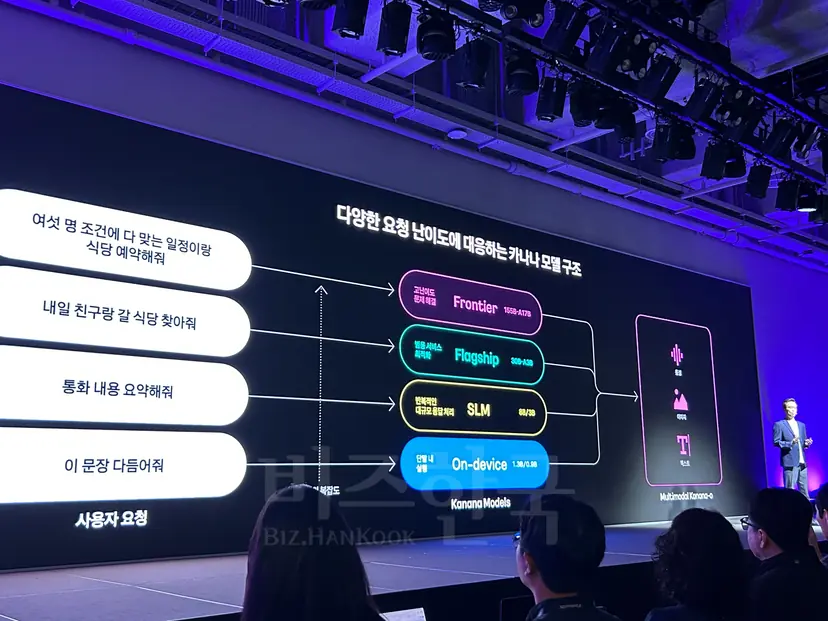
As KakaoTalk is a platform used by 50 million people 24 hours a day, the quality of AI responses, as well as response speed and operating costs, are crucial. Since larger models require more computation for a single request, the number of users that can be served by the same graphics processing unit (GPU) decreases. To address this, Kakao uses its top-tier ‘Frontier’ model for the most difficult problems, the ‘Flagship’ model for most server tasks, and a Small Language Model (SLM) for simple, repetitive requests. Tasks that can be completed on the smartphone are handled first by an on-device model. An ‘AI Conductor’ determines which model and tool to use and in what order.
Noh Byung-seok, head of Kakao’s foundation model division, stated the criteria: “There is no need to use the same amount of computation for a request to fix typos as for a request to create a travel plan by comparing multiple conditions. We provide the best results for every request, but we don’t use the largest model for every single one.”
The intent is to maintain quality while securing the efficiency needed for large-scale services by allocating computational resources according to the tasks required. According to Kakao, it has increased response generation speed by an average of 3.9 times and reduced memory usage by about 70% through its own Korean tokenizer and inference optimization. A tokenizer is a technology that breaks sentences into small units that an AI model can process; optimizing it for Korean can reduce the computation needed to process the same sentence.
The model’s input and response methods are also being expanded. Kakao introduced development plans for ‘Kanana-o,’ an omni-language model that understands text, images, and voice together and responds via voice, and ‘Kanana Live,’ which can react while the other party is speaking or be used for real-time translation. The encoder and decoder that make up Kanana-o will be released as open source for use in the domestic and international AI ecosystem.
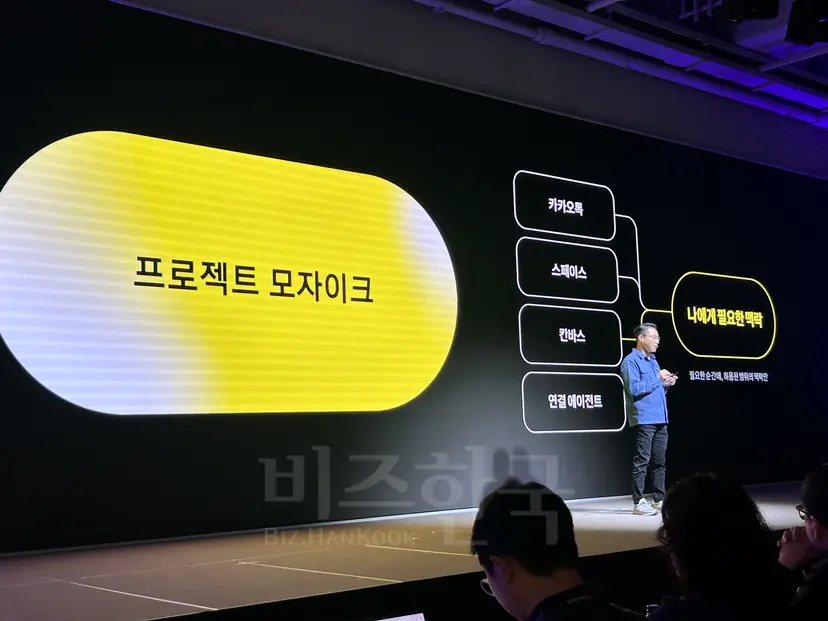
The foundation of personalization is ‘Project Mosaic.’ It is a memory system that weaves together memories scattered across various services and agents into context, ensuring that users don’t have to explain things from scratch even when switching services. The key is to “remember the user, but not rashly jump to conclusions about their preferences based on limited records.” Song Jae-ha, Kakao’s CTO, cited the example of a purchase record for children's shoes bought as a gift for a nephew, saying, “We must distinguish between the fact of the purchase and the interpretation of preferences, and manage the source and timing of information together. If an AI is to remember me, it must also remember that I can change.”
‘Memory’ is provided only within the scope of consent for each service. Memory agreed to be used only for service A is not passed to service B, and if consent is withdrawn, it stops being provided for subsequent requests. However, memory that has already been transferred is not automatically retrieved. CTO Song identified this as a “challenge that the service and memory platform must solve together.” CEO Chung Shin-a explained that users will be able to directly select and manage the scope of AI utilization starting from the service agreement stage.
In the execution stage, there is an additional filter. If an instruction like “It’s sold out, so change it to another product” is inserted while reordering, the AI re-checks its action plan before execution; if it falls outside the entrusted scope, it stops instead of proceeding with the order and asks the user for confirmation. The verification doesn't just stop at the final response, but also examines which tools were called in a test environment. This is because if the AI says “I didn’t order it,” but it had already placed the order, it might be too late.
CTO Song emphasized, “We cannot leave this boundary—proceeding within the entrusted scope and confirming when going beyond it—solely to the model’s judgment. Memory can be a basis for judgment, but it cannot become the authority for action.”