

[비즈한국] The KakaoBank labor union held a full-scale strike for the first time since the company’s inception, demanding improvements to the performance reward system. This strike has garnered attention as the first in the history of internet-only banks. As KakaoBank, which has been hitting record-breaking earnings, faces internal labor-management strife, all eyes are on how CEO Yun Ho-young, who has led the company for over a decade, will resolve these risks.
The KakaoBank labor union carried out its first full-scale strike since the company was founded on July 31. It is also the first strike since the advent of internet-only banks. According to the Kakao branch of the Korean Chemical, Textile & Food Workers' Union (the Kakao Union), about 700 union members participated in the strike by using their annual or vacation leave to cease operations. While financial authorities closely monitored the situation and conducted on-site inspections, the strike concluded without any major incidents.
Unlike traditional financial institutions, the KakaoBank union is not affiliated with the Korean Financial Industry Union, but rather with the Democratic Confederation of Trade Unions (KCTU) Chemical, Textile & Food Workers' Union, which includes the IT industry. Other internet-only banks, such as K-Bank and Toss Bank, have not yet formed unions. The Kakao Group union first went on strike (Log-out Day) on June 29 by using annual and vacation leave to stop work, and the KakaoBank union followed the same method on July 31.
The KakaoBank union stated, "We are currently discussing plans for additional actions following the first strike," and added, "We are coordinating negotiation schedules with the company." A KakaoBank official replied, "We are closely monitoring the situation, and the company is making continuous efforts to find an amicable solution through dialogue."
The KakaoBank strike stems from labor-management conflict over performance compensation methods. Despite negotiations regarding wage increases, performance bonuses, and labor conditions, both sides failed to reach an agreement. Mediation efforts by the Gyeonggi Regional Labor Relations Commission ceased on July 20, leading to a breakdown in negotiations. The union then voted to authorize the strike after a ballot on industrial action. Specific details of the negotiations have not been disclosed.
The breakdown in negotiations appears to have contributed to the expansion of the KakaoBank union. According to the Kakao Union, as of mid-July, more than half of all KakaoBank employees had joined the union, reaching a majority status. The Kakao Union explained, "Dissatisfaction has accumulated because, despite the company's growth and improved performance, rewards commensurate with that success have not been returned to the employees," adding, "Membership grew due to the prevailing sentiment that management was not sufficiently reflecting the needs of its members or offering practical solutions during the wage and collective agreement negotiations."
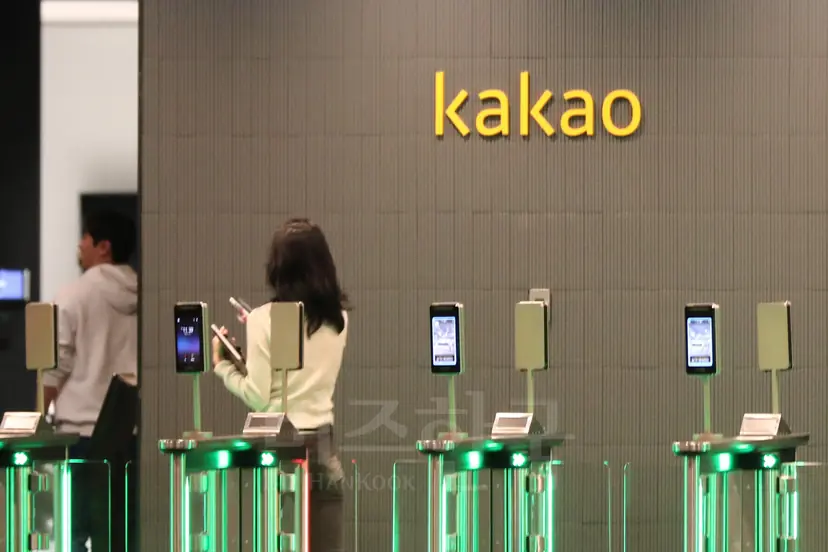
KakaoBank has been setting successive record-breaking earnings. In 2025, it recorded an annual net profit of 480.3 billion won, the highest in its history. Although interest income from loans decreased by 3% compared to the previous year, non-interest income—including commission revenue, platform earnings, and investment financial assets—surpassed 1 trillion won. In the first quarter of this year, net profit reached a record-high of 187.3 billion won, a 36% increase compared to the first quarter of 2025. This was influenced by the 93.3 billion won in non-operating profit gained from the IPO of "Superbank," an Indonesian digital bank in which KakaoBank holds equity.
The market anticipates that KakaoBank will continue to report strong earnings in the first half of the year. Woo Do-hyung, an analyst at Yuanta Securities, predicted regarding the second-quarter earnings, "Interest income is expected to increase compared to the previous quarter, and commission profit is expected to grow by around 10% due to the securitization of 'Bogeumjari' loans and increased advertising revenue," adding, "While other non-interest income remains sluggish due to rising market interest rates, it will likely be better than the first quarter."
The KakaoBank union is pushing back, arguing that the company is not distributing these achievements fairly. The Kakao Union pointed out, "While the rewards for the members who have built the company's growth on the front lines have failed to meet expectations, a structure continues where rewards based on management performance are funneled to a few executives," and noted, "In particular, at this year’s regular general shareholders' meeting, the limit for director compensation was increased from 5 billion won to 8 billion won. Performance rewards are concentrated on a few executives, while members are asked to make sacrifices."
However, public opinion is divided, given that the average annual salary of KakaoBank employees exceeds 100 million won. According to Financial Supervisory Service disclosures, as of the end of 2025, the average annual salary for a KakaoBank employee was 125 million won (144 million won for men, 102 million won for women). During the same period, KB Kookmin Bank and Shinhan Bank, the top two commercial banks, reported average salaries of 123 million won, and K-Bank in the same sector reported 104 million won.
Meanwhile, as the labor-management conflict intensifies with the first strike in company history, attention is shifting to how KakaoBank CEO Yun Ho-young will bridge the gap. CEO Yun is a founding member who has been with KakaoBank since its inception, and he has successfully been reappointed four times since becoming the inaugural CEO in 2016, marking his 11th year in the position. This is exceptional, considering that it is rare in the financial sector for a bank president or CEO to serve for more than 10 years. Having successfully extended his term by two years in March 2025, CEO Yun’s term runs until March 2027.
Since the launch of KakaoBank, CEO Yun has focused on growth, but he now faces the task of addressing internal dissatisfaction. The KakaoBank union has raised the issue, stating, "While shareholders suffered losses due to the stock price decline after listing, key management including CEO Yun realized massive economic gains."