

[비즈한국] The K9MH self-propelled howitzer has successfully broken into the U.S. export market. South Korea, which once relied on U.S. foreign military aid to defend itself with free weapons and later became one of the world's largest importers of U.S. arms, has now reversed the roles to become a country that exports cutting-edge weapons to the United States. K-Defense, which has spent decades striving for localization and self-reliant defense, now has the opportunity to help enhance the firepower and lethality of its ally, the United States.
On August 17, 2026, the U.S. Army officially announced that it had signed a prototype development contract for the Mobile Tactical Cannon (MTC) program with Hanwha Defense USA, the U.S. subsidiary of Hanwha Aerospace (012450). Reuters evaluated this selection as a “breakthrough for South Korea’s largest defense company in entering the U.S. arms market.” On the same day, Hanwha Defense USA stated in a press release that this contract is the company’s “first major U.S. Army contract.”
Although the United States always emphasizes free trade, the trade barriers in the defense industry are extremely high and robust. It selectively opens its doors only to weapon systems that it cannot produce properly itself. The AV-8B Harrier II, developed by the U.K. but operated in large quantities by the U.S., is considered one of the most successful cases of a foreign country exporting weapons to the U.S. in history.
Of course, the scale of this contract between Hanwha Aerospace and the U.S. Army is not large. The base contract value is $103,029,610, with a cumulative maximum of $262,903,274 if options are exercised. However, one should not be fixated on these numbers. The important point is that this prototype contract is the first gateway to a mass production project that could reach up to 498 units and an estimated project scale of approximately $6.7 billion (around 10 trillion KRW).
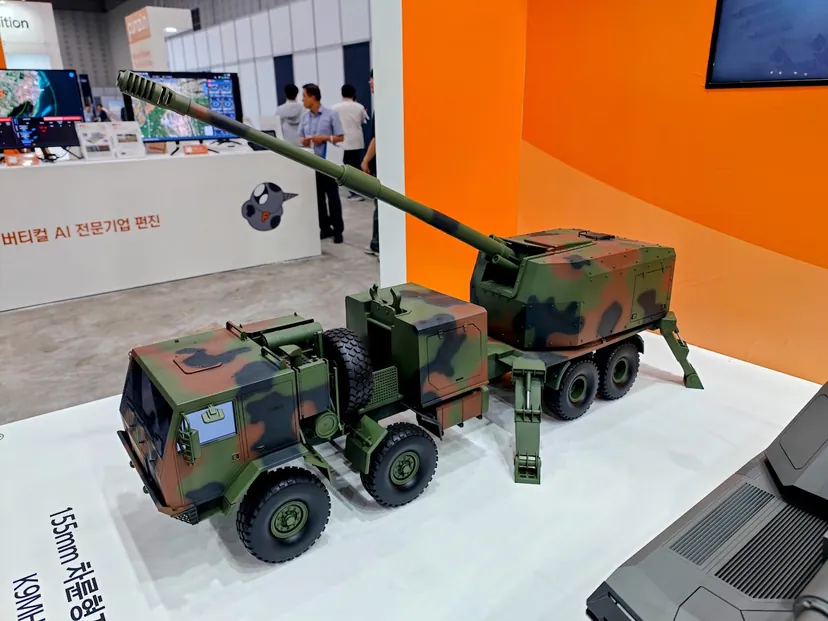
The K9MH (K9 Mobile Howitzer), which succeeded in exporting to the U.S., is a model that integrates the firepower system of the K9 series—which holds more than 50% of the global tracked self-propelled howitzer market—onto a Czech Tatra Force 8x8 wheeled chassis. While tracked self-propelled howitzers have advantages in firepower and protection, they lag behind wheeled types in road mobility and maintenance burdens. Hanwha chose a compromise by retaining the proven 155mm range and fire control system of the K9 while only changing the undercarriage to a truck-based chassis.
Furthermore, in this process, the barrel, structure, and automatic loading system of the K9A2 self-propelled howitzer were integrated into a single turret, making it easy to mount on any truck. This enabled installation on various chassis and improved maintenance, thereby increasing operational readiness.
However, this alone is not enough. Beyond the K9MH's proven performance, rapid delivery, and reliability, the U.S. has several requirements for its self-propelled howitzers. First, a new 58-caliber long-range barrel is needed to secure range. In addition to conventional shells, the integration of future munitions, such as ramjet projectiles, is required for the ultra-long-range firing of over 80km demanded by the U.S. Army. There is even a move to expand the role of self-propelled howitzers into low-cost air defense systems capable of intercepting cruise missiles and drones using 155mm shells.
Can the K9MH satisfy these requirements of the U.S. Army? Mike Smith, COO and President of the Land Systems Division at Hanwha Defense USA, stated, “The wheeled K9MH provides a path to future expansion into tracked forces and reflects a design capacity for future warfare.” This means the prototype-stage wheeled model could potentially lead to future tracked variants. Smith expressed confidence by saying, "With these capabilities, it won't be a fair fight." This response implies that they are either already prepared for the new shells or functions currently sought by the U.S. Army, or that they can be quickly integrated upon request.
Another task for the “export of 500 K9MH units to the U.S.” is expanding U.S. ammunition supply capabilities. While the U.S. Army and the government do not acknowledge a direct relationship between this howitzer project and the ammunition supply issue, it is noteworthy that the U.S. has recently been struggling with a shortage of 155mm shells.
Recently, U.S. media have been criticizing the fact that General Dynamics (GD), the largest U.S. shell producer, introduced unproven Turkish shell production equipment, which failed to function properly, leading to shell production falling short of plans. In August 2025, the GD plant halted two of its three shell production lines, and despite investing over $500 million, it has yet to produce shells normally. It is possible that the U.S. decision to adopt the K9MH also took Hanwha's shell production capability into account.
There is a widespread stereotype that the U.S. military is uninterested in artillery and focuses only on the Air Force. However, the U.S. once saved South Korea with artillery firepower. General Van Fleet decimated the Chinese military's human wave tactics with massive artillery fire, coining the term “Van Fleet ammunition.” At the time, they defended the capital city of Seoul with 300,000 shells through an operation that involved placing 400 field guns in a line from Gwanghwamun, Seoul, to the Mapo riverside and firing them day and night for three days.
Now is the time for us to repay the artillery firepower and shells the U.S. invested for us. I earnestly hope that the test exports of the K9MH proceed normally, receive excellent evaluations, and that our self-propelled howitzer establishes itself as the standard-issue artillery for the U.S. Army.