

[비즈한국] Recently, a debate erupted at a National Assembly audit regarding ‘Fanomenon,’ a project promoted by the Popular Culture Exchange Committee. While there is a tendency to focus solely on the concept of it being a massive global K-culture festival aimed at becoming a "Korean-style Coachella," what exactly is the ultimate model for Fanomenon? And how does it connect to the plans for overcoming the growth limitations of K-pop, as emphasized by the committee chairman, JYP Representative Park Jin-young?
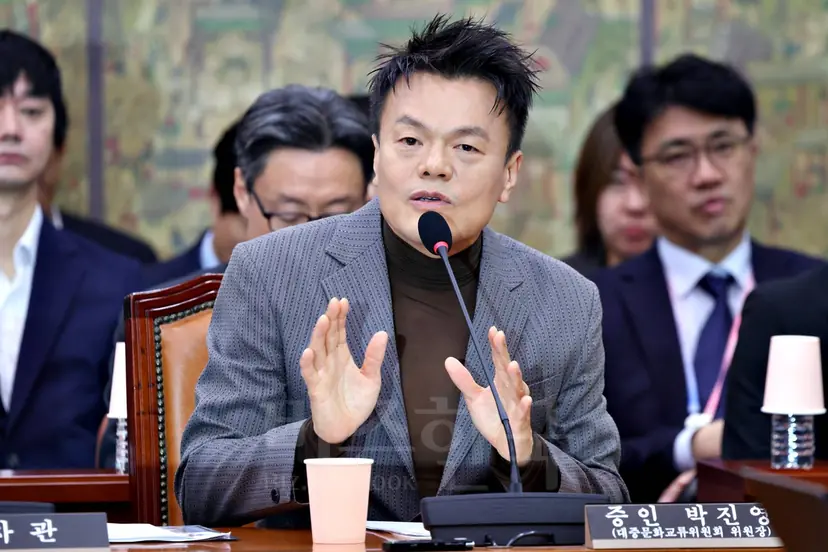
Although K-pop stands for Korean pop music, it is effectively led by private companies. In reality, global fans who come to Korea to find K-pop face a situation where there isn't even an integrated space to enjoy it. They have to visit individual agency buildings, and there is no spatial content to experience K-pop as a whole. If this is the situation domestically, it goes without saying how it is abroad. Fans are bound to feel disappointed in terms of both location and content. Even though K-pop has established itself as a national brand, it has no actual relationship with state power or the government.
K-pop is based on music products and cultural services created by private companies. Artists are inevitably centered around their agencies. However, there are limits to agencies acting individually while championing K-pop. Eventually, this leads to situations where they create Korean-American joint groups or produce American pop groups entirely. Yet, this kind of outward expansion paradoxically raises questions about K-pop’s identity.
In this context, if major agencies act in an integrated manner, it could lead to synergy and internal outward expansion. They could unite internally to increase their influence globally.
There is KCON, a K-music festival that places Korea at the center. KCON is a K-pop concert that began in 2012 and holds events overseas. It is led by the conglomerate CJ ENM, not by the music agencies. In contrast, Fanomenon is centered around the four major domestic agencies. K-pop music production and management companies are the protagonists. Here, the government’s public foundation and support are added, effectively making it a K-pop event that represents Korea.
Above all, it deepens the identity unique to K-pop. Fanomenon places a key characteristic of K-pop on the "fan." It does not treat them merely as consumers or objects. The word "Fanomenon" itself is a neologism combining "fan" and "phenomenon." It focuses on the cultural phenomenon created by fans, meaning that fans are not simple consumers but the center of K-culture.
Fanomenon is scheduled to hold K-pop performances, fandom awards, and K-culture exhibitions and experience events, centered around venues like Seoul Arena and Goyang KINTEX. In particular, the fandom award ceremony, "Fanomenon Awards," will serve as a key differentiator. The "Top 10 Fandoms" who were the most passionate and intense throughout the year will be selected by category, and artists will receive awards on behalf of their fandoms. This is different from the existing method where singers receive awards while fans passively participate or remain spectators. It truly makes the fan the lead protagonist receiving the award.
This is unprecedented anywhere in the world. It is a format that cannot be expected from the Grammys, which are centered on industry workers or experts. The way music is enjoyed and evaluated must change, and in that sense, it can be seen as creative, innovative, and aligned with K-pop's identity. Most importantly, Korea will be positioned at the center of the world of K-pop and fandom.
What happens afterward is also important. A so-called K-Culture Center will be built, which will be used on a regular basis for overseas performances and participation in K-content exhibitions. This secures a permanent location, unlike the temporary performances or pop-up stores of the past. This is crucial for the expansion of the influence of K-content centered on K-pop. However, since taxpayer money is involved, transparency must be maintained.
The Popular Culture Exchange Committee was already destined for controversy due to its unique nature. Generally, committees are expert advisory bodies and not the main agents for project execution. Conversely, the Popular Culture Exchange Committee is the subject of a project in which related content industries participate. This is the reason why the Fanomenon project, where major K-pop companies formed a corporation and received government support, was able to be pushed forward.
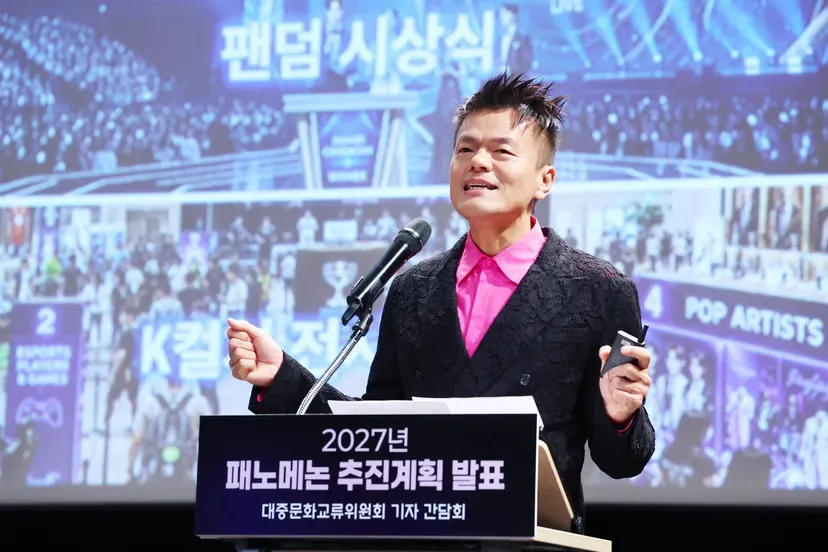
The biggest controversies are the trademark registration and future profit distribution. In a public-private consultative body, profit distribution contracts are bound to be sensitive. Since "Fanomenon" is a neologism, it was necessary to preemptively register the trademark domestically and internationally, so JYP filed for it. However, once the four major agencies establish a dedicated corporation for the event, they will hold a 50% stake in the trademark jointly with the government. Also, all profits generated by the dedicated corporation will be reinvested into the next event.
The important thing is to secure public nature and expand the outward reach of K-pop in the long term. Since government budget is being invested, Fanomenon cannot be free from the requirement of public interest. As it is billed as a mega K-culture event that gathers everything from food, beauty, fashion, and games to webtoons centered on K-pop, it must ensure that as many diverse content companies as possible benefit. It must serve as a bridgehead for small and medium-sized content companies to advance into the world.
Furthermore, the most important thing is to transparently keep the promise that Fanomenon's profits will serve as a priming water and foundation for reinvestment. Since success cannot be achieved by holding an event once or twice, it is necessary for both the ruling and opposition parties to take an interest regardless of changes in government.
Author Kim Heon-sik has been wandering through or clearing paths in the forest of popular culture phenomena since his 20s, with the expectation that there is a way to make the world a better place through culture. He continues on this same path in the 21st century, where artificial intelligence and quantum computers are active, with the same belief.