

[비즈한국] On June 28, Minister of National Defense Ahn Gyu-baek announced the defense drone and anti-drone development policy, pledging the development of the so-called ‘K-LUCAS’ (Korean-style Low-cost Uncrewed Combat Attack System). Minister Ahn stated, “In the past, a small number of high-cost weapon systems dominated the battlefield, but now, low-cost drones are being operated in large numbers, fundamentally changing the landscape of war,” adding, “North Korea is also continuously advancing its drone power, and the threats to our military facilities, national critical infrastructure, and civilian facilities are increasing.”
In other words, the plan is to respond to North Korean threats by deploying large quantities of inexpensive drones for offensive purposes instead of relying on high-cost weapon systems like missiles or fighter jets. The media understood this as the Koreanization of the U.S. LUCAS drone, which has been deployed in actual combat.
The LUCAS (Low-cost Uncrewed Combat Attack System) drone is an unmanned aerial vehicle developed by SpektreWorks, a defense startup based in Arizona, USA. It became famous after the U.S. replicated the Shahed (HESA Shahed-136) kamikaze drone used by Iran and deployed it in ‘Operation Epic Fury,’ the recent airstrike operation against Iran. Since the Shahed drone itself is an imitation/replication of Israel’s IAI Harpy, the LUCAS is a ‘copy of a copy,’ and the K-LUCAS is effectively an imitation of that.
The key condition for the K-LUCAS to be viable lies in ‘ensuring cost-effectiveness.’ While a typical cruise missile costs between 1 and 3 million USD, the Shahed costs around 20,000 USD, and the U.S. LUCAS drone is known to cost approximately 35,000 USD, drawing attention for its ‘tremendous cost-effectiveness.’
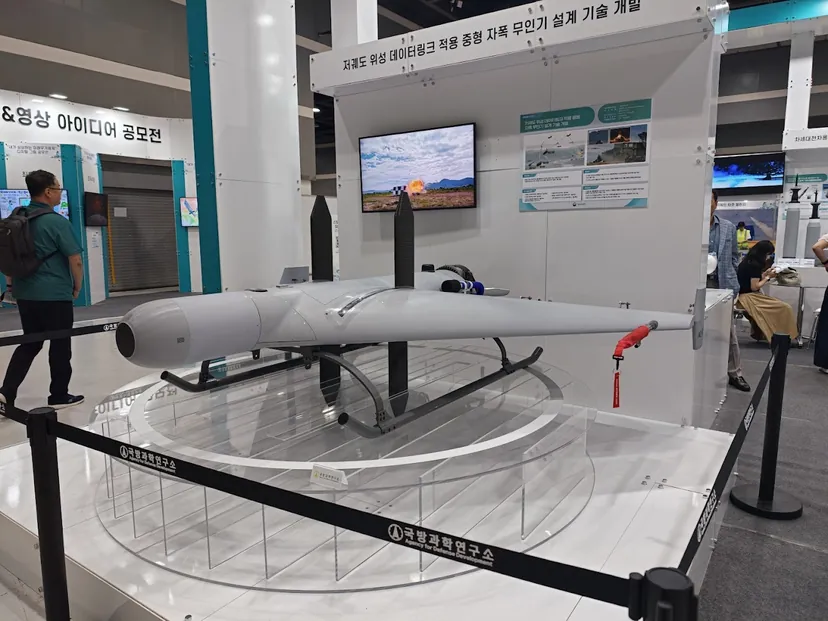
However, at the ‘Defense Science and Technology Grand Exhibition’ hosted by the Defense Acquisition Program Administration on July 30, the price of the M-1, a medium-sized kamikaze drone prototype developed under the leadership of the Agency for Defense Development (ADD), was about 1 billion KRW. Converted to U.S. dollars, that is about 704,000 USD, which means that at this rate, the K-LUCAS would be more than 20 times more expensive than the original LUCAS, and achieving cost-effectiveness seems out of reach.
Why did this happen? The answer is unexpectedly simple yet profound. It is highly likely that the data itself—stating the LUCAS drone costs 35,000 USD or about 49 million KRW—is incorrect.
First, let’s look at the medium-sized kamikaze drone M-1 developed by ADD. It is capable of real-time control via the OneWeb satellite high-speed data receiver and is equipped with NVIDIA’s physical AI computer, the Jetson Orin NX. The engine used is the UEL AR741 rotary engine produced by the UK’s UAV Engines Ltd. (UEL), and the price of just this one engine exceeds 50,000 USD, or about 60 million KRW.
If you add the internally developed special warhead and seeker, prototype production for flight testing, test flights, labor costs, and material costs, the 1 billion KRW price tag per unit is actually a natural outcome. Then why is the U.S. LUCAS drone so cheap?
In fact, the U.S. government has never disclosed the exact price of the LUCAS drone, nor is its development cost known. It is also not well-known where the manufacturer sourced its parts or how it produced them. It is simply that many media outlets widely spread the ‘estimate’ that the price of the LUCAS drone would be similar to the original Iranian-made Shahed drone.
The LUCAS drone is generally known to have the same airframe structure and flight performance as the Shahed drone, with the addition of a Starlink antenna for satellite communication and an AI computer module. Therefore, for the LUCAS drone to have a similar price to the Shahed, it must be using the same parts as the Shahed. In other words, if the U.S. LUCAS drone is truly cheap, it means it is highly likely that a large amount of Chinese-made parts are being used.
For example, the DA engine 215cc from the U.S. company Desert Aircraft, which is believed to be used in the U.S. LUCAS drone, is an engine for U.S.-made R/C model aircraft, but it is known that the actual production takes place in China. In addition to the engine, the LUCAS drone is highly likely to be ‘American in name only’ in many parts, or to use Chinese parts with the country of origin simply changed. In terms of price, if the U.S. were to develop proprietary parts for the LUCAS drone, costs would increase exponentially, and SpektreWorks, the manufacturer, is not a company with the capability to develop such parts in the first place.
In fact, RocketReach, a U.S. startup lookup service, estimates the number of SpektreWorks employees at 16 as of 2024. The fact that a startup of this size supplies drones to the U.S. military suggests that it would be impossible without buying Chinese parts from here and there, and relying on layers of sub-contracting.
The real opponent that the U.S. LUCAS drone and our M-1 drone should be compared against is the original, the IAI HAROP drone from Israel. The HAROP drone is capable of flying over 800km like the LUCAS or M-1 and has precision strike capabilities via video data, but it lacks AI features or satellite communication capabilities. The export unit price of this drone is in the 1 billion KRW range.
Should our K-LUCAS then accept reality and produce 1 billion KRW drones? The fundamental alternative is to minimize the use of Chinese parts or find ways to bypass them, and challenge ourselves to localize parts—even if it costs time and money—to produce them cheaply with our own hands.
Fortunately, South Korea still retains a manufacturing base. If the government pays close attention and invests, both existing drone companies and related industries could produce inexpensive drone parts that are independent of the Chinese supply chain. What if we utilized our non-memory semiconductor foundry capabilities to develop drone flight-control AI NPUs that do not rely on Chinese chips, pursued the development of low-cost satellite communication antennas and low-cost 2-stroke reciprocating engines, and provided technical support and equipment investment so that drone companies could mass-produce them? Even if it costs money in the immediate term, we could produce kamikaze drones that can compete in cost-effectiveness with Chinese and Iranian drones using domestic parts that are free from supply chain issues in the long run. Furthermore, if allies like the U.S. also purchase our drone parts, we could even achieve economies of scale.
The slogan ‘K-LUCAS’ is simple, but it is not easy to achieve. This is not the time to congratulate ourselves on performance by simply making a ‘1 billion KRW prototype drone’ for show, nor is it the time to blindly envy overseas defense startups that lack development capabilities. Now is the time to admit reality and embark on the localization of parts.