

[비즈한국] The government announced the 'Korean Green Great Transformation (K-GX)' strategy on October 7, which will inject a total of 1 quadrillion won—consisting of 200 trillion won in government budget and 790 trillion won in policy climate finance—over the next 10 years to support the green transformation of South Korea's industrial structure.
The green transformation is a policy designed to shift the fossil fuel-centered economic, industrial, social, and living structures toward renewable energy and eco-friendly technologies in response to the climate crisis. In conjunction with this, the plan involves launching a 220 trillion won 'K-GX Signature Project' led by the private sector and restructuring key manufacturing industries into low-carbon systems to leapfrog into becoming one of the 'top 3 green manufacturing powerhouses.'
However, to ensure the policy's effectiveness, the government faces the challenge of establishing a clear system for tracking greenhouse gas reduction performance and post-management regulations for the provided funds, which must be commensurate with the astronomical financial support.
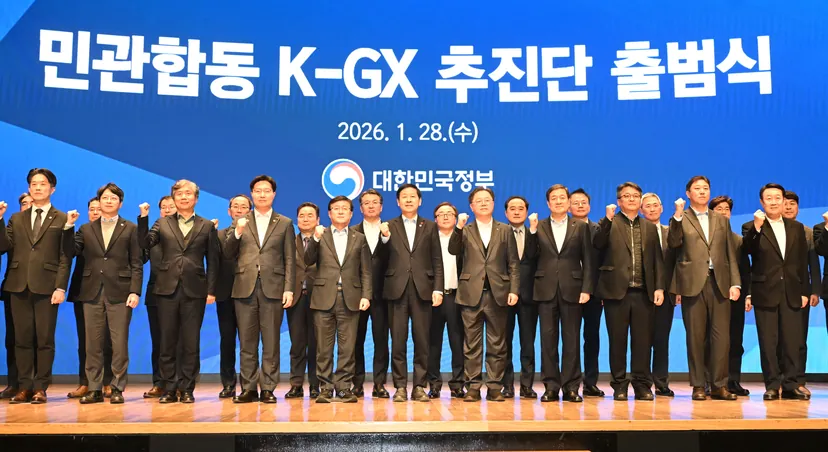
Low-Carbon Transformation, Fostering Green Industries, and Establishing Institutional Foundations are Key
The background of the government's K-GX strategy lies in the deepening climate risks and the changing foreign trade environment facing the Korean economy. According to an analysis by the Bank of Korea, if the country fails to respond preemptively to the climate crisis, South Korea's average annual GDP growth rate could decline by 0.3 percentage points by 2100. Furthermore, global supply chain instability due to geopolitical conflicts requires the full-scale electrification and decarbonization of domestic industries, which rely on energy imports for over 90% of their needs.
Trade regulations by major nations are also intensifying. The European Union's (EU) Carbon Border Adjustment Mechanism (CBAM) took full effect in January of this year, and demands for the use of renewable energy across global supply chains are growing stronger. For South Korean manufacturing, which has a high dependency on trade, carbon reduction has become a basic requirement for sustainable economic activity. In the steel industry, carbon certification costs alone due to the introduction of CBAM are expected to increase from 85.1 billion won in 2026 to 558.9 billion won by 2034. This is the background against which the government formulated its comprehensive plan based on three policy directions: 'New Growth Engine K-GX,' 'K-GX for Everyone,' and 'Sustainable K-GX.'
The first pillar of this measure, 'New Growth Engine K-GX,' focuses on converting the processes of the five major carbon-intensive industries—steel, petrochemicals, oil refining, cement, and semiconductors/displays—into low-carbon ones. In addition, it presents a goal to foster 10 major green industries, including electric vehicles, batteries, solar power, wind power, small modular reactors (SMRs), and power equipment, and to expand renewable energy to 100GW by 2030.
'K-GX for Everyone' is filled with tasks to improve regional development and public perception. In line with the '5-Pole 3-Specialty' balanced national development system, it promotes the creation of an energy-specialized city in Naju and the Jeju 2035 carbon neutrality pilot project. It also plans to designate regions where coal power plants are being phased out as 'Just Transition Special Zones' to support job stability for workers and build profit-sharing models for residents through solar and wind income villages.
'Sustainable K-GX' includes injecting 200 trillion won in budget and 790 trillion won in climate finance over 10 years, as well as refining the institutional foundation by introducing domestic production tax credits for core items and creating special regulatory zones for the circular economy.
The 'K-GX Signature Project,' valued at approximately 220 trillion won, was presented as a leading model for this policy. Several major corporations have signed onto this project. POSCO Holdings plans to build hydrogen-reduction steelmaking facilities and 1 million-ton hydrogen production infrastructure in the Southeast region, aiming for a 2030 pilot and 2037 commercialization. Hanwha Qcells aims to commercialize perovskite-silicon tandem solar cells by 2028 by building production facilities in Jincheon and Eumseong, Chungbuk. SK Hynix plans to establish a 'Decarbonization Transformation Center' in Yongin, Gyeonggi, by the end of 2026 to help its partners reduce process carbon emissions. Other major projects include LG Energy Solution's Ochang sodium-ion battery ESS pilot line, Doosan Enerbility's dedicated SMR foundry factory in Changwon, HD Korea Shipbuilding & Offshore Engineering's eco-friendly ship base in Ulsan, and the supply of heat pumps for modular housing by Samsung Electronics and LG Electronics.
How to Link and Manage Carbon Reduction Targets
In a briefing following the government announcement, participants discussed the realistic challenges that need to be addressed to ensure this strategy actually leads to greenhouse gas reductions. Regarding the sectoral reduction roadmaps to be prepared by the Ministry of Trade, Industry and Energy in the second half of this year, a major issue was how to drive additional reductions that align with the Nationally Determined Contributions (NDC) rather than stopping at the facility investment plans companies have already established independently. The point is that clear criteria must be established to prevent support policies from simply becoming facility subsidies.
In response, Kang Eun-gu, head of the Industrial Environment Division at the Ministry of Trade, Industry and Energy, stated, "Sectoral reduction roadmaps are not determined solely by private investment plans." Kang explained, "Private investment intent is only an essential factor for basing policies on the field. To achieve the 2035 NDC carbon reduction goal, we plan to construct the roadmap centered on practical reduction means by comprehensively considering the technology development stage, government facility support, and conditions for clean hydrogen and carbon-free power infrastructure."
The performance management system for policy climate finance, which is expected to provide over 790 trillion won over 10 years, is another point requiring specification. It has been pointed out that for large-scale financial support, there is no clear system yet to track the actual greenhouse gas reduction amount individually and link it directly to the NDC. Establishing fund management and post-measures to apply when supported companies fail to meet their reduction targets has also been identified as a future task.
Oh Il-young, head of the Climate and Energy Office at the Ministry of Climate, Energy and Environment, explained, "Climate finance has various uses, so it is difficult to immediately confirm the contribution to achieving the national NDC through a single financial tool." Oh stated, "However, we are reflecting a structure to pre-evaluate how much greenhouse gas is reduced through the project when designing the targets for climate finance support." Regarding post-management devices, he added, "Based on the guidelines announced by the Financial Services Commission early this year, we are discussing practical operation methods with the industry and financial sector. We plan to announce the 'Transition Finance Operation Regulations,' which contain specific operational standards, in the second half of this year."
Experts also offered suggestions regarding this policy. While they expressed consensus on the macroscopic direction of industrial transformation, they held the view that supplementation is needed in terms of specific policy tools and coherence.
Kim Byung-kwon, director of the Green Transition Institute, evaluated, "Bringing out a new green industrial policy amidst government policies overly tilted toward artificial intelligence is commendable in terms of industrial balance and climate response." However, he pointed out, "The K-GX 3 mega-projects are far from enough to act as a counterweight to the overwhelmingly tilted government policy. The low-carbonization goals for traditional industries like steel and petrochemicals are not bold enough, and the 'green industry policy' tools are still insufficient to regain competitiveness in the green industries dominated by China."
He specifically pointed out that the green transformation of the semiconductor industry and AI data centers was not properly mentioned. Kim noted, "In a situation where the semiconductor industry and AI data centers are expected to receive most of their electricity from fossil fuels, the failure to address the greening of these projects—a 'Green AI' policy—is a point that needs to be supplemented." He suggested, "It is desirable to exclude SMRs, which cannot be called a green industry, and include a substantial Green AI policy. In the green transformation of industry, success can only be guaranteed if regulation is actively combined with support for carbon-intensive industries."