

[BizHanKook] Developing a high-quality drug candidate does not automatically mean it can be sold overseas. To receive approval in the US and Europe, clinical trials must be designed to meet local standards, and the drug’s safety and efficacy must be proven. This is why companies must determine their target markets and the necessary data requirements from the very early stages of development.
Recently, as domestic pharmaceutical and biotech companies have begun developing new drugs with international expansion in mind from the start, the role of global Contract Research Organizations (CROs) has grown. A CRO is a professional firm that manages, designs, and operates clinical trials on behalf of pharmaceutical companies, while also analyzing the resulting data. International CROs are also actively seeking opportunities to collaborate with Korean companies.
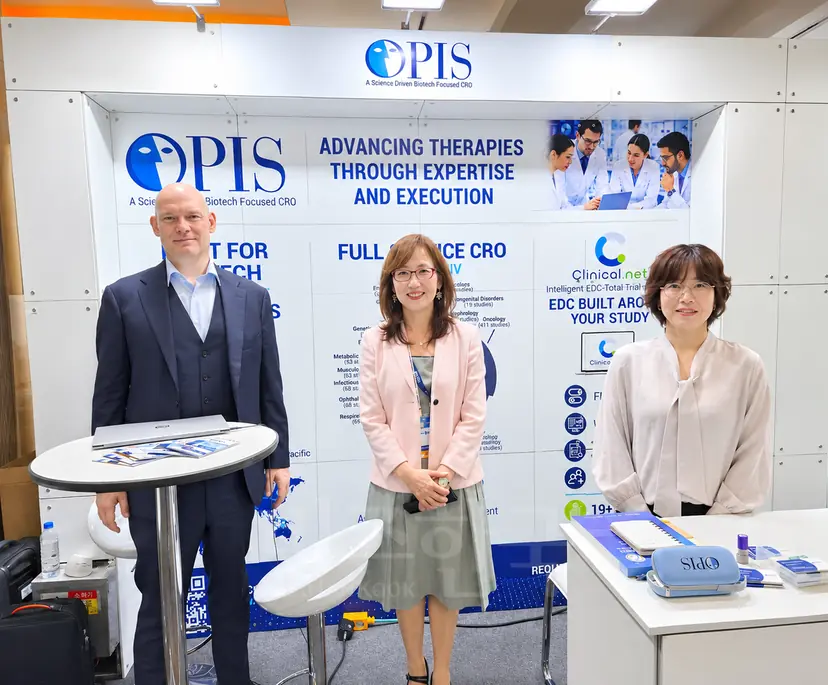
OPIS, a global CRO headquartered in Italy, has been making active moves recently. Following their participation in the '2026 KoNECT International Conference (KIC)' held at the Lotte Hotel in Seoul from the 13th to the 15th of last month, OPIS also operated an exhibition booth at 'BIOplus-INTERPHEX KOREA 2026 (BIX 2026)', held at COEX, Seoul, from the 28th to the 30th of the same month. These efforts are aimed at exploring partnership opportunities with domestic pharmaceutical and biotech firms.
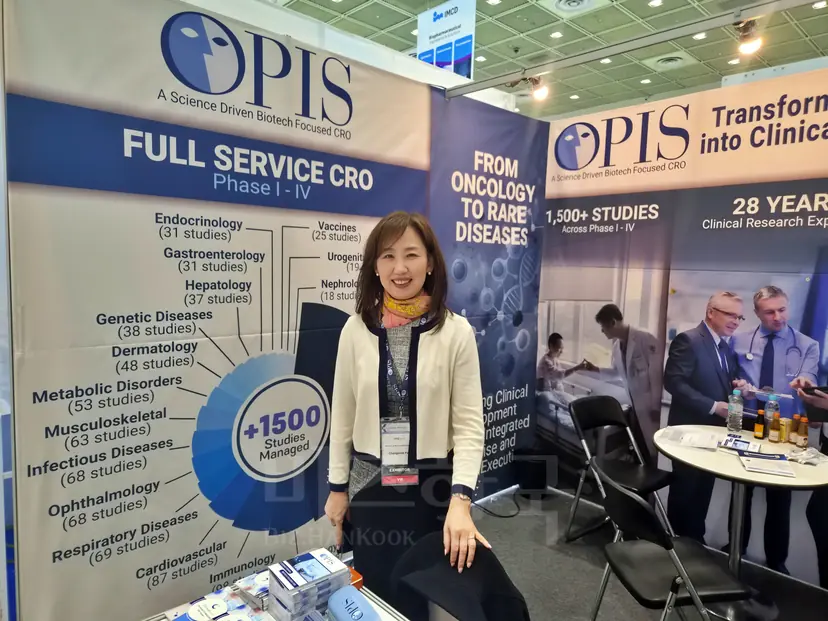
Founded in Italy in 1998, OPIS established its Korean branch in April 2022. According to the company, it possesses experience in conducting over 1,500 clinical trials worldwide and provides services across the entire spectrum of clinical development.
Giovanni Trolese, Vice President of OPIS, spoke highly of the growth potential of the Korean pharmaceutical and biotech industry in an interview with Biz Hankook. "Korea can become a key hub for global clinical development, backed by excellent clinical infrastructure and innovative developers," said Trolese. "We view Korea not merely as a regional sales base, but as a strategic partner that connects Korean companies to global markets in Europe, the US, and Asia."
Korea ranks 6th in global clinical trials... Now looking toward overseas approval and sales
Vice President Trolese praised Korea for its superior medical infrastructure, skilled medical personnel, and high-quality clinical trial institutions. He particularly noted that companies developing anti-cancer drugs, biopharmaceuticals, and treatments for rare diseases are actively entering overseas markets like the US and Europe.
He compared Korea to Japan and China to explain its competitiveness. "Japan has a mature pharmaceutical industry and a large market size, while China boasts a vast patient base and a massive biotech industry," Trolese explained. "Korea’s strength lies in its clinical trial infrastructure, technological prowess, and rapid decision-making."
Indeed, Korea is among the top countries for conducting global clinical trials. According to the Korea National Enterprise for Clinical Trials (KoNECT), Korea's share of global pharmaceutical-led clinical trials reached 3.46% in 2024, ranking 6th after the US, China, Australia, Spain, and Germany. In rankings by city, Seoul accounted for 1.32% of the share, placing it second globally behind Beijing, China (1.40%).
The pattern of overseas expansion by domestic firms is also changing. Yuhan Corporation’s lung cancer treatment 'Leclaza' received US FDA approval in 2024 for combination therapy with Rybrevant, and in September of this year, HLB's US subsidiary, Elevar Therapeutics, received FDA approval for its bile duct cancer treatment 'Rivoceranib.' HK inno.N has also applied for FDA approval for its gastroesophageal reflux disease treatment 'K-CAB' through a US partner. Biosimilar companies like Celltrion and Samsung Bioepis are also competing for global market share through international clinical development and overseas approvals.
OPIS analyzes that as domestic firms move beyond simple market entry into full-scale global drug approval and market competition, their approaches to clinical development are also shifting.
Park Chang-sook, Head of Business Development (BD) at OPIS Korea, explained, "In the past, companies often considered overseas expansion only after securing domestic clinical results. Now, an increasing number of companies are considering US and European regulatory requirements, international clinical trial design, and the potential for technology transfers from the very early stages of development."
In particular, there is a trend where domestic biotechs secure evidence of safety, initial efficacy, and optimal dosage through early-stage clinical trials, and then leverage this for subsequent development, technology transfers, and attracting investment.
Consequently, the demand for support across the entire development process—not just for multi-country clinical trial operations, but also for clinical trial design, responding to overseas regulatory agencies, and data management and statistical analysis—is becoming increasingly important.
OPIS Korea is expanding its scope of cooperation with domestic firms to meet this demand. In January of this year, it signed a business agreement with GCCL, a domestic clinical laboratory service provider, for global clinical trial cooperation. However, the company did not disclose the number of clinical trial contracts signed with domestic firms or specific progress, citing confidentiality obligations with clients.
“Strengths in technology and execution”... Global clinical development strategy remains an area for improvement
Director Park pointed to high technological capabilities and rapid execution as the primary strengths of Korean companies. They are credited with having the capacity to develop innovative candidates and respond quickly to major decision-making points, even under limited resources and tight schedules.
“The clinical development capabilities of Korean companies have advanced significantly compared to the past,” she explained. “They are moving beyond just performing clinical trials toward establishing development strategies that consider the requirements of global markets and regulatory bodies from the initial development stage.”
However, for global drug development, one must comprehensively consider differences in regulations by country, the international acceptability of trial designs, management of multi-country projects, and the consistency of clinical data.
Director Park emphasized the necessity of establishing a global development strategy from the early stages of new drug development. “By considering the regulatory requirements and approval strategies of the target market from the moment a clinical trial plan is created, companies can reduce unnecessary trial repetition and additional costs,” she said.
She also cited the ability to integrate and manage multi-country clinical trials as an area that needs improvement. Because conducting clinical trials in multiple countries simultaneously requires complex coordination of contracts, budgets, and data management, as well as navigating different regulatory requirements and healthcare system operations in each nation.
In fact, a 2023 study published in the international journal 'JCO Global Oncology' showed that the 'ASCOLT' investigator-initiated Phase 3 clinical trial for colorectal cancer patients, conducted across 74 medical institutions in 12 Asia-Pacific countries and regions, took about two years just for trial preparation due to regulatory and administrative procedures in each country. This process required over 100 contracts and 49 institutional review board (IRB) approvals, and in China, patient recruitment and data sharing were halted for 18 months due to regulatory changes.
As such, multi-country clinical trials can be impacted by regulatory and operational environments in each country, affecting the overall development schedule. Therefore, a long-term perspective is needed to consider not only the success of individual trials but also the role of those trials within the entire drug development process.
Director Park commented, "If Korean companies supplement these areas through cooperation with global professional organizations, the likelihood of translating their technological competitiveness into actual global business success will increase significantly."
European clinical strengths lie in regulation and research networks; CRO cooperation is key to development strategy
Vice President Trolese highlighted regulatory systems and access to medical and research networks as the key strengths of European clinical trials in the global drug development process.
The European Union (EU) operates an application system through the Clinical Trials Information System (CTIS) in accordance with the Clinical Trials Regulation (CTR). Utilizing this, companies can submit a single application for multi-country clinical trials across several member states and coordinate review procedures with regulatory agencies in each country.
In particular, for fields such as oncology, hematology, immunology, neurological disorders, and rare diseases, companies can leverage highly specialized university hospitals and research institutions.
In clinical trials involving rare diseases or patients with specific biomarkers, the patient accessibility and researcher networks of each institution become even more critical.
Trolese emphasized that when selecting countries for clinical trials, one should comprehensively consider patient recruitment potential, institutional experience, regulatory timelines, data quality, and overall development schedules rather than simply comparing costs.
He explained that these factors must also be considered when collaborating with a global CRO. The goal should not be to simply perform clinical trials, but to approach them strategically so that the acquired data can be utilized for subsequent development, technology transfer negotiations, and product approval preparation.
However, Trolese noted, "Technology transfer and business development outcomes are influenced by various factors, including clinical results as well as the characteristics of the candidate substance, patents, marketability, and development strategy."
He assessed that while Korean companies already possess sufficient technological potential, they need to further refine their development strategies to achieve tangible results in the global market.
“Going forward, the ability to integrate global regulatory and commercialization strategies from the early stages of development, and to ensure clinical results lead to the next development stage and commercial value, will become even more important,” he added.