

[비즈한국] Korea's three major battery manufacturers (LG Energy Solution, Samsung SDI, and SK On), which had been struggling due to the prolonged stagnation (chasm) in global electric vehicle (EV) demand, all successfully transitioned to a profit in the second quarter of 2026, establishing a foothold for an earnings rebound. Despite the continued sluggish sales of EV batteries, the turnaround was driven by a surge in demand for Energy Storage Systems (ESS) following the expansion of AI data centers, North American production subsidies (AMPC), and the positive effects of exchange rates and tariff refunds.
LG Energy Solution Returns to Profit via ESS Growth and High-Margin Cylindrical Battery Expansion
LG Energy Solution recorded consolidated Q2 revenue of 7.5602 trillion won and an operating profit of 113.3 billion won, returning to profitability for the first time in two quarters. Revenue increased by 15.3% from the previous quarter and 24.8% year-on-year. While the company still recorded a net loss of 328.6 billion won, operating profit turned positive thanks to improved capacity utilization in European plants, increased sales of high-margin cylindrical products, and benefits from North American production subsidies. The Advanced Manufacturing Production Credit (AMPC) under the U.S. Inflation Reduction Act (IRA), amounting to 241 billion won, significantly contributed to the return to profit.
In particular, the rapid growth of the ESS business, which supplies power to AI data centers, acted as an earnings driver. First-half ESS revenue surged 4.6 times compared to the same period last year, expanding to the high-20% range of the company's total revenue, and the company secured over 3 trillion won in new orders, including those for hyperscale AI data center projects.
Lee Chang-sil, CFO of LG Energy Solution, stated during the earnings call, “Our revenue for the first half of this year reached 14.1 trillion won, growing by more than 10% year-on-year,” adding, “We responded swiftly to demand shifts through stable ESS capacity conversion, and we plan to secure over 50GWh of North American ESS production capacity by the end of the year.”
Samsung SDI Posts Operating Profit for the First Time in 7 Quarters
Samsung SDI also achieved Q2 revenue of 3.7688 trillion won and an operating profit of 203.8 billion won, successfully turning an operating profit for the first time in seven quarters. Revenue increased by 5.4% from the previous quarter and 18.5% year-on-year, and net profit was recorded at 471.6 billion won. On a cumulative basis for the first half, the company achieved a profit with revenue of 7.3452 trillion won and an operating profit of 48.2 billion won.
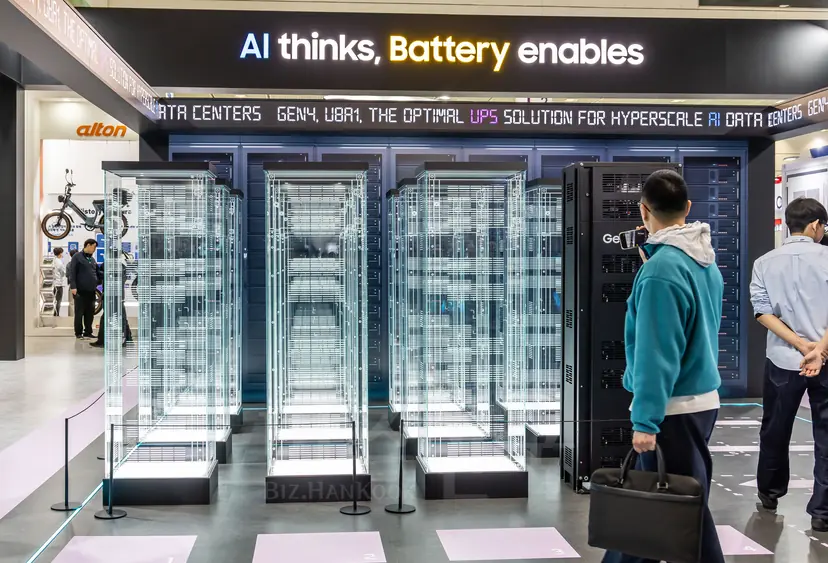
Initially, the market expected a turnaround in the second half, but the timeline was advanced due to increased sales of high-output premium power products for AI data centers—such as Uninterruptible Power Supplies (UPS) and Battery Backup Units (BBU)—as well as increased shipments of EV batteries to Europe, 107.7 billion won in AMPC benefits, and U.S. reciprocal tariff refunds.
To secure future growth engines, Samsung SDI is also pursuing portfolio diversification into new applications such as aerospace and humanoid robots.
Cho Han-jae, Executive Vice President of the Strategic Marketing Office at Samsung SDI, emphasized during the earnings call, “We are preparing to mass-produce all-solid-state batteries in the second half of 2027 as originally planned,” adding, “Given current customer demand and collaborative progress, the first commercialization project is highly likely to be in the humanoid sector, and we plan to supply samples for humanoids in the second half.”
SK On Rebounds Sharply Through Structural Reform and AMPC Effects
SK Innovation's battery subsidiary, SK On, also succeeded in significantly improving its performance. Driven by increased sales in Asia, customer compensation payments, and higher AMPC, SK On’s Q2 revenue reached 2.946 trillion won, a 57.5% increase from the previous quarter (1.8701 trillion won). Operating profit surged from a loss of 349.2 billion won in the previous quarter to an operating profit of 821.8 billion won, an improvement of 1.171 trillion won.
SK On underwent portfolio rebalancing, including finalizing the termination of its joint venture (BOSK) with U.S. automaker Ford and transitioning to a standalone factory system under "SK On Tennessee." The key to the rebound was easing financial burdens by significantly cutting annual fixed costs by approximately 500 billion won, including roughly 300 billion won in annual depreciation and 200 billion won in interest expense savings.
In addition, the expansion of sales volume in Asia, compensation received from clients, and increased U.S. AMPC benefits compared to the previous quarter contributed significantly to the improved performance.
Kim Young-kwang, Head of the Financial Management Office at SK On, explained during the earnings call, “Q2 revenue increased significantly compared to the previous quarter due to sales growth in Asia, customer compensation, and increased AMPC,” adding, “The operating profit of 821.8 billion won represents a substantial improvement, reflecting the visible effects of the company’s cost-cutting efforts on actual profitability.”
Positive Outlook for the Second Half
The return to profit for the three battery companies in Q2 is analyzed as a result of breaking through the temporary stagnation in the EV market by focusing on alternative markets like ESS, high-value product lines, and North American policy benefits.
This trend is expected to continue in the second half. As big tech companies continue to invest in AI infrastructure, demand for power grid batteries—such as BESS, UPS, and BBU—is expected to remain robust.
LG Energy Solution plans to secure 50GWh of ESS production capacity in North America by the end of the year and expand new orders through the mass production of its 46-series cylindrical batteries and LFP lines. Samsung SDI is pursuing additional orders based on discussions with major European OEMs, while accelerating the diversification of applications, including the supply of all-solid-state battery samples for humanoids. SK On also plans to review line conversions at its North American and Seosan plants and continuously strengthen its competitiveness in AI data center-tailored ESS businesses through collaboration with SK Group affiliates.