

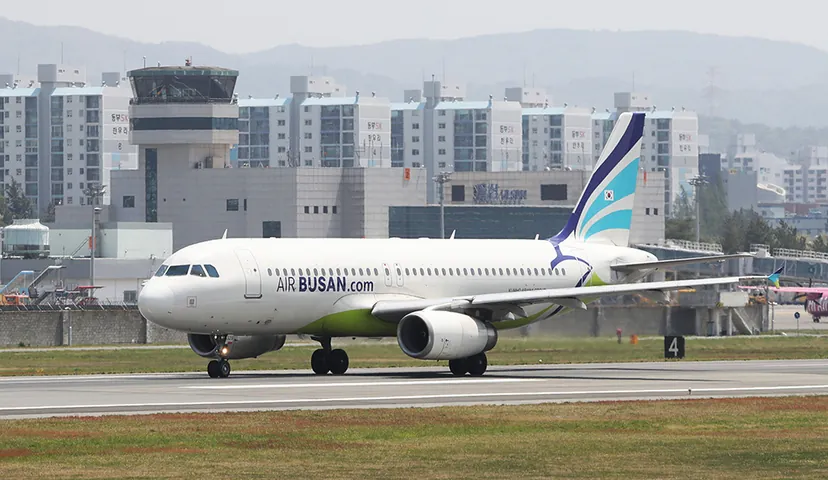
[비즈한국] As Hanjin Group accelerates the integration of its low-cost carrier (LCC) subsidiaries—Jin Air, Air Busan, and Air Seoul—the local community is mounting demands for the consolidated LCC's headquarters to be located in Busan Metropolitan City. The concern is that if the headquarters are based in Seoul, the aviation industry foundation that Air Busan has built in Busan could be weakened. Supporters argue that the consolidated LCC headquarters must be in Busan for the sake of balanced regional development and the competitiveness of Gadeokdo New Airport.
Busan Faces Backlash, Calls for Korea Development Bank Accountability Emerge
With the integration of Korean Air and Asiana Airlines scheduled for December, the work of merging their respective LCCs has also begun in earnest. Hanjin Group plans to merge the three companies: Jin Air (a Korean Air subsidiary), Air Seoul, and Air Busan (both Asiana Airlines subsidiaries). On August 21, Jin Air announced that it would absorb and merge with Air Seoul and Air Busan, making the three-way merger official. The scheduled launch date for the integrated entity is March 17, 2027.
Jin Air will be the surviving entity, while Air Seoul and Air Busan will be dissolved, and the merged entity will operate under Jin Air's system. Consequently, the new headquarters are expected to be located in Gangseo-gu, Seoul, where Jin Air is currently based. The Busan community is demanding that the headquarters be located in Busan, where Air Busan is currently headquartered.
The Democratic Party of Korea's Busan City Chapter held a press conference on September 3, stating, "The government is currently pursuing a large-scale national project called Gadeokdo New Airport, but simply building an airport does not make it a hub airport." They added, "It is unacceptable to place the headquarters of the consolidated LCC—which should have routes based at that airport and create synergies with the aviation industry—in the capital region."
Previously, on August 26, members of the People Power Party in the Busan Metropolitan Council also held a press conference, emphasizing, "The move to bring the integrated LCC headquarters to Busan is not just about attracting one company." They described it as "a stepping stone for balanced national development that will revitalize Gadeokdo New Airport—the international gateway to the southern region—complete the marine capital area by strengthening national logistics competitiveness, and, above all, break the chains of the ruinous capital-centric system to propel South Korea into a true advanced nation."
On September 11, the Busan Metropolitan Council adopted a 'Resolution Urging the Attraction of the Consolidated LCC Headquarters to Busan and Decisive Action from the Government and Korean Air for the Successful Opening of Gadeokdo New Airport.' Across party lines, the Busan community is speaking with one voice to demand the headquarters.
While a private company cannot be forced to relocate its headquarters, and the Korea Development Bank (KDB) maintains that the decision is up to the company, some argue that because Korean Air received support from the state-run KDB during its acquisition of Asiana Airlines, it has a responsibility to cooperate with the government's balanced regional development policy.
The Busan community is calling for action from the government and the KDB. The Democratic Party's Busan Chapter pointed out, "The KDB currently holds a stake in Hanjin Kal, and the investment agreement stipulates prior consultation and consent for major management matters, management evaluation, the establishment of post-merger plans, and implementation responsibilities." They added, "When the airline merger was proposed in 2020, the KDB suggested 'fostering a second hub airport based in the region and vitalizing the local economy.' It is difficult to understand the KDB's current stance that this is 'a matter decided autonomously by Korean Air' ahead of the extraordinary general meeting of shareholders to approve the LCC merger."

No Way to Force Relocation... Hanjin Group Faces Task of Persuading Local Community
Hanjin Group maintains its position that it will keep its headquarters in Seoul or the capital region. In response, People Power Party lawmakers from the Busan region have announced their intent to summon Hanjin Group Chairman Cho Won-tae and KDB Chairman Park Sang-jin as witnesses for the parliamentary audit.
Representative Kim Mi-ae of the People Power Party stated on social media, "At the upcoming parliamentary audit, I will thoroughly question the KDB on its specific implementation plan for the promised 'provincial airport second hub,' the placement of the consolidated LCC's headquarters and core organizations, and the flight operation plans from Busan." She added, "They cannot simply take the assets and routes of Air Busan, which were nurtured by the citizens and commercial sector of Busan, while concentrating the headquarters and decision-making power in the capital region."
The government is also feeling the pressure. Busan Mayor Park Heong-joon has stated on several occasions recently that he will discuss the consolidated LCC headquarters with the KDB. It seems difficult for the government to simply ignore the request of the Mayor, who is classified as being 'pro-Lee Jae-myung' (pro-DP).
However, if the government intervenes, it is likely to face criticism for meddling in the management of a private company. Furthermore, there is no clear way to force a headquarters relocation. The KDB holds a 10.58% stake in Hanjin Kal, the holding company of Hanjin Group, and the National Pension Service holds 5.11%. However, Chairman Cho Won-tae and related parties hold a 20.57% stake, giving the Chairman the advantage in any potential proxy battle.
The Busan community had previously requested that if locating the consolidated LCC headquarters in Busan is difficult, Air Busan should be sold off separately. However, with Jin Air's announcement of the three-way merger, a separate sale of Air Busan has become practically impossible. It appears Hanjin Group never considered a separate sale of Air Busan to begin with.
In a press conference in March last year, Chairman Cho Won-tae stated, "I've heard talk of a separate sale of Air Busan for two or three years, but I haven't given it serious thought." He added, "Jin Air will play an even more important role when the new Busan airport (Gadeokdo New Airport) opens, and even if they are merged later, that position will be maintained." This is interpreted to mean that they intend to keep Air Busan's role as a Busan-based airline even if the headquarters remain in Seoul.
If the citizens of Busan turn their backs on Hanjin Group, it will not be good for Chairman Cho Won-tae. If they choose to use other airlines, it could immediately impact performance. The task of persuading the Busan local community remains a significant challenge ahead.