

[BizHanKook] ‘Manhaeng’ (Ten Thousand Acts) refers to the ten thousand paths of practice undertaken for the sake of enlightenment. If one's goal is to attain ultimate realization, then everything from leaving the meditation hall to wander through mountains and streams, to working as a servant or living as a beggar, can be considered a Manhaeng. Thus, it is fitting to call Monk Jichan's unique practice—drawing cartoons instead of Buddhist paintings, riding a bicycle instead of a cow to reach a state of samadhi, and swimming to reach the "other shore" of enlightenment—a form of Manhaeng. I met Monk Jichan, the creator of the cartoon character "Eora" and known as the "Runner in Monk's Robes" or the "Triathlon Monk," at a quiet soft tofu restaurant in Yangju, Gyeonggi Province.
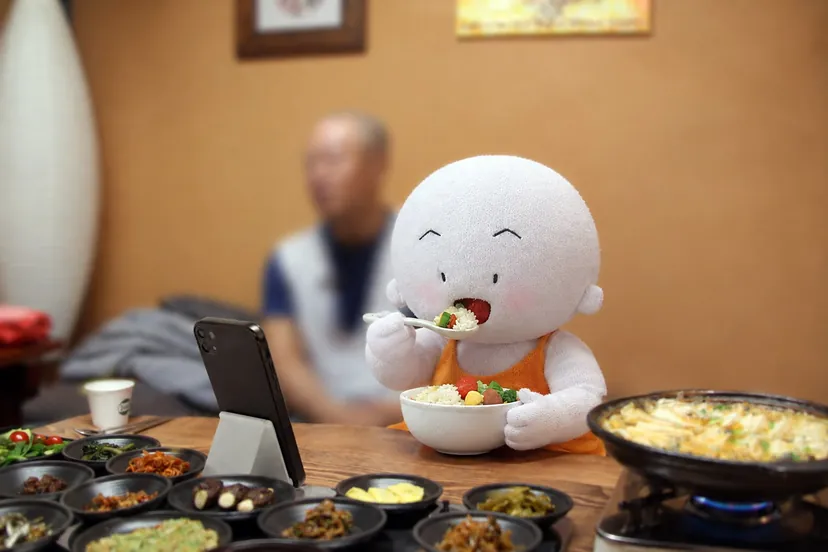
Tofu, a Monk’s Source of Protein
In Buddhism, where the taking of life is forbidden, tofu is both a precious offering and the best source of protein. Introduced during the Unified Silla period, tofu production technology developed around temples. During the Joseon Dynasty, the connection between Buddhism and tofu was so deep that thirty-five temples, known as 'Joposa,' were specifically designated to provide tofu for royal rites and ancestral tombs. Since it is counted among the three foods that make monks smile (along with noodles and rice cakes), it is a logical consequence of "conditioned arising" (pratītyasamutpāda) that Monk Jichan would choose tofu as his soul food.
Shortly after becoming a monk, he stayed at Baekdamsa Temple on Mt. Seorak for a while, where he struggled due to his specific dietary needs related to his practice and constitution. One day, while heading out for dental treatment, he stumbled upon a restaurant in the village near the temple. He tried the soft tofu made by the grandmother who owned the shop, fell in love with the taste, and continued to visit the shop with his fellow practitioners (friends or colleagues who practice the Buddhist path together).
Whether it was truly because of the grandmother's exceptional touch or because it simply tasted better than temple tofu, one can guess that his dental appointments became more frequent and treatment slower, as he confessed he visited the shop with the mindset of a soldier on leave. Aside from soft tofu, the area around Baekdamsa is famous for dried pollack and hand-cut noodles; the noodle shop where the grandmother kneaded the dough herself was another place the monk enjoyed visiting as much as the tofu house. A sense of regret lingered in his voice as he mentioned that the grandmother eventually closed the shop due to poor joint health.
Stories of Temple Food
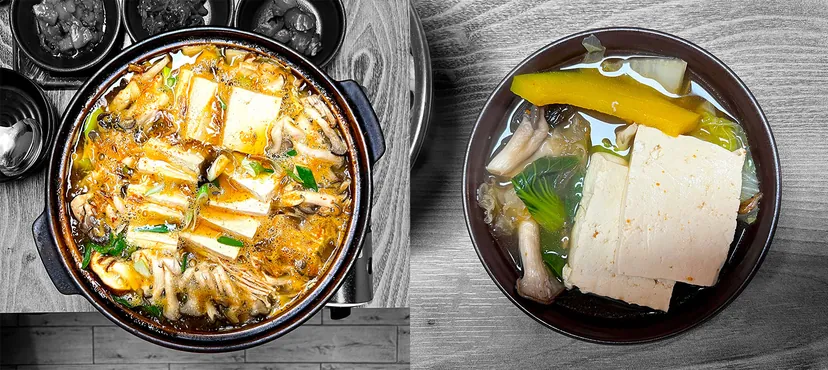
The conversation about soft tofu, started with a bowl of the dish in front of us, naturally expanded into stories about temple food. These weren't stories about the "temple cuisine" that is gaining huge popularity for its simplicity and neatness, but about the plain, unadorned, and authentic food of the monastic life.
When the monk was at Bongamsa Temple, senior monks would sometimes give him pine mushrooms they had picked during walks, which he would put into soup or instant noodles. He says he still cannot forget that subtle fragrance, true to the saying, "1. Pine mushroom, 2. Tricholoma mushroom, 3. Shiitake." Just listening to his story, one can almost conjure up the heavy, deep scent and chewy texture of the pine mushrooms—a state of "heart-to-heart transmission" achieved through the flavor of the words.
The monk was ordained at Songgwangsa, a temple renowned as a 'Seungbo-sachal' (Temple of the Sangha Jewel). He mentioned that the porridge served for breakfast there was also exquisite. There is a famous Buddhist anecdote that asks, "If you ask monks if they want porridge, no one answers, but if you ask if they want noodles, everyone answers." However, the porridge at Songgwangsa, which became a tradition after the 1970s, is the exception. At Songgwangsa, they rotate the breakfast menu daily—pine nut porridge, vegetable porridge, sweet potato porridge, millet porridge, corn porridge, spinach porridge, radish porridge, lotus root porridge, peanut porridge, scorched rice porridge, and so on. The porridge was so good, he recalled, that there was an American novice who would fill his bowl to the brim and go back for seconds. Porridge, once a symbol of the hardships of practice, had transformed into a simple joy of temple life.
However, not all temples are in such a position. In smaller temples or hermitages where a monk stays alone, it is not easy to manage daily meals. Sometimes monks and laypeople from other temples help, but there are places of practice where even this is difficult. It strikes me that practice is a "hwadu" (riddle) rooted in cold, hard reality.
Cartoon Manhaeng
'Eora, I’m Doing Fine,' published in 2016, is a cartoon that captures the experiences of monastic life, centered on a cute monk character named 'Eora.' Subtitled "A Comprehensive Struggle for Life and Practice," this book was his first work, compiling cartoons he had posted on his blog. The monk said that while he has lingering regrets about the technical aspects, it is a book for which he has a special affection, as it condensed long years of work. 'Eora’s Life Cartoon,' released in 2017, also depicted the joys and sorrows of a practitioner's daily life, and the ease of an author who had become fully liberated from the tension of his first work gently embraces the reader.
While living in the meditation hall, the monk became interested in the way Japanese haiku compresses meaning into short sentences. Around that time, he encountered Yoshihiro Koizumi's cartoon 'We Are All Pigs' and decided to pursue cartooning. Seeing a non-Buddhist author wittily depict Buddhist philosophy within a four-panel comic strip inspired him to try and express his own practice through cartoons.
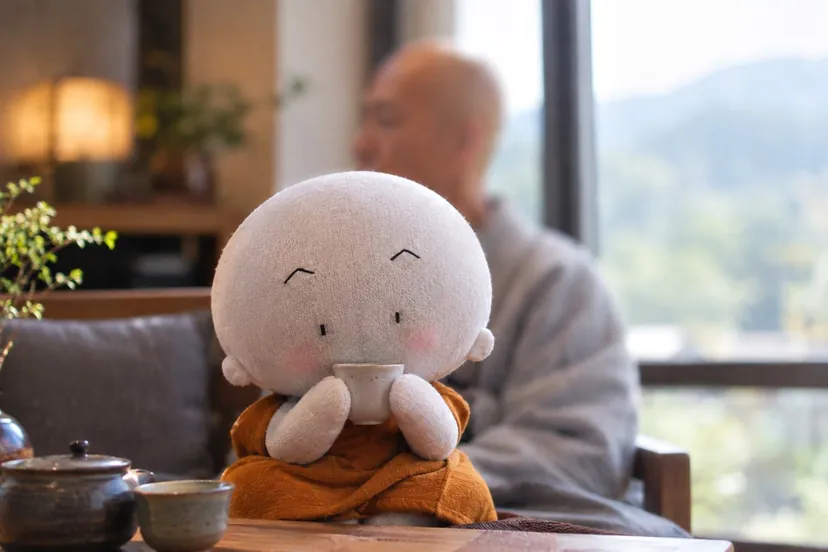
In 2011, he enrolled in a cartoon creation course at the Sungshin Women's University Institute of Social Education. He says he struggled to keep up among people who were skilled at drawing beautiful 8-head-tall figures for romance comics. It was there that he met cartoonist Kim Dong-bum (Ddonggae), who taught him about the cartoon format. He felt that the cartoon, which compresses meaning into a single panel, felt similar to Zen painting (Seonhwa).
His signature character, 'Eora the Monk,' was born around this time. Finding it difficult to draw 8-head-tall bodies, he moved toward putting emotions into 2-head-tall characters, which were relatively easier to draw. At the time, 2-head-tall characters in lighthearted comics and daily webtoons were popular, and the influence of a drawing style that trades detailed anatomy for expanded facial expressions and emotional display can be seen in 'Eora the Monk.'
Nowadays, Buddhism has become "hipster," from EDM to dance and merchandise, but when the monk first ordained, there was quite a bit of criticism toward such free, cartoonish expressions. With more monks practicing in various forms now, and even the emergence of virtual YouTubers communicating via beautiful characters, it feels like a completely different era.
“People might ask, 'What kind of practice is just doing what you like?' But if you do something for a long time, if you stay with it, you find that even if you aren't perfect in life, you gain a kind of realization of your own, or things just start to melt into you. I started with that kind of heart, wondering if I could melt what I studied into my cartoons with that confidence. It just happened that the first thing I encountered was cartoons, so I started drawing them.”
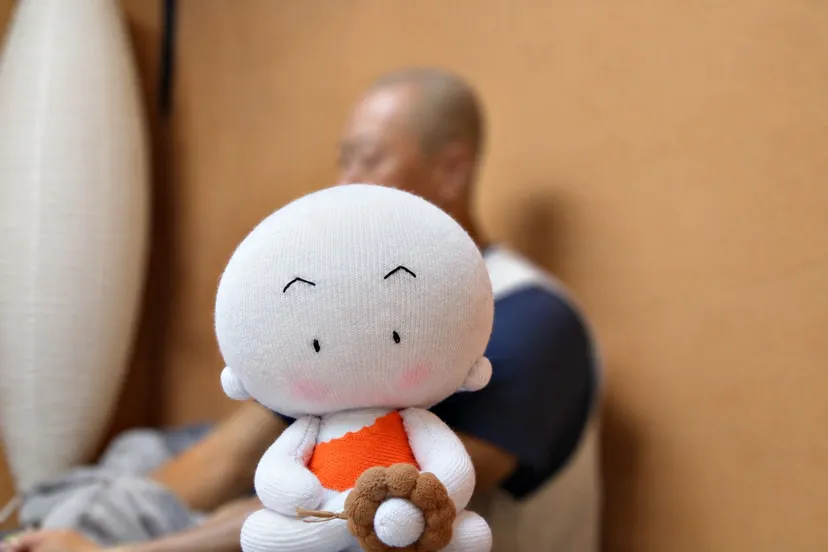
Keeping pace with changing times, the monk has steadily expanded his scope. He obtained a sock craft certification to create dolls of Eora, and he even released emoticons using the character, though they were rejected several times for being a religious character. Recently, while he hasn't been able to draw as much due to his dedication to swimming and running, he continues to try new things, such as opening an Instagram account for Eora using AI.
When asked how he keeps his mind clear as he sometimes feels his own lack of study and the limitations of his abilities during that process, he said, “Not everyone can reach the top. That sometimes becomes greed, or leads to wounds, and when you feel your limits, that is where ‘letting go’ happens. I am placed in that exact same process.”
From Cartoons to Running and Triathlons, and Beyond
As the title of the preface to his essay, 'A Monk's Running,' states—"Even if you are a practitioner, your body is still that of a sentient being"—the monk experienced menopausal symptoms as he passed his late 40s. Depression crept into the space left by receding muscle. The monk, who started running to shake off this depression, completed a full marathon in the year he turned fifty.
Monks may gain realization through the mind via practice, but the spring, summer, autumn, and winter of the body must be experienced firsthand. Even high-ranking monks sometimes found it difficult to endure the physical ailments of old age; even if they were enlightened early on, there was still something left to be realized through the body for a lifetime. Thinking that physical practice was necessary, he started running, and now, he has moved through marathons to the triathlon. While running, the monk experienced a state of "calm down" distinct from a "runner’s high," which he says is a sensation similar to "near-samadhi," a state where the mind is calmly focused.
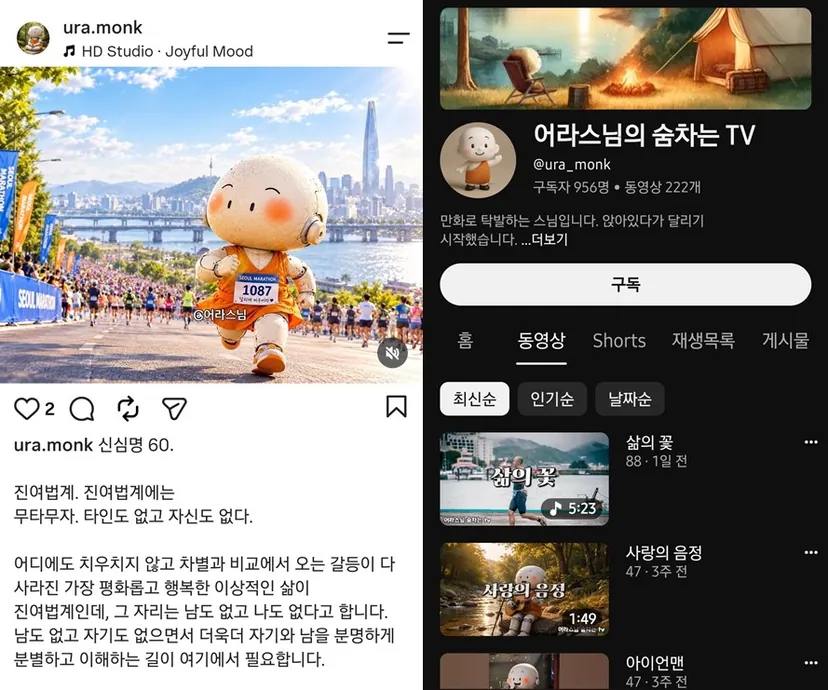
Even in October, when we held this interview, the monk completed an Ironman course (3.8km swim, 180km bike, 42.195km marathon). It’s the same course that former UFC fighter Kim Dong-hyun completed. His final goal is a national cross-country journey of over 600km, after which he plans to return to sitting meditation. Unlike people who focus on 'records,' the monk sets his mind on the 'completion' itself. He is testing himself not to attain the liberation of life and death, but to gain inner fullness.
In a way, it seems that for the monk, cartoons and exercise share the commonality that they are both practice and a way to melt what he has studied into his life and reality. Once he achieves his current goal of obtaining a lifeguard certification, that process will likely become creative material as well. I asked him to continue his activities not just through essays, but through cartoons. I want to see the next cartoon featuring 'Eora the Monk.'
Monk Jichan said he wants to eventually prepare a place for practice in a place like Ganghwado with a yard and a small kitchen. I look forward to seeing the monk laughing just like 'Eora' in a warm space where he can look back on his own body and mind while mingling with people through hobbies like coffee, books, and sports.