

[BizHanKook] Nvidia founder Jensen Huang has publicly expressed his intention to return as CEO. This comes just five days after he stepped down following a controversy over an extramarital affair. However, the Nvidia board of directors stated on the same day that they have no plans to reappoint Huang as CEO. While the quarterly earnings report, the first released since his departure, beat market expectations, it is too early to judge the future of a “Nvidia without Huang” based on these results alone. The variables that will determine the possibility of his return are the results of an independent investigation, the selection of a successor, and the choices of shareholders.
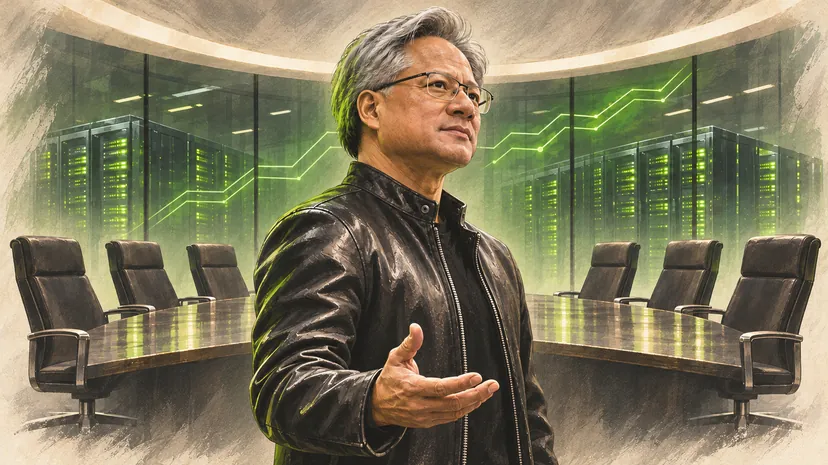
Huang says “I will return”… Board says “No comeback”
Jensen Huang stepped down as Nvidia’s CEO and board member on the 12th, marking his departure after 33 years. Several reports regarding his extramarital affairs emerged before his resignation. One of the individuals involved was an executive at a Singaporean technology firm, which U.S. intelligence authorities reportedly believe to have ties to Chinese intelligence agencies. Reports also surfaced regarding a relationship with an Nvidia employee. The Chinese government has denied espionage allegations.
In a post on X on the 17th (local time), Huang stated that he had received requests to return from employees, investors, business partners, and customers after his resignation. He admitted to making serious mistakes in his personal life and causing trouble for the board, expressing his willingness to cooperate with an independent investigation. He further stated that if the board determines that his return aligns with the interests of shareholders, employees, the company, and the United States, he would return as CEO. While making his intention clear, he left the final decision to the board.
The board’s response was firm. Harvey Jones, chairman of the Nvidia board, said during the quarterly earnings call that the board had accepted Huang’s resignation unanimously and had no intention of reinstating him as CEO. Nvidia appointed Colette Kress, the Chief Financial Officer (CFO), as interim CEO. Kress will continue to serve as CFO until a permanent successor is appointed. The board has selected the headhunting firm Heidrick & Struggles to find a successor.
Public opinion demanding Huang’s return remains significant. Over 190,000 people had signed the online petition “Stand with Jensen” by the 17th, with thousands of participants identifying themselves as Nvidia employees. However, since the employee and shareholder status of the petitioners is self-reported, these figures have not been independently verified. The campaign organizers stated they are filtering out fake signatures. There was also a mishap involving Bryan Catanzaro, an Nvidia VP, who publicly refuted the inclusion of his name on a separately circulated letter signed by employees, stating his name had been added erroneously.
Among institutional investors, Altimeter Capital and Aristeia Capital have asked the board to keep the door open for Huang’s return. However, their combined stake in the company is less than 0.1%. They also acknowledged that if the board refuses to accept his return after all the facts are laid out, it is the board’s prerogative. As support grows, the board now faces the situation of needing to explain to investors why they are refusing Huang’s return and how they plan to lead the company without him.
Revenue increased by 103%, but “performance without Huang” remains an unknown
Nvidia announced that revenue for the third quarter of fiscal year 2027 was $115.8 billion, an increase of 103% compared to the same period last year. The company projected revenue for the next quarter to be $130 billion (±3%), exceeding the market expectation of $125.2 billion. However, the fourth quarter contains 14 weeks, one week more than usual, and Chinese data center revenue was not included in the forecast. Interim CEO Kress emphasized the progress of the new AI platform “Vera Rubin” and product development plans. Although the stock price rose nearly 4% in after-hours trading immediately following the earnings announcement, it remains about 17% lower than it was at the beginning of the year. Looking only at the numbers from the report, Huang’s resignation has not yet dampened the immediate demand for AI semiconductors.
However, this quarter ended on October 25th, before Jensen Huang stepped down. Therefore, it is difficult to attribute the strong performance to the new management or to use it as evidence that Nvidia can operate without issues without Huang. This is because the product development and customer contracts that Huang led were already reflected in the earnings for this period.
The key moving forward is who will sustain this growth. Beyond chip sales, Nvidia must manage investment plans from major clients and suppliers, product delivery schedules, and U.S. export controls against China. Huang was the company’s face in these decisions, serving as both the technical head and the person who convinced customers. Tesla CEO Elon Musk remarked that many of Nvidia’s supply contracts were made via a handshake with Huang rather than written agreements. The claim is that without Huang, some key deals might be lost. Even if the board finds a successor, the challenge remains on how to integrate the relationships and decision-making style Huang cultivated into the organization. Conversely, if the new management can maintain this stably, the persuasiveness of the calls for his return may diminish.
Two paths for a return: Board reversal or shareholders' choice
The fastest path is for the current board to change its stance. The first variable is the ongoing independent investigation. The board launched the investigation on the 8th, while Jensen Huang was still CEO, due to reports that he had been a target of access by foreign intelligence agencies. The investigation is led by a committee of independent directors receiving external legal counsel. The board stated at the time that they had no reason to believe national security or company secrets had been compromised, but said they would examine all relevant information. If no significant additional issues are confirmed in the investigation and the search for a successor hits a snag, there is room for the board to re-evaluate the possibility of his return.
However, even if the investigation results are favorable to Huang, it does not automatically guarantee his return. The independent investigation deals with the issue of foreign intelligence access. Even if it concludes there are no issues in that area, problems regarding the company’s code of conduct, such as the relationship with an employee, remain separate. Huang has admitted his fault, and the board has publicly stated it accepted his resignation unanimously. To reverse that decision, the board would need to explain why they reached a different judgment than they did initially and whether it conflicts with the company’s standards applied to other employees.
On the day of the earnings announcement, the board established a new permanent body, the “National Security and Export Control Oversight Committee.” The chair is Susan Nora Johnson, a former vice chair of Goldman Sachs. In such a climate, rushing to bring back Huang could be burdensome. Political sentiment is also divided. President Donald Trump praised Huang’s leadership and questioned whether the espionage allegations should be grounds for resignation. In contrast, the chairs of the House committees on Foreign Affairs, Intelligence, and the Select Committee on the CCP issued a joint statement, saying they want to hear directly from Huang about what role he played in the potential breach of national security.
The second path is for shareholders to influence the composition of the board. According to Nvidia’s 2026 annual meeting materials, shareholders who have held at least 3% of voting rights for three consecutive years can nominate board candidates to be included in the company’s proxy materials, provided they meet certain requirements. Up to 20 shareholders can combine their stakes to meet these requirements. They can nominate the greater of two candidates or 20% of the board’s authorized size. As of March 23rd, Huang’s reported stake was 3.58%. If Huang continues to meet the requirements, he could attempt to change the board by nominating candidates who align with his views.
However, nomination does not guarantee election. Nvidia’s annual general meeting of shareholders is typically held in June, so this path is at least half a year away. Even if all nominated candidates are elected, they would only occupy a few seats on a board of about 10 people. To lead a decision to reappoint a CEO, the consent of other directors is required. This means Huang’s shares alone cannot change the board or restore him to the CEO position. Ultimately, Huang’s return depends less on the scale of support petitions and more on the results of the independent investigation, the performance of the successor regime, and the long-term value of the company as judged by major shareholders. The answer the board has officially given is currently “no return.” For that answer to change, a shift greater than the mere fact that Huang wishes to return will be required.