

[BizHanKook] Global semiconductor stocks, which had surged on the back of the artificial intelligence (AI) investment frenzy, are experiencing significant volatility. Shares of U.S.-based Intel plummeted by nearly 29% in a single day, while Nvidia surrendered its spot as the world's most valuable company by market capitalization to Apple. In South Korea, Samsung Electronics and SK Hynix also saw their stock prices tumble despite reporting record-breaking earnings, causing the KOSPI to retreat toward the 5,700 level. While expectations for growth in the AI industry remain intact, market skepticism is mounting over whether massive investment costs will actually translate into profits.
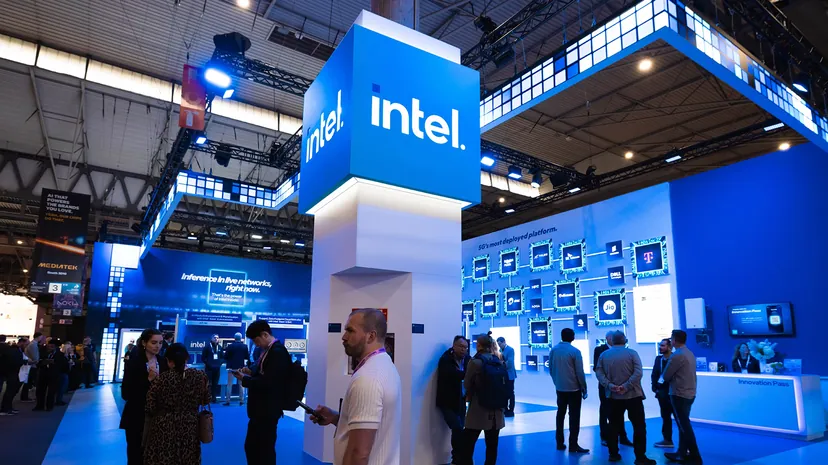
Intel Stock Hits 52-Year Low; Apple Reclaims No. 1 Market Cap
On October 30 (local time), Intel's stock price plummeted by 28.58% on the New York Stock Exchange. This marks the largest single-day drop in approximately 52 years, since it fell 29.9% in July 1974. As a result of the sell-off, Intel's market capitalization evaporated by about $140 billion (approximately 200 trillion won) in just one day.
Intel’s stock had soared this year on the back of rising demand for AI-related semiconductors and expectations of a business turnaround. Starting the year around $38, the stock climbed past $140 by last June, jumping 3.7-fold in about six months. However, sentiment cooled rapidly after the company’s recent earnings forecast fell short of market expectations.
Intel's third-quarter earnings actually exceeded market consensus. Revenue reached $16.5 billion, a 21% increase year-on-year, surpassing the $16.48 billion expected by the market. Adjusted earnings per share (EPS) also came in at $0.52, beating the market projection of $0.40. However, the revenue guidance for the fourth quarter was set at $15 billion to $16 billion, falling short of the market’s expectation of roughly $17.1 billion. The adjusted EPS forecast of $0.25 also missed the market expectation of $0.44.
Despite solid third-quarter results, investors were disappointed by concerns that future growth might slow, triggering the share price collapse. In particular, with sluggish PC demand expected to persist through the first half of next year, the financial burden of continued investment in semiconductor manufacturing facilities has also acted as a negative factor.
Following Intel's collapse, other U.S. semiconductor companies also saw their shares fall in unison. On October 30 (local time), Nvidia's stock dropped 4.22%, and AMD plummeted 10.88%. As the decline in semiconductor stocks continued, the Philadelphia Semiconductor Index fell 7.2%. The tech-heavy Nasdaq Composite Index also slid 2.86%.
Nvidia lost its top spot as the world's most valuable company to Apple. On this day, Nvidia's market cap decreased to about $4.93 trillion, while Apple reached approximately $5.03 trillion. Although Apple's stock also fell by more than 1%, its smaller decline allowed it to reclaim the number one spot in market cap for the first time in about three months since July.
Domestic Stock Market Plunges Amid U.S.-Led AI Investment Concerns
Concerns regarding the profitability of AI investments by major U.S. tech firms have also impacted the South Korean stock market. Amid deteriorating investor sentiment toward U.S. tech stocks and Intel’s disappointing earnings forecast, a wave of selling hit domestic semiconductor stocks as well.
On October 30, the KOSPI closed at 5,730.74, down 206.92 points (3.48%) from the previous trading day. During the session, it even dipped below the 5,600 mark, falling as low as 5,599.42. As the index plummeted, a "sidecar" trading halt was triggered, and foreign investors net-sold approximately 1.6 trillion won worth of shares on the KOSPI market.
Samsung Electronics closed at 225,000 won, down 7,000 won (3.02%) from the previous session, while SK Hynix plunged 108,000 won (7.08%) to 141.8 million won. Both companies reported record-breaking earnings for the third quarter but could not escape the downward trend.
In particular, SK Hynix, which had been enjoying a rally until the previous day due to strong results and large-scale shareholder return plans, saw a complete reversal of sentiment in just one day. Related stocks such as Samsung Electronics Pref (-5.33%), Samsung Electro-Mechanics (-7.50%), and SK Square (-5.88%) all showed weakness simultaneously.
Securities analysts believe that while demand for AI-related semiconductors remains robust, rising concerns over investment profitability could lead to increased market volatility. Han Ji-young, an analyst at Kiwoom Securities, analyzed the earnings of Amazon, Intel, and Sandisk in a report on the 30th, stating, "While the earnings of these three companies confirmed the solid demand for AI servers, concerns over investment profitability and slowing B2C demand have been highlighted. Therefore, it is necessary to prepare for increased volatility as the market digests these competing upward and downward factors."