

[BizHanKook] Companies sometimes make decisions that are difficult to explain by money alone. Understanding the underlying laws and systems can help provide a deeper understanding of the situation. 'Useful Business Laws' introduces clues that help in understanding business trends.

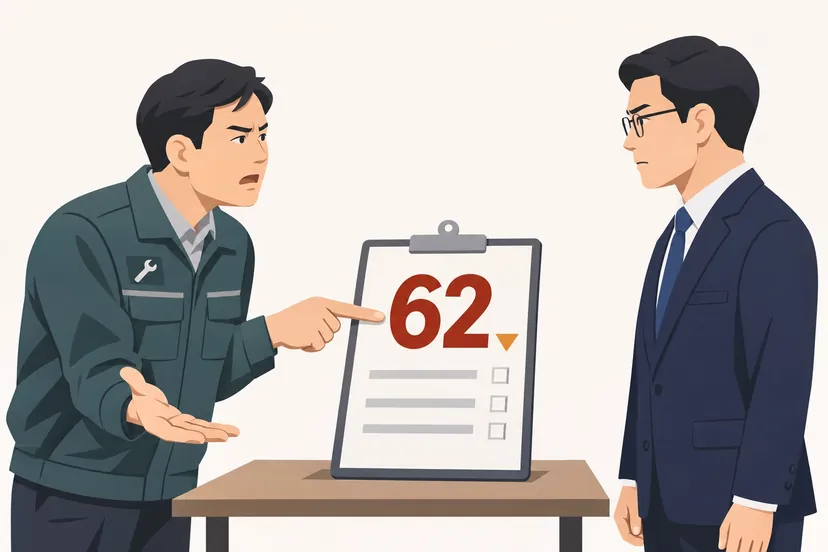
Let's assume a company has 30 repair partners nationwide. In this year's regular partner evaluation, Company A, which has been a partner for eight years, received a score of 62 out of 100. The baseline set by the company is 70 points. The operations department argues, "Processing delays and customer complaints are recurring," and suggests ending the partnership when the contract expires at the end of the year. Since the partner did not meet the evaluation criteria, it seems the contract termination would not be an issue. But is that really the case? Although this is a hypothetical scenario for explanation, it is a scene commonly seen in the business field.
In principle, a business operator can decide for themselves who to do business with. The mere fact that a relationship with a long-term partner has ended does not immediately constitute a violation of the law. However, there are exceptions. First, if the partner relies heavily on the company and cannot easily find other clients, cutting ties could jeopardize the partner's business itself. Second, if a powerful company cuts ties with the intent to harm a specific partner. Third, if the termination is used as a means to force an unfair demand. The Fair Trade Act regulates this as "unfair refusal to deal," and similar disputes constantly occur in subcontracting, agency, and franchise transactions.
Ultimately, a company must be able to demonstrate that it acted for "justifiable reasons and applied the same standards to all partners." The most certain means is an objective evaluation system. The Enforcement Decree of the Franchise Business Act explicitly mandates this. If common evaluation criteria are notified to all franchisees in advance, evaluated accordingly, and renewal is refused based on those results, it is not considered an unfair refusal of renewal that discriminates against a specific franchisee. The evaluation system acts as a kind of safe zone. While there are no such explicit provisions in the Agency Act or the Subcontracting Act, the principle remains the same: objective evaluation records serve as strong evidence that the termination was not for "retaliation or other ulterior motives."
Court judgments align with this direction. In an automobile dealership case (Seoul Central District Court 2018Gahap547755), the company generally refused contract renewals for dealerships that scored below 700 out of 1,000 points. A dealership that ranked last among 302 agencies with a score of 655 filed a lawsuit, but the court ruled in favor of the company. This was because the criteria were applied equally to all dealerships, the scoring was based on objective figures, and the basis for evaluation had been stipulated in the contract in advance. An eye-catching detail was the operational method: the company sent the draft evaluation criteria to all dealerships for feedback, adjusted the deduction ranges, and held re-interviews with 12 dealerships classified for renewal refusal, ultimately continuing contracts with 5 of them.
On the other hand, in a hypermarket service provider case (Seoul High Court 2020Na2005912), the conclusion was different. The court deemed the evaluation system itself—which distributed criteria regarding service quality, customer complaints, safety incidents, and theft incidents in advance—as legitimate. However, regarding stores that terminated contracts during the contract period, the court acknowledged the company's liability for damages, stating that the termination requirements set forth in the contract had not been met. This means that a legitimate evaluation system and the satisfaction of contractual requirements for individual terminations are separate issues.
Synthesizing the two rulings, the court mainly looked at two things. One is substantive fairness, or whether the judgment itself was correct. It examines whether evaluation items are related to the purpose of the business, whether the results correspond to the facts and responsibilities, and whether the measure of termination is commensurate with the severity of the fault. The other is procedural fairness, or whether fair procedures were followed. It examines whether criteria were notified in advance, whether they were applied equally to all partners, and whether opportunities for explanation and improvement were provided.
To achieve substantive fairness, evaluation items must be selected carefully. They should not be indicators that are easy to measure, but indicators that properly reflect the partner's responsibility. Vague items like "cooperation with headquarters" are easily suspected of giving lower scores to partners that voiced dissent. It is better to replace them with specific items directly linked to contractual obligations, such as "accuracy of mandatory reports." Furthermore, factors such as raising objections, negotiating terms, filing reports, or organizational activities should not be reflected in the evaluation.
The core of procedural fairness lies in showing that "the conclusion was not predetermined." If the department requesting the termination also handles the scoring and the processing of objections, it is difficult to avoid such suspicion. It is desirable to separate the evaluators from the verifiers, provide the basis for each item along with the score when announcing results, and ensure that when an objection is filed, a different person—not the original evaluator—reviews it. It is also inappropriate to terminate a deal simply for failing to meet a benchmark. The partner must first be given an opportunity to object and improve.
Let's return to the case of Company A. Company A objected for four reasons: delays caused by late arrival of parts from the headquarters were counted as its own fault; the same complaint from the same customer was counted multiple times; its qualitative evaluation score dropped after it raised objections to headquarters; and it claimed it was treated differently from Company B, which had a similar score but continued its contract. If a dispute arises, these four points become the headings of a complaint or a lawsuit.
The company must review these counter-arguments one by one, reflect valid parts in the score, and explain the reasons for rejecting others. Also, if Company B was given an opportunity for improvement and recovered its score through re-evaluation, it is only fair to give Company A the same opportunity. Because to reach different conclusions for similar scores, there must be facts that explain the difference. If Company A implements an improvement plan with support from the headquarters and exceeds the 70-point baseline upon re-evaluation according to the predetermined method, it is appropriate to continue the business relationship.
In this case, the company's change in conclusion is not because it was being generous. It is because the evaluation system corrected errors and provided a substantial opportunity for improvement, with the entire process documented. If an evaluation system actually works and is operated objectively and neutrally, it is difficult to criticize it as a mere formality or an unfair procedure. Even if the partner fails to improve and the contract is eventually terminated, the company will have the basis to explain that the decision was justified.
Of course, building and operating such an evaluation system requires manpower, money, and time. However, as partners' sense of rights grows and issues regarding partner management are raised not only by the parties involved but also by regulatory agencies, establishing a principle-based partner management system in advance is ultimately the way to save larger costs.