

[비즈한국] Following the August 3 tax reform proposal, the August 13 supply measures were released. Every time a new measure is announced, the questions I receive always boil down to one thing.
“So, will this finally bring down house prices?”
I believe this is the very question that needs to change.
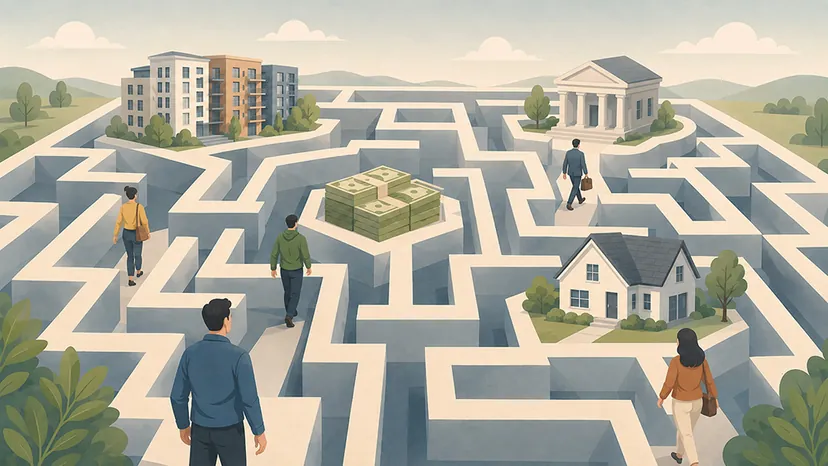
The most ideal real estate policy is not one that artificially inflates or suppresses house prices. It is a system that enables people to buy, sell, rent, and move homes according to their needs. House prices are a result. The subjects that policy should manage are not the numerical price, but the structure of housing supply, mobility, finance, taxes, and the rental market.
However, for the past several decades, our government has moved in the opposite direction. When prices rose, it blocked loans, raised taxes, and restricted transactions. When prices fell, it loosened loans, cut taxes, and eased regulations. As a result, people look at policies instead of houses. They ask, “Is this the time the government wants us to buy, or sell?” A market like this cannot be normal.
So, what should an ideal system look like? I have outlined the principles as I see them.
Free transactions, low transaction taxes
The most important thing in the real estate market is the freedom of transaction. Transactions should not be blocked just because house prices are rising. What happens when we expand land transaction permit zones, impose mandatory residence requirements, and raise capital gains taxes on multi-home owners? People stop selling their homes. Regulations intended to curb speculation end up locking up the market supply.
According to market principles, if prices rise, the number of sellers should increase. It is normal for people to sell when values are high. But if the path to selling is blocked by taxes and regulations, houses don't enter the market even if prices rise. The conclusion is simple: transaction taxes, such as acquisition and capital gains taxes, should be kept as low as possible, while the costs for ownership should be applied broadly and moderately. Lower transaction taxes, broader property taxes. This is the simplest and most predictable structure.
Look at ‘how much,’ not ‘how many’
The biggest problem with the current tax system is its focus on the ‘number of homes.’ A person who owns two homes worth 500 million won each is considered a multi-home owner, while someone who owns one home worth 5 billion won is a single-home owner. Economically speaking, this makes little sense.
It is more rational for the tax system to be based on the asset value rather than the number of houses. In that sense, the recent tax reform, which shifted the comprehensive real estate tax from a home-count basis to an asset-value basis, is moving in the right direction. However, just because the direction is right doesn’t mean the job is done. The entire dichotomy that single-home owners are "good" and multi-home owners are "bad" must disappear. Multi-home owners are, at the same time, rental housing providers. What matters is not how many houses you own, but how much wealth you hold and what economic benefits you derive from it.
Build where people want to live
Looking at South Korea as a whole, there may not be a housing shortage. However, there is a shortage of housing where people actually want to live. This is the crux of the matter. No matter how many houses are built in rural areas, the housing problem in Seoul will not be solved. People congregate in specific areas with good jobs, transportation, schools, and commercial districts.
Therefore, policy should not say, “Do not live there,” but rather, “We will ensure more people can live there.” We should allow for higher density near subway stations, faster reconstruction of aging housing, and redevelopment of low-rise residential areas if the residents desire it.
Reconstruction is not a matter for the government to allow or block depending on market conditions. Once a building ages beyond a certain point and resident consent is secured, the process should move toward an automated system according to established procedures. Urban renewal is not a special favor; it is the metabolism of a city. Buildings grow old. Yet, in this country, whether the government will allow reconstruction is more important than the fact that an apartment is dilapidated. This structure must change.
Supply is about ‘living zones,’ not ‘number of units’
Every time a measure is announced, numbers like tens or hundreds of thousands of units appear. But people do not live in numbers; they live in neighborhoods. Even if you supply a million units, if it takes two hours to get to work and there is no transportation, school, or commercial district, those are not the homes people want.
The unit for supply policy should shift from ‘number of houses’ to ‘living zones.’ Rather than building houses first and laying railroads later, transportation, jobs, schools, commerce, and parks must be planned as a single package with housing. And once an urban plan is announced, it must continue even if the administration changes. An apartment has a lifespan of 40–50 years; if policies are overturned every five years, normal long-term decision-making is impossible.
Loans are not a water faucet
We must stop the practice of tightening loans when prices rise and loosening them when they fall. The purpose of financial policy is not to control house prices, but to prevent households from taking on debt they cannot afford. The criteria should not be where the house is or which home number it is, but whether that person can actually repay the principal and interest. It is correct to shift toward DSR (Debt Service Ratio) rather than LTV (Loan-to-Value).
Furthermore, these criteria should not suddenly fluctuate from 40% because Seoul house prices rise to 70% because the market stagnates. Good financial regulation is not about being "strong," but about being predictable.
Jeonse or monthly rent is not for the government to decide
I do not think we should eliminate Jeonse (lump-sum deposit rental) or encourage monthly rent. For someone with a large lump sum, Jeonse might be appropriate, while for someone with stable cash flow, monthly rent might be better. The government’s role is not to choose a specific form of lease, but to create a market where contracts can be signed safely regardless of the type.
Tenants should be able to easily verify a landlord’s debt and senior claims before signing, and information on the landlord’s ability to return deposits should be transparently disclosed. What the rental market needs most is not regulation, but trust.
Housing welfare should support people, not prices
We cannot make homes cheap for everyone. It is impossible to lower the price of Gangnam apartments so that everyone can afford to live there. We must separate welfare policy from market policy.
The public sector should actively support those who have difficulty securing housing on their own, such as low-income families, young people, the disabled, and the elderly. However, there is no need to control the price of the entire housing market to achieve this. Supporting those in need directly and allowing market prices to be determined by the market is the most efficient approach.
In the same vein, the government has no obligation to protect house prices in every region. Some cities grow while others decline. Risks must exist in real estate, too. In areas with shrinking populations, vacant homes should be cleared and cities compressed; in areas where people flock, density should be boldly increased. Applying the same policy to every region is, in fact, unfair.
The most important thing is not to change the rules
And there is one principle I consider the most important: do not change policy frequently.
How much the acquisition tax is, how much the capital gains tax is, how reconstruction proceeds, and how much credit is available—there must be a belief that these principles will hold for at least 10 or 20 years so that citizens can make long-term decisions. Real estate is not something you buy today and sell tomorrow. It is an investment of a person’s life savings and a space where a family lives for decades. The rules for such assets should not change every time an election occurs.
In the end, the ideal real estate policy I imagine is, surprisingly, mundane.
Buying and selling are done freely. Transaction taxes are low. Ownership carries a reasonable cost. We look at asset value rather than the number of houses. We keep building where needed. Aging housing is reconstructed naturally. Loans are based on repayment ability. Rental diversity is recognized. Vulnerable groups receive direct support. And these principles remain unchanged for a long time.
There are no dramatic measures here. There is no “war on house prices” or “war on speculation.” Instead, one very important thing emerges in the market: predictability.
House prices can rise or fall. The government cannot prevent that. However, we can create a society where people are not blocked from moving during the course of getting married, having children, changing jobs, upsizing, or downsizing in old age because of policy.
A good real estate system is not one that keeps house prices stagnant. It is a system that allows people to move.
What is more important than stabilizing house prices is stabilizing people’s lives.