

[BizHanKook] While the domestic stock market has been significantly shaken by uncertainty regarding U.S. investments in artificial intelligence (AI), automotive stocks have shown a contrasting trend. Following the U.S. midterm elections, selling pressure spread primarily among semiconductor stocks due to concerns over stricter data center regulations, but Hyundai Motor and Kia rose on expectations of eased tariff burdens. This is interpreted as reflecting hopes that changes in the U.S. congressional landscape could put a brake on the Trump administration's trade policies. However, some analysts point out that it is still uncertain whether this will lead to actual tariff cuts or repeals.
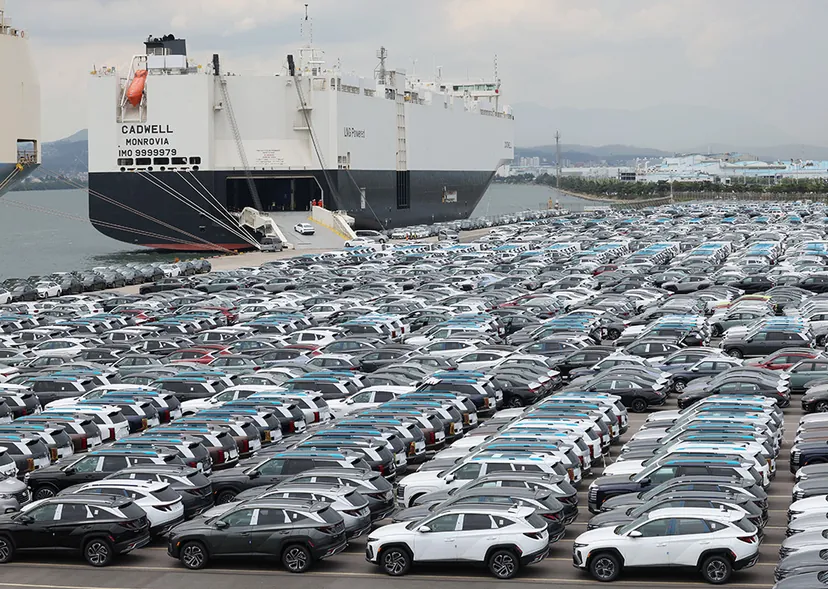
According to the Korea Exchange on the 8th, the domestic stock market was heavily shaken on the 5th due to the aftermath of the U.S. midterm election results. With the "Blue Wave" reality—where the Democratic Party secured control of both the Senate and the House—concerns about stricter AI data center regulations grew, and selling pressure spread centered on large-cap semiconductor stocks like Samsung Electronics and SK Hynix. Consequently, the KOSPI closed at 5383.80, down 5.28% from the previous trading day.
Unlike the overall market and semiconductor stocks that plunged, automotive stocks showed strength on the same day. On the 5th, Hyundai Motor closed at 293,500 won, up 3.53% from the previous trading day, and jumped more than 8% during intraday trading. Kia also finished trading up 5.22% at 100,800 won.
The rebound in automotive stocks appears to be driven by expectations that U.S. trade policy could change. With the Democratic Party taking control of both houses, prospects have grown that the aggressive tariff policies pursued by the Donald Trump administration could be checked. In this process, expectations have formed that the high tariffs imposed on automobiles might also be eased.
The fact that the Democratic Party is relatively friendly toward eco-friendly policies, such as the expansion of electric vehicles, also seems to have been a positive factor. In addition, the influx of bargain hunting due to perceptions that the stocks were oversold following recent significant price adjustments is interpreted as having influenced the rebound.
Hakeem Jeffries, the House Democratic Leader who has had a long-standing confrontational relationship with President Trump, said after winning the midterm elections, "House Democrats have regained control of the U.S. Congress," and "You will have a Congress that knows we work for the American people, not for the President, the Vice President, or the Supreme Court." This suggests an intention to place congressional checks on the policy initiatives of the Trump administration.
Yoo Ji-woong, an analyst at Daol Investment & Securities, assessed that the possibility of easing tariffs under Section 232 of the Trade Expansion Act, which had burdened the valuation of the automotive industry, has increased. He explained that if discussions on tariff repeal gain momentum, the valuation of the automotive sector could rise rapidly. President Trump imposed high tariffs on imported cars based on Section 232 of the Trade Expansion Act, and a 15% tariff is currently applied to Korean-made cars and parts.
Automotive tariffs have been a major variable that has weighed on the performance and stock prices of domestic automakers. Hyundai Motor and Kia, which have a high proportion of sales in the U.S., could expect profitability improvements if the tariff burden is reduced.
However, some analysts argue that it is unlikely that automotive tariffs will be lowered immediately just because of the change in the U.S. congressional landscape. This is because the authority to impose tariffs under Section 232 of the Trade Expansion Act rests with the President, limiting the ability of Congress to reverse the policy through checks alone. In fact, Meritz Securities assessed the possibility of automotive tariff repeal as "limited" for this reason. They also pointed out the possibility that President Trump might instead show an even tougher stance on trade policy to recover his political influence after the midterm elections.
Amid this uncertainty, the rebound in automotive stocks lost steam after just one day. With the KOSPI plunging another 6.02% on the 6th, Hyundai Motor closed at 279,500 won, down 4.77%, giving back a significant portion of the previous day's gains. Kia also finished trading down 0.50% at 100,300 won. However, Kia's decline was limited compared to the overall market.
Meanwhile, the government announced a preemptive response plan as volatility in the domestic financial market increased following the U.S. midterm elections. Lee Hyung-il, First Vice Minister of Economy and Finance, said at the 276th Meeting of Ministers for External Economic Affairs held at the Seoul Government Complex on the 6th, "We will preemptively devise and implement necessary measures in a timely manner to ensure our stock market does not react excessively compared to economic fundamentals."
The government also plans to check the impact of changes in U.S. tariffs, export controls, and industrial support policies on domestic companies. The plan is to stably implement the existing Korea-U.S. trade agreements while strengthening communication with the U.S. administration, Congress, and state governments.