

[BizHanKook] While Hyundai Motor Company is cutting its automotive sector investment plan by 1.8 trillion won this year, it has decided to make an additional capital contribution of 285.2 billion won to its software subsidiary, 42dot. Including this latest contribution, the cumulative planned investment in 42dot announced by Hyundai Motor totals 1.2205 trillion won.
42dot's consolidated revenue last year stood at just 27.7 billion won, while its operating loss reached 349.8 billion won and its net loss hit 363.9 billion won. Its accumulated deficit has also swelled to 922.9 billion won. The amount Hyundai Motor has decided to contribute in this round is more than 10 times greater than 42dot's entire revenue last year.
Nevertheless, Hyundai Motor continues to invest because 42dot is a core organization responsible for the internalization of Software Defined Vehicle (SDV) and autonomous driving technologies within the Hyundai Motor Group. Mass production of next-generation SDVs is scheduled to begin in 2028. This means that while Hyundai Motor is lowering its overall investment scale and sales and profitability targets in response to market uncertainty, it is maintaining investments in core future mobility technologies.
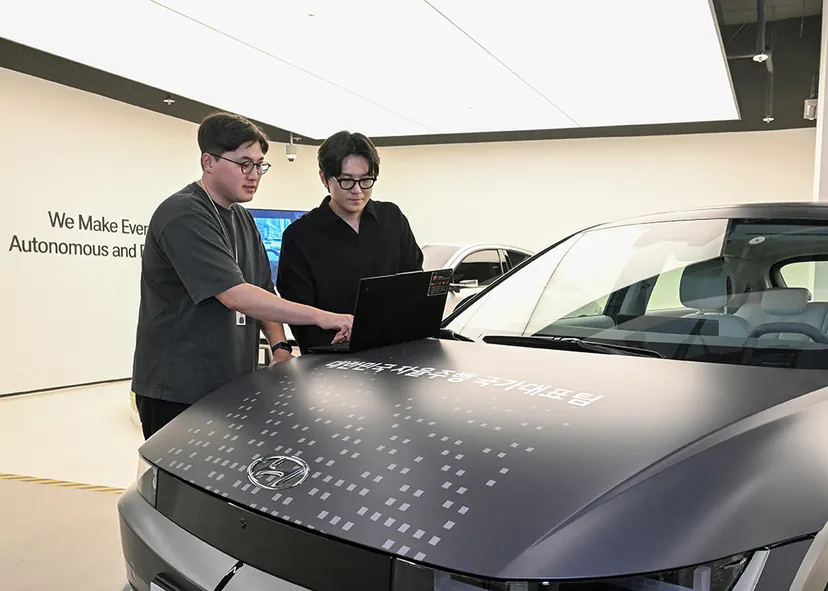
Automotive Investment Cut by 1.8 Trillion Won, Yet 285.2 Billion Won Allocated to 42dot
On the 29th, Hyundai Motor announced that it would participate in 42dot’s shareholder-allotted paid-in capital increase, acquiring an additional 2,210,597 common shares. The investment amount is 285.167 billion won. The new share issuance price is 129,000 won per share, and the funds will be paid in two installments in November of this year and April of next year. Hyundai Motor’s stake in 42dot is 58.95%.
Hyundai Motor stated that it decided to participate in the capital increase to accelerate the group's transition to SDVs and strengthen 42dot’s role as a global software innovation center. The company explained that it intends to utilize 42dot's software and autonomous driving capabilities to establish an SDV framework and internalize related technologies.
Coincidentally, on the same day, Hyundai Motor reduced its automotive sector investment plan for this year. Earlier this year, Hyundai Motor planned to invest a total of 17.8 trillion won, including 7.4 trillion won for research and development (R&D), 9 trillion won for capital expenditure (CAPEX), and 1.4 trillion won for strategic investments. However, in its third-quarter earnings announcement, the company revised its annual automotive investment plan down by 1.8 trillion won to 16 trillion won after re-evaluating investment priorities and execution schedules.
Sales and profitability forecasts were also lowered. The annual wholesale sales target was reduced from 4,158,300 units to 4 million, and the consolidated operating profit margin target was lowered from 6.3–7.3% to 5.5–6.5%. Consolidated revenue for the third quarter was 45.1102 trillion won, a 3.4% decrease compared to the same period last year. This is the first time in approximately six years, since the second quarter of 2020, that Hyundai Motor’s quarterly revenue has declined year-on-year. Accumulated operating profit for the first three quarters of this year also stood at 8.0428 trillion won, a 17.7% decrease compared to the same period last year.
Even with the reduction in the overall investment plan, the capital contribution to 42dot continues. However, it cannot be confirmed from publicly available documents whether this contribution is included in the revised 16 trillion won automotive investment plan.
42dot’s Losses More Than 12 Times Its Revenue
42dot’s financial status is still far from that of a business that generates full-scale profits. Its consolidated revenue in 2025 was approximately 27.7 billion won, a 10.9% increase from 25 billion won the previous year. However, its operating loss was approximately 349.8 billion won, a 98.7% increase from 176.1 billion won the previous year. Its net loss also more than doubled from approximately 175.4 billion won to 363.9 billion won.
This means the speed of cost increases due to R&D, personnel, and infrastructure expansion is much faster than the growth in revenue. At the end of last year, cash and cash equivalents stood at approximately 338.9 billion won, and other current financial assets were approximately 100.6 billion won. Total assets were 766.7 billion won, and total equity was 495.8 billion won.
Last year, 42dot also conducted a 500.3 billion won paid-in capital increase. Hyundai Motor contributed approximately 293.9 billion won, Kia contributed approximately 196 billion won, and the remainder was covered by the then-CEO Song Chang-hyeon. The funds raised were designated for the advancement of SDV technology, Agentic AI, GPU infrastructure investment, and securing global key talent.
Hyundai Motor had previously injected approximately 207.7 billion won into 42dot in 2023 and approximately 157 billion won in 2024 through capital increases. As financial support has continued, 42dot has established itself as Hyundai Motor Group's representative investment target for future technology.
Results Expected After 2028
The reason for the continued investment lies in the role 42dot plays. After acquiring 42dot, an autonomous driving startup, in 2022, Hyundai Motor Group nurtured it into the group’s global software center. Currently, 42dot develops core SDV software, including the vehicle operating system (OS), autonomous driving AI, infotainment, and vehicle data and control systems.
This year, the group recruited Park Min-woo, an expert in autonomous driving technology formerly of Tesla and NVIDIA, as the Head of Hyundai/Kia’s Advanced Vehicle Platform (AVP) Division and CEO of 42dot. The structure involves him leading both the automaker's advanced vehicle development organization and 42dot's software and autonomous driving organization. However, it will take time for the results of the current investment to appear in the figures.
Hyundai Motor Group plans to finish preparing for the mass production of next-generation SDVs by the end of 2027 and begin sales in 2028. It aims for mass production of Level 2+ autonomous vehicles utilizing NVIDIA technology in the first half of 2028, and Level 2++ in the second half of the same year. The goal is to mass-produce Level 2++ vehicles applying ‘Athria AI,’ the autonomous driving AI developed in-house by 42dot, in the second half of 2029. The strategy is to utilize external technology to expedite initial mass production while simultaneously developing its own technology.
Some technologies are already being applied to mass-produced vehicles. The voice AI ‘Gleo AI’ developed by 42dot was first applied to the Hyundai Grandeur released this year, and the vehicle control solution ‘PLeOS Fleet,’ co-developed by Hyundai Motor Group and 42dot, was applied to the Kia PV5.
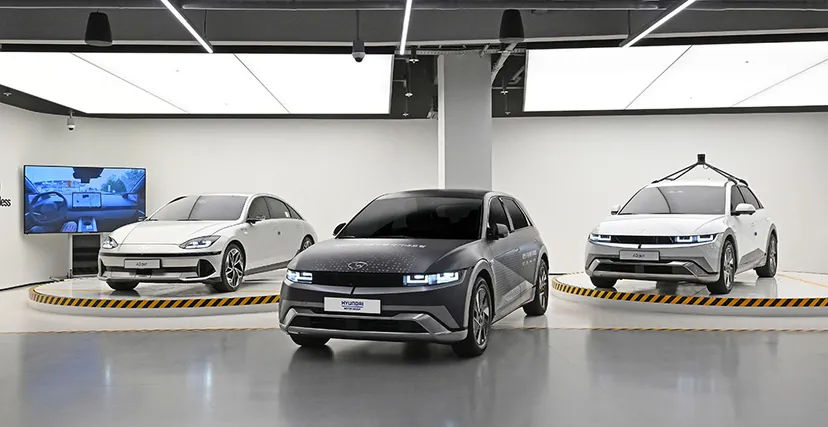
Investing in SDVs Despite Cost-Cutting
The reason Hyundai Motor continues to invest in 42dot despite cutting its overall investment plan is that it views software and autonomous driving technology as the core competitive edge in the future automotive industry. In the 10-year investment plan for 2024–2033 announced in 2024, Hyundai Motor allocated 14.5 trillion won to autonomous driving and E/E (Electrical/Electronic) architecture R&D for the SDV transition, and 7.4 trillion won for strategic investments, including future mobility businesses like 42dot and Motional.
As competition in the automotive industry shifts from hardware such as engines and vehicle bodies to software areas like operating systems, autonomous driving AI, and vehicle data, the strategy is to secure core technologies in-house. The fact that Hyundai Motor Group utilizes NVIDIA technology in the early SDV mass-production process while simultaneously developing 42dot’s autonomous driving AI is part of this same context. The goal is to use external technology in the short term to advance the mass-production timeline while securing core technologies directly in the long term.
The problem is the investment results. While generating 27.7 billion won in revenue last year, 42dot posted an operating loss of 349.8 billion won. Large-scale capital injection is inevitable as it is still in the R&D stage, but if it fails to turn a profit even as application to mass-produced vehicles expands, Hyundai Motor’s burden could continue to grow.
Ultimately, while Hyundai Motor has lowered its investment plans and sales and profitability targets this year due to growing uncertainty in the automotive market, it continues to pour funds into SDV and autonomous driving technologies, which it considers the core of future vehicles.
The full-scale assessment of 42dot’s investment success is expected to come after 2028, when next-generation SDVs go into mass production. Whether the expansion of actual vehicle application leads to increased revenue and improved profitability for 42dot will likely determine the success or failure of the large-scale investments made so far.