

[BizHankook] This week, while Bitcoin and Ethereum were pressured by concerns over the U.S. Federal Reserve’s hawkish stance, altcoins with individual capital inflows dominated the top gainer charts. Hyperliquid, where fee revenue is tied to token buybacks, surged late in the week, and a rotation of funds flowed into meme coins and privacy coins. Rather than a market-wide rally, the week saw buying interest shift toward assets with clear narratives or high price elasticity. Although the Federal Reserve held the benchmark interest rate steady at 3.75–4.00% on October 28, it left the door open for further tightening, which subsequently weighed on major assets like Bitcoin and Ethereum.
According to the global cryptocurrency market tracker CoinMarketCap, Hyperliquid recorded the highest weekly gain of 20.88% in the cryptocurrency market from 6:00 AM on October 23 to 6:00 AM on October 30. Hyperliquid’s current price is 124,835 KRW, and it has risen 15.04% over the last 24 hours, signaling a strengthening short-term upward trend.
Memecore ranked second with a weekly gain of 19.91%. Memecore is currently priced at 1,364 KRW and saw a short-term correction, falling 2.51% over the last 24 hours. Pepe took third place, rising 12.73% over the week. Pepe’s current price is 0.006604 KRW, with a 24-hour change of -1.56%, giving back some of its weekly gains.
Stable ranked fourth with a weekly gain of 5.34%. Stable is currently priced at 35 KRW and fell 2.51% over the last 24 hours. Leo placed fifth, gaining 4.70% over the week. Leo is currently priced at 12,672 KRW and maintained a gentle upward trend with a 24-hour change of 0.14%.
The 6th-ranked Monero rose 4.00% for the week and is trading at 837,596 KRW. The 7th-ranked SPX6900 rose 3.84% over the week to 496 KRW, and 8th-ranked BinanceLife is trading at 693 KRW, up 3.70% for the week. The 9th-ranked Zcash recorded a weekly gain of 3.58% to reach 1,678,425 KRW, and 10th-ranked Just is trading at 189 KRW, up 1.59% over the week.
Hyperliquid: Fueled by Fee-Based Buybacks and Leverage Demand
Hyperliquid is a decentralized trading platform that processes perpetual futures and spot trades on its own Layer 1 on-chain order book. HYPE tokens are used for network staking and fee payments, and a portion of trading fees is used for market buybacks via an assistance fund. The structure where the fund holds the purchased tokens, thereby reducing circulating supply, serves as a foundation for price demand.
While no major service launch was confirmed to explain this week’s surge, the existing buyback structure and an expansion in derivative positions were highlighted. As of October 29, the assistance fund’s HYPE buybacks over the last 30 days were recorded at 62.3 million USD. On the same day, open interest in HYPE perpetual futures increased by 32.19% within 24 hours to reach 2.18 billion USD. The fact that a significant portion of the weekly gains was concentrated in the final 24 hours indicates that not only spot buying but also new leverage positions amplified the price elasticity. However, it should be noted that the purchased volume is held in a fund rather than being burned, so it must be distinguished from permanent supply removal.
Memecore is a Layer 1 blockchain that goes beyond issuing meme tokens by connecting project-specific activities and rewards on-chain. M tokens are used for trading fees, validator staking, governance, and ecosystem rewards. It promotes a “Proof of Meme” structure, where a dedicated reward vault is created upon token issuance, and rewards are distributed to participants based on trading volume and community activity.
However, there were no clear new project announcements during the tracking period to fully explain the weekly gains. While derivative open interest increased alongside the price rebound around October 23, spot trading volume actually decreased, suggesting that the price volatility was driven more by leverage and thin liquidity than by broad-based spot buying. It also carried the nature of a recovery from a previous sharp drop. It fell 2.51% in the last 24 hours, indicating profit-taking and a slowdown in upward momentum after the spike.
Pepe is an Ethereum-based meme token where community recognition and trading supply/demand drive the price more than a separate network or revenue-generating business. This week, increased activity from large wallets and growth in derivative trading—rather than product launches—served as the backdrop for the rise.
Following a significant decrease in exchange-held tokens in mid-October, futures trading volume and open interest both rose on the 28th. However, large wallets moving tokens to exchanges were also observed, indicating a mix of accumulation and sell-side pressure. The trend of a double-digit weekly gain followed by a decline in the last 24 hours can be interpreted as a weakening of short-term buying pressure and the emergence of profit-taking.
From Expanded Trading Support to Meme and Privacy Coin Rotation
The 4th-ranked Stable is a Layer 1 network designed to allow users to pay fees and process settlements in USDT. STABLE tokens do not serve as gas assets for general users but support network security and governance. On October 27, Coinbase began spot trading for STABLE, and the project announced a mainnet 1.9.0 upgrade, aimed at enhancing security and staking stability, for October 31. While expanded trading access and the upgrade schedule helped support the rise, it fell in the last 24 hours, suggesting the post-listing buying momentum did not persist.
The 5th-ranked Leo is a utility token used for fee discounts on trades and deposits/withdrawals within the iFinex and Bitfinex ecosystem. It features a structure where a portion of iFinex-related revenue is used to buy back and burn LEO in the market. No new announcements were confirmed to have driven this week’s price hike. With a 24-hour change of only 0.14%, it appears the price was supported by the consistent burn structure rather than explosive short-term trading like that seen in meme coins.
From 6th to 10th place, it was clear that buying interest had spread to assets with higher volatility rather than those in specific technical fields. Monero and Zcash are privacy coins that conceal transacting parties and amounts, while SPX6900 and BinanceLife are meme tokens influenced more by community, narrative, and trading volume than by real-world services. Just is a decentralized finance (DeFi) protocol that provides lending and stablecoin services on the Tron network. The fact that two meme tokens and two privacy coins appeared in the top 10 indicates a rotation of funds into assets with high short-term price elasticity rather than a sector-wide technical rally.
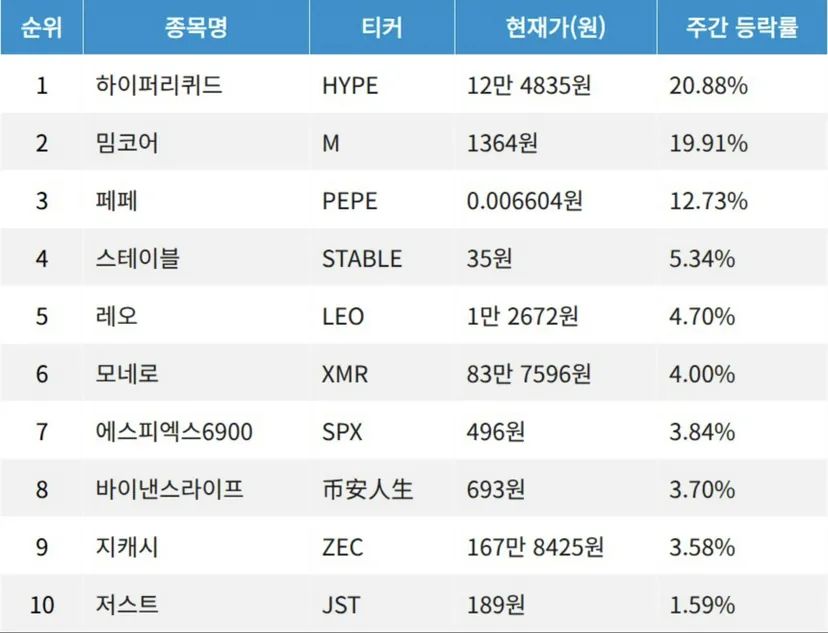
The composition of the top 10 assets shows that this week’s gains were far from a synchronized rally in the cryptocurrency market. Bitcoin and Ethereum showed weakness following the Fed meeting, but Hyperliquid independently expanded its gains through a combination of its token buyback structure and an increase in open interest. Stable had individual catalysts in the form of an exchange listing and an upgrade, while Leo was supported by its burn structure.
Conversely, Memecore, Pepe, SPX6900, and BinanceLife were more heavily influenced by recovery from losses and capital flows from derivatives and large wallets than by business changes. The inclusion of Monero and Zcash in the gainers' list suggests this was closer to selective rotation into specific themes during a market downturn, rather than a broad expansion of risk appetite from large platforms to small and medium-sized altcoins. Given that many assets fell in the last 24 hours after their weekly spikes, it is too early to conclude that a new medium-to-long-term trend has been formed.
※ This article was written by BizHankook and MetaVX's generative AI.