

[비즈한국] The competitive axis of humanoid robots is shifting toward ‘how precisely they can grasp and handle objects.’ For them to create actual economic value in manufacturing and logistics sites rather than just being for demonstrations, the capability of the ‘hand’—the ability to perceive objects and manipulate them by adjusting force—is the key. At the ‘Humanoid Summit Seoul 2026,’ held at COEX in Seoul for two days starting on the 22nd, robot hands, tactile sensors, and hand-motion data collection equipment drew just as much attention from visitors as the completed robots themselves.
‘Perception’ and ‘Manipulation’ Capabilities Take Center Stage
On the global stage, the center of gravity is also shifting toward the hand. At the World Robot Conference (WRC 2026) held in Beijing last month, it was noted that robot hands, which had previously been treated as ‘accessories,’ stood at the center of the stage. Tesla CEO Elon Musk estimated that the hand accounts for about 60% of the challenges in developing the ‘Optimus’ humanoid.
Xu Yongkui, Chief Technology Officer (CTO) of MRDVS, who served as a startup speaker on the opening day, said, “A humanoid robot without vision capabilities is like a ‘blind body’.” He continued, “Even if a robot is no longer restricted in its mobility, it eventually hits a limit in the gap between its ability to walk and its ability to perceive the physical world.” This means that unlike logistics robots that follow fixed paths, humanoids must be able to perceive and handle objects in unstructured environments.
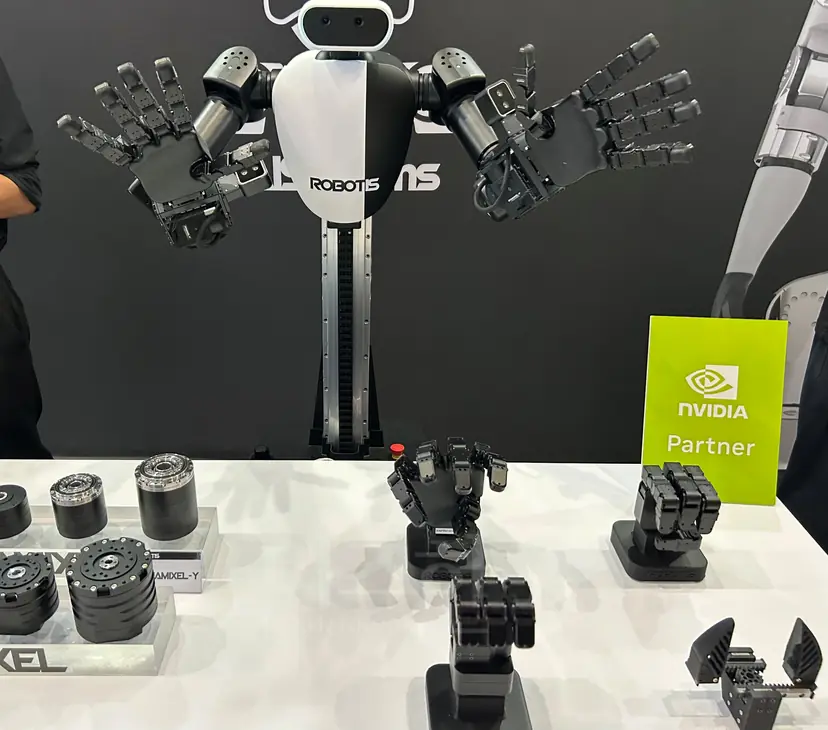
Domestic physical AI company Robotis showcased a range of 2-to-5-finger hand products based on its modular actuators. A Robotis official explained, “A 5-finger hand is advantageous for data learning because it resembles a human hand, but 4-finger and 3-finger hands have lower degrees of freedom, yet are much cheaper and can be miniaturized to the size of a human hand,” adding, “One can choose according to the purpose.”
The technology emphasized by Robotis is ‘backdrivability.’ This is the property where, in addition to the gripping force of the motor, the fingers accept force applied from the outside, allowing them to naturally curl around the shape of an object. The company explained that this helps to grasp objects stably and assists the AI model in recognizing whether the object has been grasped properly.
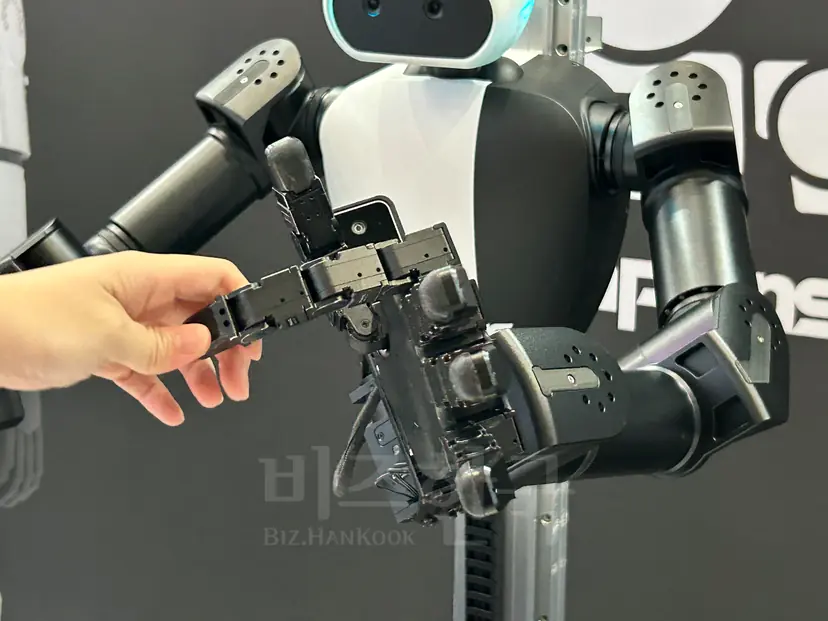
Robot foundation model company RealWorld unveiled a prototype for controlling a 5-finger robot hand. A RealWorld official said, “A 5-finger hand has the characteristic of being able to intuitively apply tasks previously performed by humans without redesigning them,” adding, “It is suitable for securing a wide range of tasks, as the roles of the ring or little finger are often important depending on the task.” They noted that existing gripper-type tools have limitations for high-precision work.
The Bottleneck is ‘Hand Data’
The industry's common concern is ultimately data. Field representatives unanimously pointed to data as the current bottleneck. A Robotis official pointed out, “Ironically, the bottleneck of physical AI lies in AI software and data collection.” Unlike Large Language Models (LLMs), which are overflowing with text-organized data, there is a severe shortage of data regarding which object a robot grasps and with how much force.
This is why leading overseas companies are staking everything on data acquisition. A WhatsLab official said, “Even companies like Figure, which are considered to be making good humanoids, are collecting and purchasing daily life data from the general public via mobile apps,” adding, “In the field of robotics, it hasn't been decided yet what kind of data is the ‘correct answer,’ so we are in the stage of searching for it.”
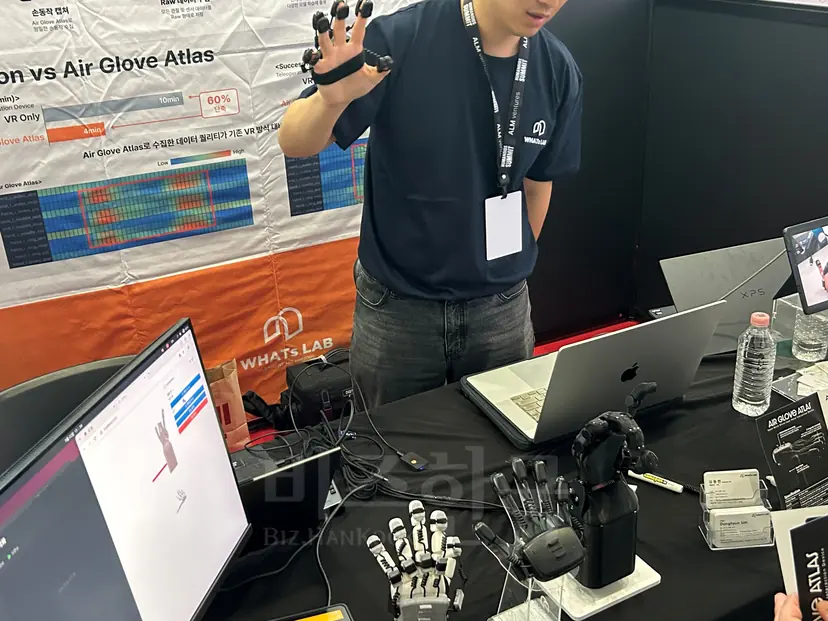
As competition for data heats up, the market for the ‘tools’ to collect it is also opening up. WhatsLab, a startup collaborating strategically with Robotis, has released a glove-type controller for collecting hand-motion data. The method involves a human wearing the glove and moving, which extracts the hand motions as numerical data, which is then used for remote robot control or AI learning.
Shim Dong-hyun, CEO of WhatsLab, argued, “The method used by the leading company Manus of the Netherlands is heavily influenced by surrounding magnetic fields, causing noise even near motors or mobile phones.” He also noted, “Camera-based hand tracking drops significantly in accuracy if hands overlap or are obscured.” WhatsLab claims to have overcome these limitations with Inertial Measurement Unit (IMU) sensors. They also stated that they have developed an algorithm that is automatically applied without the need for data conversion work (retargeting) every time the robot hand shape changes.
The market clock is also moving faster than expected. The industry initially predicted that tactile gloves would emerge in earnest around the end of this year. However, with major companies all exhibiting data-collecting gloves—which capture human hand movements and tactile feedback to transfer to robot hands—at the WRC last month, assessments suggest that the market’s opening has been accelerated.
‘Tactile’ Senses Added, but AI Connection is in its Infancy
However, a gap remains between the technologies touted by companies and their actual level of implementation. Wang Xingxing, CEO of Unitree, predicted that while the robotics industry is approaching a ‘ChatGPT moment,’ it could take 2 to 10 years for robot software that handles unfamiliar real-world environments to progress significantly. This means that for humanoids to ‘start working’ at factories, fingertip technology and the data to support it must be filled in first.
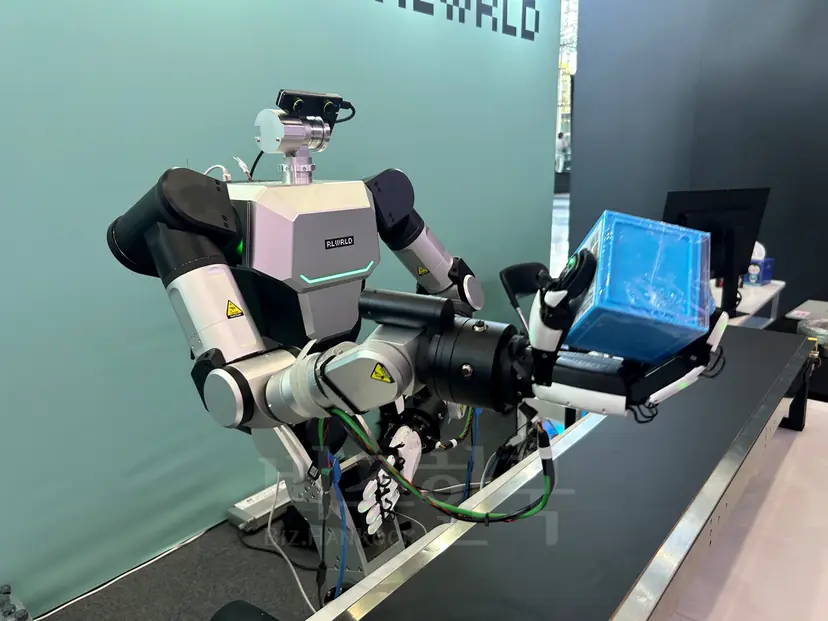
Both Robotis and WhatsLab have either equipped or announced plans to equip tactile sensors that detect fingertip pressure, but the stage where AI utilizes this information for decision-making is just beginning.
A RealWorld official explained, “While many tactile sensors themselves are being developed, research into utilizing them directly in VLA (Vision-Language-Action) models is currently underway,” adding, “We are focusing on efficiently applying tactile information to VLA models.”
There are also tasks regarding data collection methods. Currently, the structure relies on humans directly controlling robots to accumulate data, which reduces work efficiency. A WhatsLab official stated, “Our goal is to allow humanoids to learn from data simply by having people work naturally.”
The government also plans to step in to resolve the data bottleneck. At this event, the Ministry of Science and ICT announced a plan to build a ‘Physical AI Data Library,’ where AI models, robots, and demand companies can collectively accumulate data and use it to further advance models.