

[비즈한국] Homeplus has reopened its doors 22 days after entering temporary suspension. Following a soft opening of 67 stores nationwide on the 7th, the company plans to resume normal operations starting on the 13th. While it has begun normalizing operations by securing 200 billion won in emergency operating funds, it is also drawing attention for simultaneously pursuing the sale of its store properties.
Quiet stores regain life: “Products like ‘Bomeokdae’ to be fully stocked by the 13th”
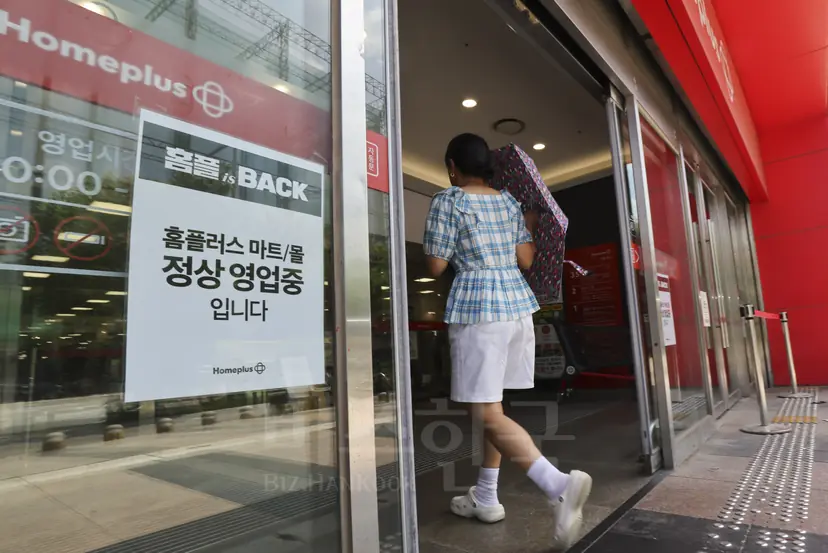
Homeplus stores, which went into temporary suspension on July 13, welcomed customers again after 22 days. At a store in Seoul visited on the morning of the 7th, employees were busy moving new products and organizing shelves. Some customers who arrived early in the morning checked their surroundings after seeing the "Preparing for a new look" sign at the entrance, asking, "Are you really back in business?"
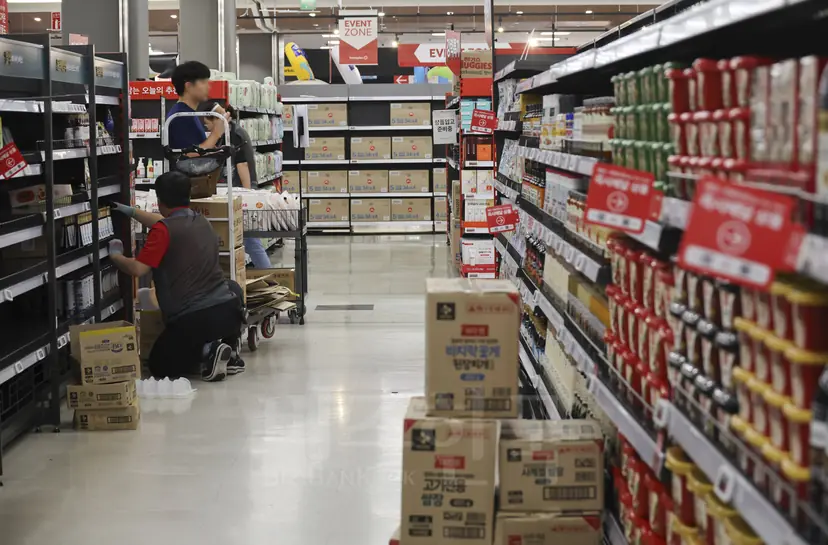
Although operations have resumed, the store interior felt somewhat cluttered as it is currently in a soft-opening phase. Even while the store was open, refrigerated and frozen goods were arriving sequentially. Employees remained busy moving and displaying the newly arrived products.
Product supply has not yet fully normalized, leaving a significant number of shelves—such as those for dairy, alcohol, processed foods, and household goods—empty. The appearance of some shelves being filled with Homeplus private brand (PB) products was not much different from last month, just before the temporary suspension.
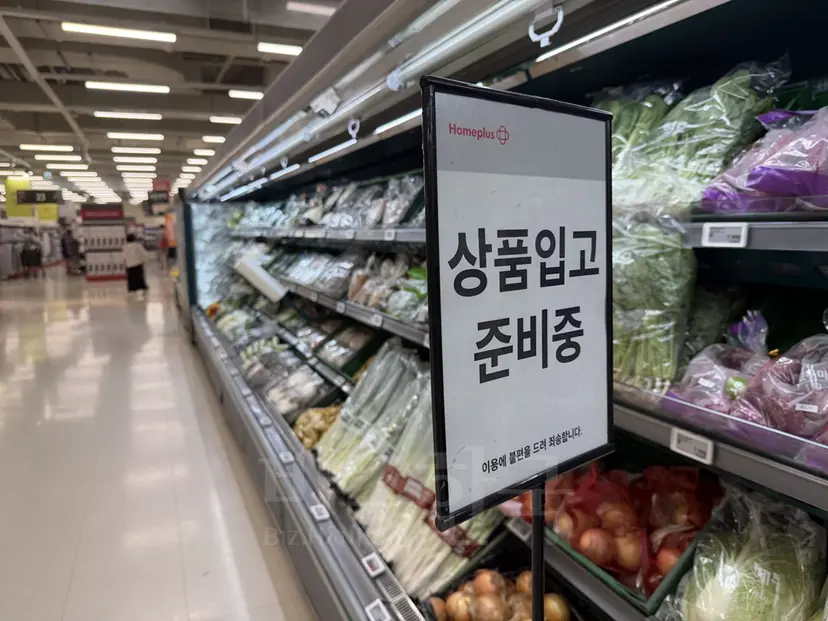
However, fresh food, for which supply had been tight until just before the suspension, began arriving at the stores. Shelves were stocked with vegetables and fruits, and some inventory was also delivered to the egg section. The bakery section featured bread made in-store that day. The seafood section once again displayed fish and shellfish, and about half of the meat section shelves were filled with products. While the volume was not yet sufficient, the resumption of fresh food supplies began to bring a bit of life back to the stores that had been deserted just before the suspension.
One store employee said, "Because we are still in a soft-opening phase, product supply hasn't fully normalized yet," adding, "We have been informed that signature items like 'Bomeokdae' (barley-fed pork) will also be stocked by the 13th when normal operations begin."
A customer who visited the store said, "I was disappointed that the Homeplus I usually frequent was closed, so I came when I heard the news that they were resuming operations," adding, "It's a shame that there aren't many products yet, but since they said they would start normal operations on the 13th, I expect the situation to improve."
Homeplus is accelerating the normalization of store operations after securing 200 billion won in emergency operating funds. On August 5, the Seoul Rehabilitation Court approved DIP (Debtor In Possession) financing—operating funds raised by a company in rehabilitation to continue its business—for Homeplus.
A Homeplus official stated, "The soft opening is a final preparation procedure before the official reopening to check if the overall system is functioning correctly and to address any deficiencies," and added, "Currently, the product stocking rate is about 30%, and we expect to continue receiving deliveries until the 12th. Everything will be perfectly prepared by the official opening date on the 13th."
Store sale procedures initiated alongside operational normalization
Along with the resumption of business, the process of selling stores appears to be in full swing. According to Biz Hankook's investigation, Homeplus submitted an "Application for Approval of Store Sale Notice, Selection Criteria for Highest Bidder, and Bidding Guide" to the Seoul Rehabilitation Court on July 31. This is a procedure to obtain court approval for the sale notice, bidding process, and criteria for selecting the highest bidder.
In the revised rehabilitation plan submitted to the court at the end of June, Homeplus announced its intention to repay public interest claims and rehabilitation claims using the proceeds from store sales and operating profits. There are 37 underperforming stores slated for closure during the rehabilitation period. Homeplus plans to secure liquidity by disposing of sellable store assets among these and using the funds as a source for rehabilitation.
This application for approval is interpreted as a follow-up measure to translate the store sales plan contained in the revised rehabilitation plan into actual bidding procedures. If the court grants approval, it is expected that the process of selecting buyers will begin in earnest following the sales notice and bidding.
The sale of store assets is expected to play a crucial role in securing the financial resources for Homeplus's rehabilitation. This is because the funds secured through the sales are intended to be used for the repayment of public interest and rehabilitation claims. However, experts point out that since it is difficult to generate continuous cash flow through asset sales alone, normalizing the core business—store operations—is ultimately vital for the stable implementation of the rehabilitation plan.
In the industry, the outlook is that how quickly product supply and sales recover after the resumption of operations will determine the feasibility of the Homeplus rehabilitation. Since the deadline for voting on the rehabilitation plan is September 4, it appears that the business performance over the approximately four weeks following the soft opening will influence the outcome of the vote.
Labor unions and political circles have appealed to citizens to support the normalization of Homeplus. The Homeplus branch of the Mart Industry Labor Union and the Democratic Party of Korea's Euljiro Committee held a press conference on the 7th, emphasizing the need for customer patronage and continuous support from the government.
The Homeplus branch of the Mart Industry Labor Union stated, "Just because the lights are back on in the stores does not mean Homeplus has been saved. Complete normalization is only possible if customers return and sales recover," adding, "A single shopping trip will become a force that protects the jobs of workers and partner companies and revives the local economy."