

[비즈한국] With HLB successfully securing US Food and Drug Administration (FDA) approval for its bile duct cancer treatment, lirafugratinib, the focus has now shifted toward commercial viability.
HLB's US subsidiary, Elevar Therapeutics, holds the direct global development and commercialization rights for lirafugratinib. Now that the uncertainty surrounding FDA approval has been largely removed, the key will be how many patients are prescribed the drug in the US and how much actual revenue it can generate.
In particular, since competing drugs already exist, the challenge for lirafugratinib will be to demonstrate clinical differentiation while simultaneously navigating issues such as insurance coverage, sales networks, and patient acquisition.
Global Bile Duct Cancer Treatment Market to Reach 5 Trillion Won by 2034: What Sets it Apart from Existing Treatments?
According to the American Cancer Society (ACS), approximately 8,000 new cases of bile duct cancer are diagnosed in the US each year. This figure includes both intrahepatic and extrahepatic bile duct cancers. As diagnosis is difficult or cases are sometimes classified under other cancers, the actual number of patients may be higher.
The global market for bile duct cancer treatments is also on an upward trend. According to global market research firms Coherent Market Insights and Grand View Research, the global bile duct cancer treatment market is projected to grow from approximately 800 million dollars (109.34 billion won) in 2024 to about 1.8 to 2 billion dollars (2.4601 to 2.7334 trillion won) by 2030.
Since the FDA-approved indication for lirafugratinib is for patients with unresectable locally advanced or metastatic bile duct cancer who have prior treatment experience and have been confirmed to have FGFR2 gene fusion or other rearrangements, it does not target the entire bile duct cancer treatment market.
In the US, drugs such as Incyte's pemigatinib and Taiho Oncology's futibatinib are currently being used for patients with FGFR2 fusion or rearrangement-positive bile duct cancer.
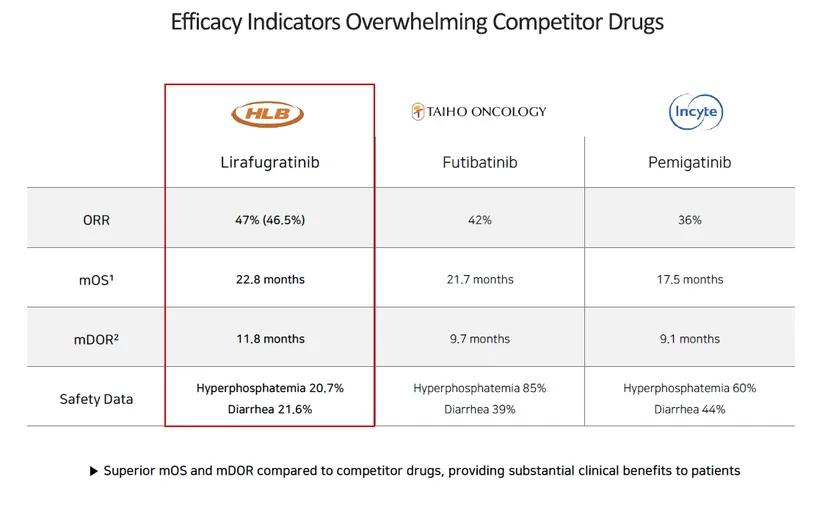
Pemigatinib recorded an ORR of 36%, mOS of 17.5 months, and mDOR of 9.1 months, while futibatinib showed an ORR of 42%, mOS of 21.7 months, and mDOR of 9.7 months. Lirafugratinib recorded an ORR of 46.5%, mOS of 22.8 months, and mDOR of 11.8 months. HLB also presented the incidence of hyperphosphatemia after drug use as 20.7% for lirafugratinib, compared to 85% for futibatinib and 60% for pemigatinib, with diarrhea incidence rates of 21.6%, 39%, and 44%, respectively.
Existing FGFR targeted therapies inhibit not only FGFR2 but also other FGFR subtypes. Pemigatinib inhibits FGFR1, 2, and 3, while futibatinib inhibits FGFR1-4; side effects caused by inhibiting FGFR subtypes other than the target have been cited as a limitation of treatment.
Lirafugratinib was designed to selectively inhibit FGFR2 to reduce these limitations. Preclinical studies showed that it has approximately 250 times higher selectivity for FGFR2 than FGFR1 and about 5,000 times higher than FGFR4.
HLB estimates that if lirafugratinib secures a 20-30% share of the global bile duct cancer treatment market, it could generate annual revenue of 200 to 350 million dollars (273.3 billion to 478.3 billion won) or more.
Will Lirafugratinib Be the First to Utilize the US Sales Network Built for Rivoceranib?
Another significance of lirafugratinib for HLB is the ability to directly attempt commercialization in the US.
HLB had originally been building Elevar's commercial organization with the expectation of direct US sales following the FDA approval of rivoceranib. Elevar has proactively prepared its organization for the US product launch, including hiring executives for sales and market access.
Since the start of this year, the human resources composition of HLB Group's headquarters has also shifted toward focusing on the commercialization stage following research and development.
At the end of last year, HLB Group brought in Kim Tae-han, the first CEO of Samsung Biologics, as Chairman of the Bio Division. Chairman Kim is an individual who led Samsung Biologics from its inception, accumulating experience in orders from global pharmaceutical companies, production facility expansion, and commercialization. As HLB nears the approval and commercialization of rivoceranib and lirafugratinib, they have placed a figure with global bio-business experience in charge of the bio business.

Last May, Yang Eun-young, former Chief Business Officer (CBO) of CHA Bio Group, was recruited as President of HLB Group's Bio Business Development Division. President Yang oversees global technology exports, licensing, joint development, and strategic partnerships for HLB Group’s bio pipeline, as well as global sales partnerships and commercialization strategies required at the commercialization stage.
President Yang also handled business development at Samsung Biologics and is a global BD (business development) expert who holds pharmacist licenses in both Korea and the US. HLB's recruitment of both Chairman Kim Tae-han and President Yang can be seen as a signal that the focus of its major pipelines is shifting from clinical development to post-approval commercialization.
Elevar also appointed Kim Dong-geon, who served as CEO of HLB in January this year and currently holds the concurrent position of CEO of HLB US and Immunomic Therapeutics, as the new CEO. CEO Kim has over 30 years of experience in M&A, corporate finance, and investment in the US and Korea, and set the execution of commercialization strategies after NDA as a primary task upon taking office as Elevar CEO.
As the local US sales infrastructure prepared for rivoceranib is being augmented by global commercialization personnel at the HLB Group level, the focus is now on how the company will sell lirafugratinib in the US and how quickly it can establish its position in the market.
It is also important that Elevar directly holds the global commercialization rights for lirafugratinib. Unlike the structure where domestic pharmaceutical companies receive sales royalties from overseas partners, if Elevar becomes the direct entity for US sales, product revenue can be more directly reflected in the group's performance.
Bile Duct Cancer Is Just the Beginning: Expanding Indications to FGFR2 Solid Tumors
Clinical trials for expanding indications for lirafugratinib are also underway.
Elevar is currently conducting a global Phase 2 clinical trial of lirafugratinib for patients with FGFR2 fusion/rearrangement-positive advanced solid tumors, excluding bile duct cancer. The first patient was dosed at Samsung Medical Center last June, and patient dosing has also begun at the Moffitt Cancer Center in the US. The clinical trial is being conducted in the US, Korea, UK, Spain, France, and other countries.
The strategy is to verify the efficacy of lirafugratinib by selecting patients based on FGFR2 fusion/rearrangement across various cancers such as stomach cancer, pancreatic cancer, and head and neck cancer. In the long term, this can be seen as a process of confirming the possibility of expanding the indication to a "tumor-agnostic" cancer treatment that is used based on specific genetic abnormalities rather than the organ where the cancer originated.
Expansion into Europe is also occurring in parallel. On the 15th, Elevar applied for marketing authorization to the EMA (European Medicines Agency) for lirafugratinib as a second-line treatment for FGFR2 fusion/rearrangement-positive advanced/metastatic bile duct cancer. Following the US, the approval process has now begun in Europe.
Ultimately, the commercial success of lirafugratinib will likely depend not on the FDA approval itself, but on how quickly it can secure a prescription base in the US market, expand sales regions to Europe and beyond, and broaden its indications to other cancers with FGFR2 mutations.