

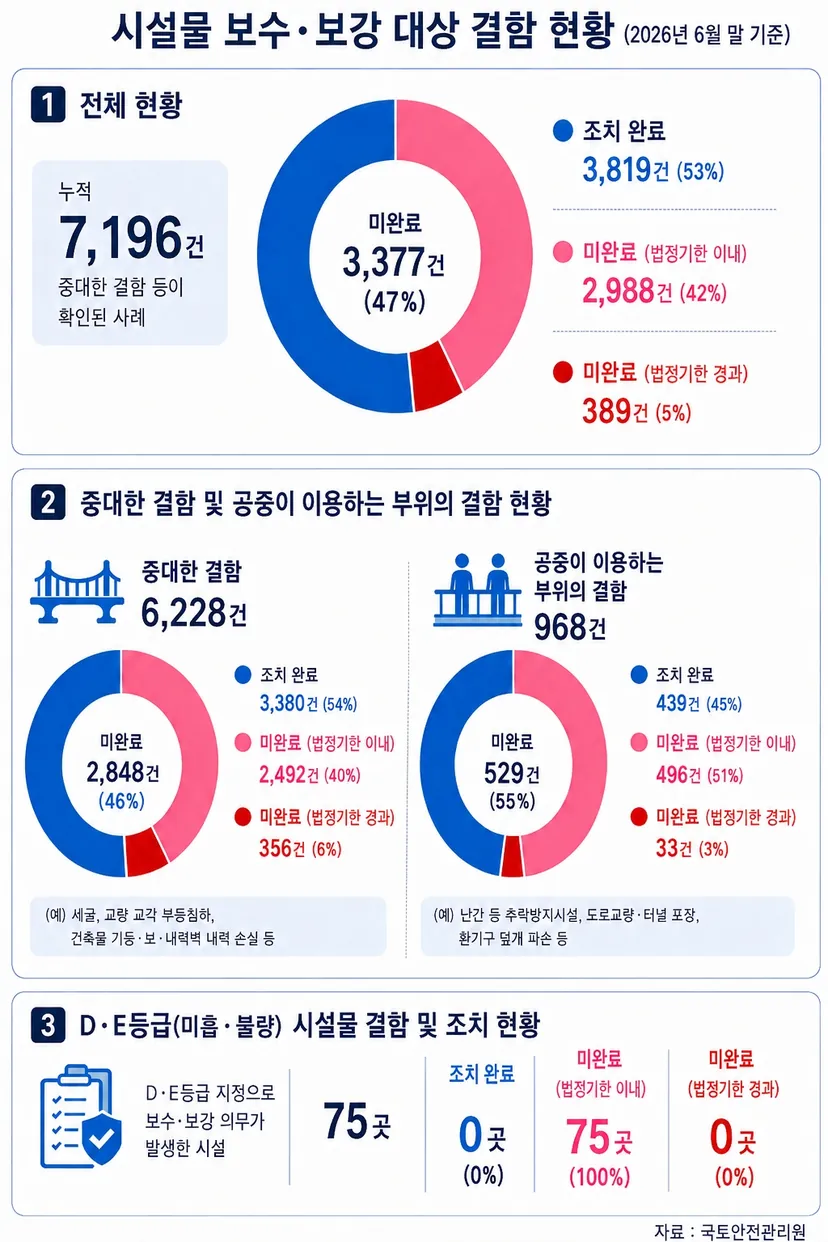
[비즈한국] As a result of Bizhankook’s investigation, it was confirmed that 3,377 cases—nearly half of the instances where defects affecting facility structure or user safety were identified and mandated by law for repair or reinforcement—have yet to be resolved. Notably, 389 of these cases have even exceeded their statutory deadlines. Furthermore, all 75 D and E-grade facilities, which have been subject to new repair and reinforcement obligations since the end of last year, have also failed to complete the required measures.
The Special Act on the Safety Control of Public Structures mandates that entities responsible for facility management must take necessary actions, such as repairs and reinforcements, when safety issues are identified. Typical cases include receiving an administrative order following an emergency safety inspection, or being notified of major defects during routine safety inspections or diagnostic processes. With the amendment of the law at the end of 2024, facilities receiving a D or E grade in precision safety inspections or diagnostics have been included as mandatory subjects for repair and reinforcement since December of last year.
2,848 Cases Affecting Structural Safety and 529 Cases Involving Publicly Accessed Areas Remain Unresolved
According to data provided to Bizhankook by the Korea Authority of Land & Infrastructure Safety, a total of 7,196 cases of major defects and similar issues were identified in facilities as of the end of June this year. Of these, 3,377 cases (47%) have not yet completed repairs or reinforcements. While 2,988 cases (42%) are still within their statutory deadlines, 389 cases (5%) remain unaddressed despite having passed the deadline. These figures represent the number of defects, and multiple defects can occur in a single facility.
A total of 6,228 cases of major defects directly affecting the structural safety of facilities were identified. Of these, 2,848 cases (46%) have not yet completed repairs or reinforcements, and 356 cases (6%) have exceeded their legal deadlines. Major defects include problems that significantly impact the structural integrity of a facility, such as scouring where soil or sand around the base is washed away, differential settlement of bridge piers, and loss of load-bearing capacity in building columns, beams, or load-bearing walls.
There were 968 cases of defects in areas used by the public. 529 cases (55%) have yet to be repaired or reinforced, and 33 cases (3%) have passed their statutory deadlines. Examples include damage to fall-prevention facilities like railings, road bridge or tunnel pavement, and breakage of ventilation covers in areas used by pedestrians or vehicles. The law classifies both the aforementioned major defects and defects in publicly accessed areas as "major defects, etc.," and imposes an obligation for repair and reinforcement on the responsible management entities.
However, failing to complete repairs or reinforcements does not automatically mean a violation of legal obligations. The current enforcement decree requires that necessary measures, such as repairs and reinforcements, be initiated within 2 years from the date of notification of major defects, and completed within 3 years from the initiation date unless there is a special reason. Following the amendment of the enforcement decree last December, the deadline for initiation will be shortened to within 1 year from the notification date, and the completion deadline will be shortened to within 2 years from the initiation date, starting this December.
D and E-Grade Facilities Also Subject to Repair Obligations Since Last Year… All 75 Facilities Incomplete
The scope of facilities subject to repair and reinforcement obligations was expanded following the enforcement of the amended law last December. Facilities designated as D (insufficient) or E (poor) grades in precision safety inspections or diagnostics are now also subject to these mandates. Safety ratings like D and E are the result of evaluating the overall safety status of a facility and are a separate concept from "major defects," which refer to individual flaws. Even facilities with a C (average) grade or higher can still have major defects discovered.
From December of last year, when the new system was implemented, to the end of June this year, there were 75 facilities that became subject to repair and reinforcement obligations due to being assigned a D or E grade. There were 63 facilities with a D grade and 12 with an E grade, all of which had not yet completed repairs or reinforcements. However, all of these are currently within their statutory deadlines, and this number may include facilities that have already begun repair and reinforcement work but have not yet finished.