

[비즈한국] Hanwha Aerospace and Poongsan-Tech have joined forces to develop a "drone killer." While Hanwha and its affiliates already produce a wide range of Counter-UAS weapons—including lasers, autocannons, and missiles—they have now introduced a "Canister-type Interceptor Drone," a drone designed specifically to hunt other drones. If Hanwha secures this drone-hunting capability to complement its existing lineup of lasers, autocannons, and missiles, it will possess a world-class anti-drone solution. Meanwhile, this collaboration allows Hanwha's partner, Poongsan-Tech, to acquire core technologies that other competitors lack, drawing significant industry attention.
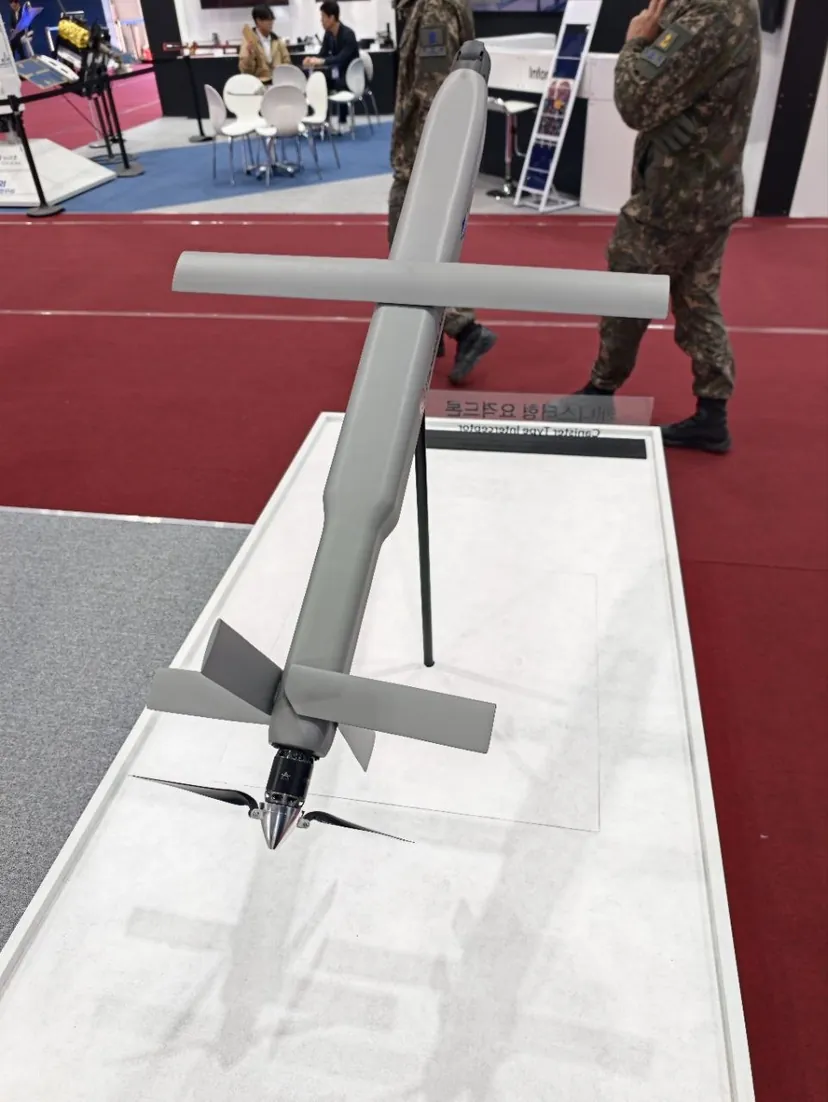
On October 23, 2026, at the Sacheon Airshow and Aerospace & Defense Exhibition (GADEX) held in Sacheon, Gyeongnam, Hanwha Aerospace and Poongsan-Tech unveiled their new joint weapon system. The "Canister-type Interceptor Drone" features a system where the drone is housed within a sealed launch canister, offering significant improvements over existing products.
Among current methods of intercepting drones, "interceptor drones" are gaining attention precisely because they use one drone to shoot down another. They are being highlighted for their ability to destroy enemy drones using a much simpler and more cost-effective structure than expensive, complex missiles. Several types of interceptor drones, such as the "Sting," are already in operational use in the war in Ukraine, and various domestic models, such as Nearthlab's "KAiDEN," are also under development in South Korea.
However, until now, development of interceptor drones has been largely driven by small and medium-sized enterprises (SMEs) or startups, leading to limitations in maturity and performance. In fact, at the "2026 Defense Drone Technology Exhibition" held in Pocheon last month, an interceptor drone developed by a domestic SME failed to hit its target, disappointing onlookers.
The Canister-type Interceptor Drone introduced by Hanwha Aerospace and Poongsan-Tech is judged to be a superior product in terms of maturity and development potential. First, unlike similar weapon systems, it uses a container-based launch method that protects the drone, reducing the risk of shock or mechanical failure compared to manual or external launch systems. Additionally, it utilizes the explosive pressure of gunpowder at the moment of launch, allowing for rapid deployment and providing the initial propulsion required to match the response speed of a missile.
Its flight performance is also noteworthy. Developed through the collaboration between Poongsan-Tech and Hanwha Aerospace, the canister-type drone weighs several tens of kilograms and can fly for several minutes at speeds exceeding 300 km/h, allowing it to intercept enemy drones at a distance of 3 to 5 km. With flight performance that surpasses current models from Ukraine or Korean startups, it is expected to be capable of intercepting not only micro-drones but also faster, high-altitude targets.
Furthermore, while most domestic interceptor drones have been "direct-collision" types without warheads, the model unveiled by Hanwha and Poongsan-Tech is equipped with a warhead and a proximity fuze. With a wider blast radius and greater destructive power, it appears capable of easily intercepting large drones like the Shahed.
Unlike other interceptor drones that typically feature four motors and four rotors, the canister-type drone is stored with its two pairs of tail fins and single main wing folded against the fuselage, which then deploy after launch. This design suggests excellent gliding and flight efficiency, as well as suitability for long-range flight due to the reduced number of engines.
Although the budget, demand, and timeline for the canister-type interceptor drone are not yet finalized, its completion is expected to add new competitiveness to South Korea’s anti-aircraft system exports. It is reported that Hanwha Aerospace intends to mount this drone on its H-SHORAD next-generation anti-aircraft gun and the intelligent multi-purpose 50kW laser armored vehicle currently under development. Both systems are expected to perform well in export markets, particularly in the Middle East. With Saudi Arabia and the UAE having suffered significant damage from Iranian Shahed drones during the recent U.S.-Iran tensions, the canister-type interceptor drone supplied by Hanwha and Poongsan-Tech could bolster existing air defense systems and help mitigate the damage caused by enemy drone attacks.