

[비즈한국] One hundred years ago, two histories surrounding Hangeul began on the same day. On November 4, 1926, the Chosun Language Research Society held the first "Gagya Day" event to commemorate our writing system. On that same day, Songam Park Doo-sung unveiled "Hunmaengjeongeum," a Hangeul braille system he created to allow visually impaired people to read and write in Korean. Both the movement to protect and celebrate Hangeul and the efforts to make it accessible to everyone have reached their 100th year together.
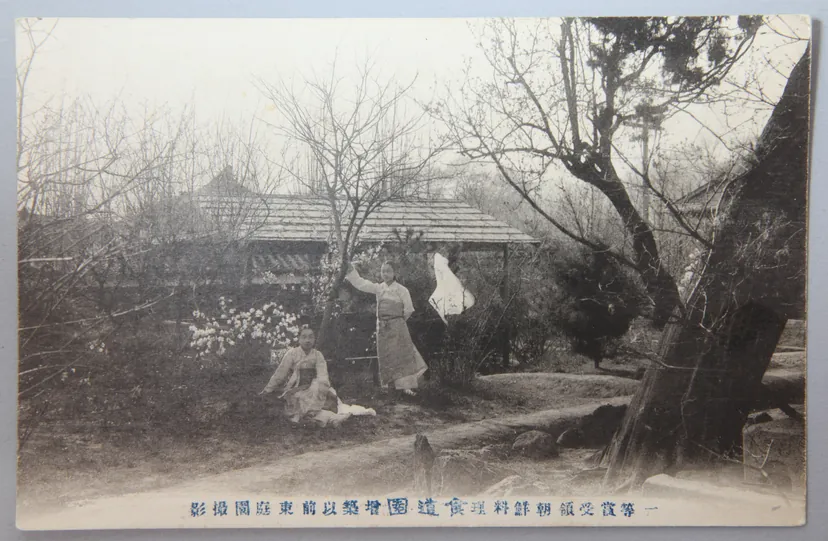
Hangeul Day originated from a commemorative ceremony held by the Chosun Language Research Society on November 4, 1926, at Sikdowon, a restaurant in Jongno, Seoul, to celebrate the 8th sexagenary cycle (480 years) since the publication of "Hunminjeongeum." The original name of Hangeul Day was "Gagya Day," named after the first two syllables of the "Ga-Gya, Geo-Gyeo, Go-Gyo" sequence used to learn Hangeul at the time. The establishment of Gagya Day was part of a movement to protect our language and script during the Japanese colonial period.
The reason the first Gagya Day fell on November 4 lies in the historical interpretation of that time. Based on records in the Annals of the Joseon Dynasty stating that the Hunminjeongeum booklet was completed in the 9th lunar month of 1446, the Chosun Language Research Society designated the 29th day of the 9th lunar month as the day Hangeul was introduced to the world. When converted to the solar calendar in 1926, that date was November 4.
On the same day Gagya Day was established, the Hangeul braille system "Hunmaengjeongeum" for the visually impaired was also introduced to the world. Songam Park Doo-sung, who taught students at the Je-saeng-won School for the Blind, began researching Hangeul braille in 1920 amidst a reality where the visually impaired were forced to use Japanese braille. After forming the Joseon Language Braille Research Committee with his disciples in 1923 and testing various systems, he completed the Hangeul braille system and announced it under the name "Hunmaengjeongeum" on November 4, 1926.
Hunmaengjeongeum uses combinations of six dots to represent consonants and vowels. It was created based on principles of being easy to learn, requiring few dots, and ensuring no confusion between letters. By allowing the initial, medial, and final sounds of Hangeul to be represented in braille, it opened a path for the visually impaired to read and write our language directly.
Hunmaengjeongeum has been refined several times since then to align with changes in Hangeul orthography and braille usage environments. Hangeul braille gained national regulatory status in 1997 when the government announced braille standards, and subsequently, November 4 was designated as "Hangeul Braille Day" under the revised "Braille Act."
Gagya Day also evolved over time. As the term "Hangeul" became widely accepted, the name was changed to Hangeul Day in 1928. The commemorative date also shifted several times until the discovery of the Hunminjeongeum Haeryebon (commentary) in 1940, which confirmed that the book was completed in the first ten days of the 9th lunar month of 1446, establishing the current date of October 9 as Hangeul Day.
This year, as the two 100th anniversaries coincide, exhibitions and events looking back on the history of the past century are taking place in various locations.
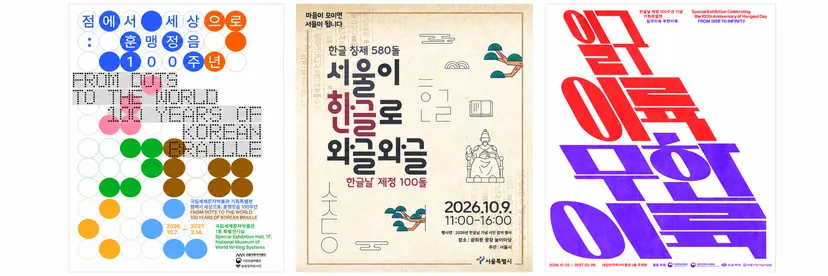
The National Hangeul Museum, the National Museum of Korean Contemporary History, the Hangeul Society, and the King Sejong Memorial Society have been holding the special exhibition "1926-2026: Infinite Hangeul" at the National Museum of Korean Contemporary History since the 2nd. The exhibition covers the birth and transformation of Hangeul Day, starting with the first Gagya Day in 1926, and the stories of the people who have protected Hangeul.
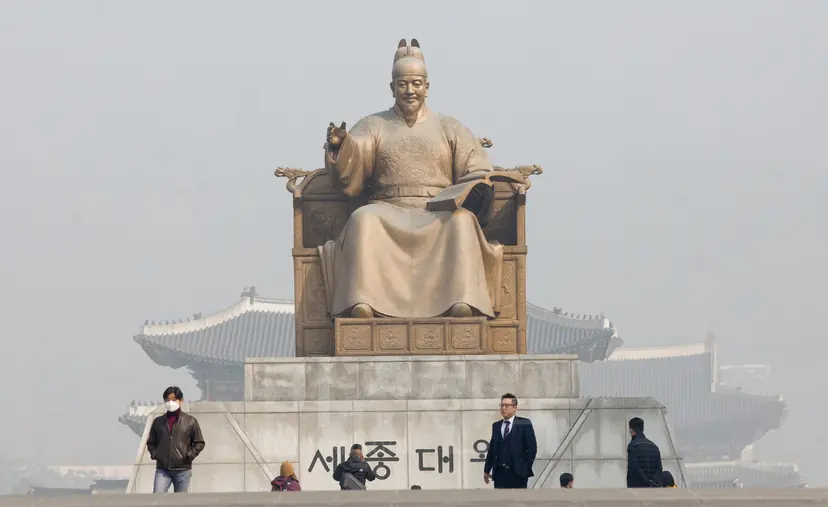
The Seoul Metropolitan Government is also hosting a commemorative event, "Seoul is Abuzz with Hangeul," on the 9th at the plaza in front of the King Sejong statue in Gwanghwamun Square to mark the 100th anniversary of Hangeul Day. The event will feature exhibitions on Hangeul orthography and Hangeul signage, citizen experience programs, and performances of songs in our language.
Events looking back on the 100th anniversary of the publication of Hunmaengjeongeum are also underway. The National Hangeul Museum, the National Museum of World Writing Systems, and the Songam Braille Library opened the special exhibition "From Dots to the World: 100 Years of Hunmaengjeongeum" at the National Museum of World Writing Systems in Incheon on the 7th. It introduces the birth process of Hangeul braille and how it has served as a means of learning and communication for the visually impaired over the past century.
Meanwhile, the financial sector is also marking the 100th anniversary of Hangeul Day. Kiwoom Securities has been selling a special issuance of short-term bills with an annual interest rate of 5.8% since the 8th. The 5.8% rate embodies the meaning of the 580th anniversary of the publication of Hunminjeongeum, while the total sales limit of 10 billion won and the per-person subscription limit of 1 million won symbolize the 100th anniversary of Hangeul Day. The maturity is three months.
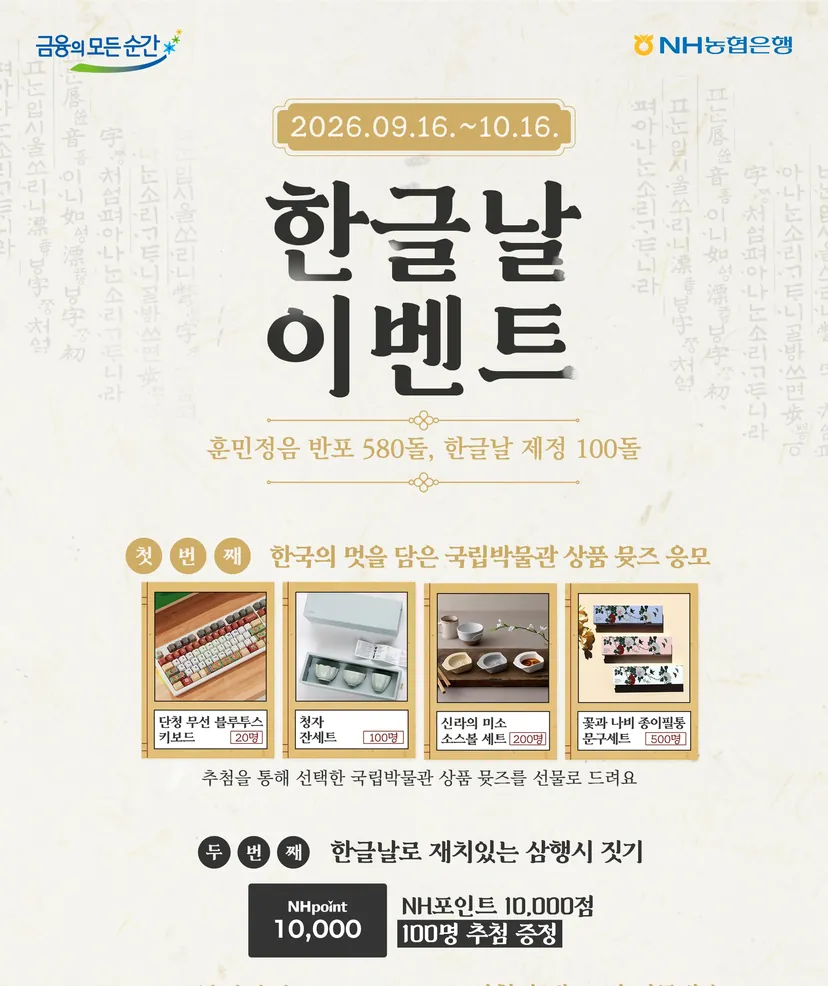
NH Nonghyup Bank is running a 100th-anniversary event on its mobile platform, NH All-One Bank, until the 16th. Customers can participate by applying for the National Museum's "MU:DS" cultural products or by writing a three-line poem on the theme of "Hangeul Day." The bank is providing 820 national museum products, such as dancheong wireless Bluetooth keyboards and celadon cup sets, and will draw 100 people from the poem participants to win 10,000 won in NH points.
Shinhan Securities also released its brand campaign video, "Hangeul, Containing the World," on its official YouTube channel, "Alpha TV," on the 8th. The video starts with everyday expressions—such as the different nuances conveyed by "Ne," "Neb," and "Neng," despite having the same meaning—and introduces how Hangeul has recorded emotions, knowledge, and culture. It also highlights cases where independence activists used Hangeul as a code by swapping consonants and vowels, and the evolution of Hangeul input methods from typewriters to computers and mobile phones. An "Investment Language Mock Exam" event, where users can define investment terminology, is also running until the 14th.