

[비즈한국] “I will find, compare, and even book your flights and hotels.”
I decided to entrust an AI with tasks I usually handle myself. After accessing the service via a temporary invitation link provided by Instinct, I synced it with my iMessage. Instinct introduced itself in English. When I asked, “Let’s talk in Korean,” it immediately switched languages and began responding.

'Instinct,' a personal AI agent developed by Sphere Street Technology, is garnering attention following a successful large-scale funding round. It is a service that performs actual tasks—such as sending emails, finding information, and making reservations—based on instructions given via iMessage or WhatsApp. On the 28th, Instinct raised $1 billion in Series C funding, reaching a valuation of $10 billion (approximately 13.8 trillion KRW). Its market value has quadrupled in just one month from $2.5 billion.
Instinct is currently operating with a limited number of users as it expands its computing resources and service stability. New users must join a waitlist and receive a notification when a spot opens up.
As generative AI evolves beyond merely answering questions into a "personal assistant" capable of carrying out multi-step tasks for users, the question remains: to what extent can Instinct handle work previously done by humans?
Delegating a Business Trip... From Finding Flights and Hotels to Payment
I asked Instinct to help prepare for a business trip to Japan this coming November. When I set the destination as Sapporo, Hokkaido, and noted that the dates were not yet finalized, Instinct replied that it would look for a 5-day, 4-night itinerary in November, considering airfare and travel convenience.
About 10 minutes later, it suggested a round-trip ticket for the 8th–12th at the lowest price of $237. When I asked it to convert this into Korean Won, it applied the exchange rate and calculated it to be approximately 329,000 KRW. Once I confirmed the dates, it compared options from Jin Air and Korean Air, providing departure/arrival times and prices. It didn't just show search results; it offered tailored flight options based on whether I prioritized cost or time spent on the ground.
After selecting the flights, it then looked for accommodations. Since the event venue was not yet decided, it narrowed down candidates near Sapporo Station for convenient access to the airport and city center. Once I chose a hotel, Instinct compared prices between the hotel's official website and booking platforms, and even informed me of the deadline for free cancellation.
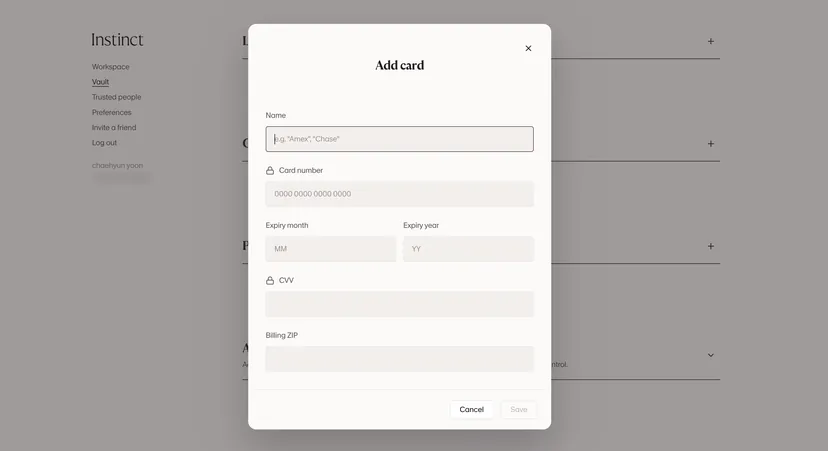
When I requested a reservation after finalizing the flight and hotel, Instinct directed me to a separate page to register a payment card. After saving the card information, it displayed the selected flights, hotel, total payment amount, and cancellation terms, requesting my approval before proceeding with the booking. When the hotel price increased during the process, it halted the reservation instead of paying. It suggested re-checking the price on the hotel’s official website, where free cancellation might still be available.
Failed to Send Messages on My Behalf... Limited Scope of Use
I also tested it with a simple task. Every morning, I organize my work schedule and report it to my company. After drafting the report as usual, I asked Instinct to send it for me.
However, Instinct said it couldn't find the contact and asked for a mobile phone number. It suggested that connecting my Google account would allow it to find it, but after doing so, it replied, "I can find emails and calendars, but the function to search the address book itself is not yet available." It then asked me to provide the phone number directly.
In the end, I entered the phone number myself. Even then, there was a condition that it had to verify if the recipient also used Instinct. When I explained the recipient wasn't a user, Instinct replied, "In this instance, you will have to send it yourself." It explained that currently, it cannot send text messages to non-Instinct users through my own text messaging account.
After connecting my Google account and manually entering the phone number, I ended up sending the message myself. Instinct acknowledged that this was "definitely a shortcoming" and stated it would pass on my feedback to the product team requesting the ability to send user-approved messages even to people who do not use the service.
Kakao and Meta Compete in the Agent Race
The focus of the AI race is shifting toward agents that act on behalf of users. 'Agentic AI'—which grasps user intent and processes necessary tasks across multiple services in succession—is emerging as the next-generation service.
Kakao is restructuring its business around KakaoTalk and AI. Through a planned spin-off next year, the company will split into 'Kakao AI' and 'Kakao X,' with plans to develop KakaoTalk into an "agentic AI interface" that understands user intent and context, centered around Kakao AI. The idea is for users to convey what they want via message, and the AI will search for information, provide recommendations, and handle everything up to purchase and payment.
Kakao outlined this direction during its May earnings call. At the time, Kakao stated it would begin the transition into an "agentic AI platform used by 50 million people" based on KakaoTalk. The vision is to expand beyond an AI that simply answers chats into a platform that connects user requests to actual service usage and transactions.
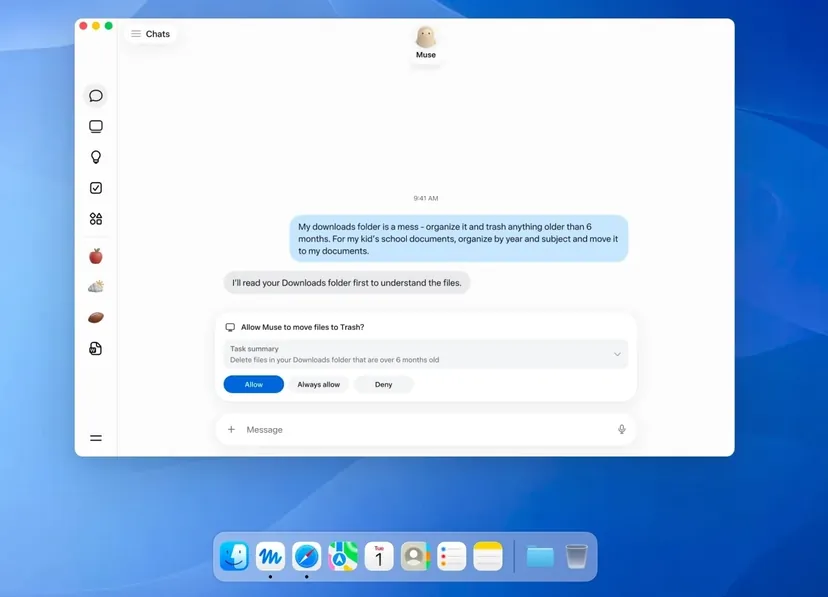
Meta also launched its personal AI agent, 'Muse,' on the 8th. Muse performs tasks such as sending emails, booking travel, and making payments by accessing third-party services linked by the user. Its key feature is that it processes multi-step tasks without requiring the user to issue specific instructions for every action.
The Task of Establishing Privacy Standards
However, as the range of tasks AI can perform on behalf of users grows, privacy and safety issues become increasingly important. Executing actual tasks requires access to the user's personal information and permissions for third-party services. Critics point out that if an AI makes a wrong judgment, the consequences are no longer limited to just a bad answer, but could lead to real-world actions like sending unwanted messages, making reservations, or unauthorized payments.
In fact, Meta previously experimented with having outside contractors handle some of Muse's phone-related tasks instead of AI, but halted the practice. Although it marketed the service as an autonomous AI, the human intervention in some tasks raised concerns that contract workers could access sensitive user personal information. Meta acknowledged this and withdrew the feature.
The government is now moving to establish privacy standards in line with the spread of agentic AI. The Personal Information Protection Commission (PIPC) included the publication of sector-specific guidelines, including those for agentic AI, in its work plan for the second half of this year. On the 23rd, it held a public-private policy council to discuss potential privacy issues and directions for institutional improvement in the AI agent data processing process. The PIPC plans to prepare a 'Guideline for Agentic AI Personal Information Processing (tentative name)' by the end of this year.