

[비즈한국] “That place is right here.”
For more than twenty years, ever since I read the short story collection ‘Fruits Cocktail,’ I would peer into every alleyway whenever I passed by Myeongdong Cathedral in midsummer, looking for a snack bar that sold strawberry bingsu (shaved ice). It was because the final scene of the manga, where Ju-yeong and Mi-ri search for a strawberry bingsu shop in a secluded alley past the cathedral, stayed with me for so long. Although I don’t particularly enjoy sweets or cold food, and I had no way of knowing if it was a space the author invented or one that had long since disappeared, I would vaguely find myself looking for “that place” whenever I was in the neighborhood.
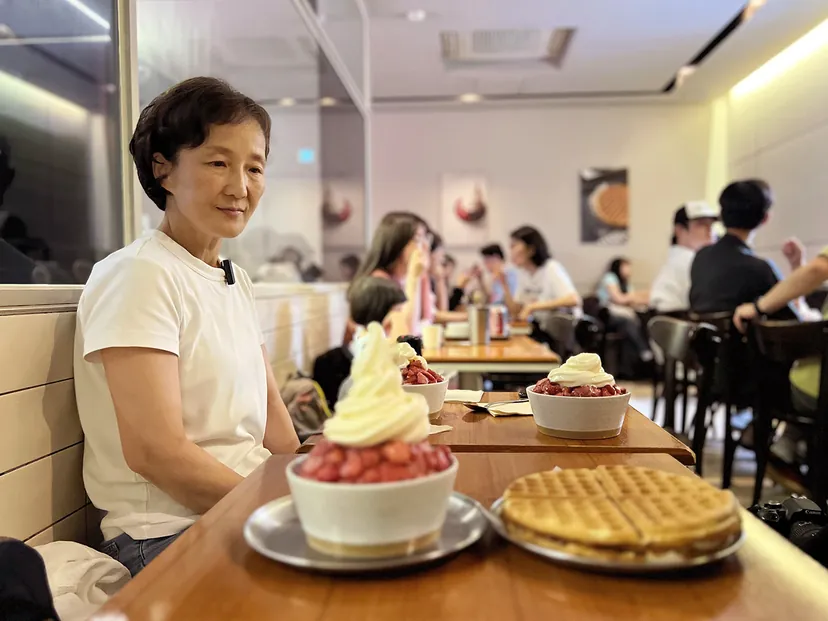
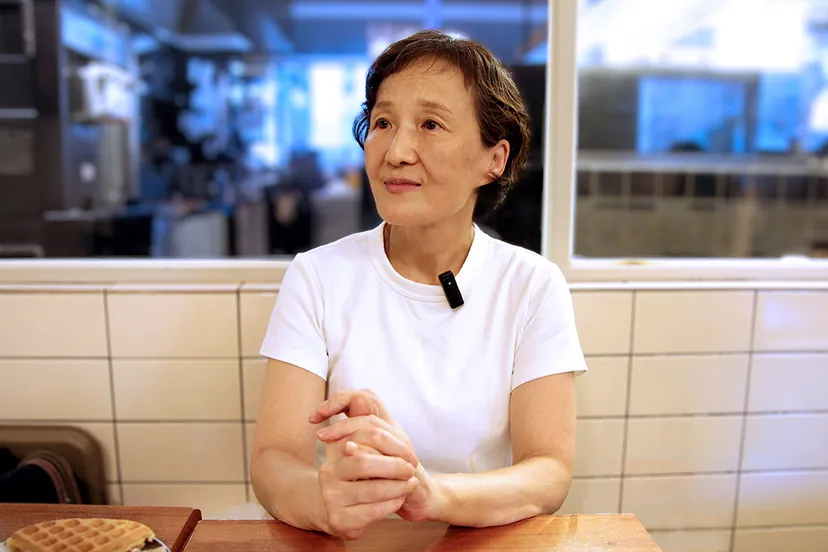
When I met author Han Hye-yeon at a waffle shop near Sookmyung Women’s University, I told her that I could never find that place in the back alley of the cathedral, and asked her if it was a treasure island that never existed, or a treasure ship that had sailed away at some point. Her quiet words, “That place is right here,” made me feel as if this story were one of her own mangas. It felt as if Ju-yeong and Mi-ri would open the door and walk in, wiping away sweat, at any moment. The strawberry bingsu placed in front of us shone like a Christmas tree.
“Another month finished”
The author has a long history with the area around Sookmyung Women’s University. The high school she attended, the place where she would sneak out during evening self-study sessions to read manga, the neighborhood where she once lived on her own, and this waffle shop—which she has frequented since 1990, the year after it opened—are all near the university. Whenever the author, who now resides in Icheon, visits Seoul, this is a neighborhood she never fails to visit, along with Samcheong-dong, which is famous for its sujebi (hand-pulled dough soup) and red bean porridge.
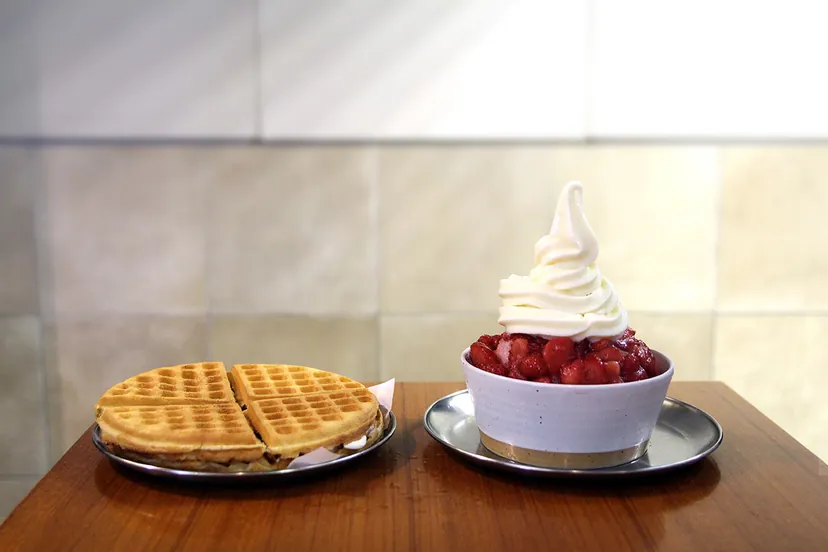
Back when waffles were still unfamiliar, the author first encountered them at this shop. Although there is a much wider variety of waffles on the menu now, the author consistently sticks to the ‘Butter & Jam’ waffle labeled ‘classic.’ These Korean-style waffles, with butter and apple jam spread inside the freshly baked dough, are impressive for their moist texture and flavor.
The strawberry bingsu, which the author considers her top pick, is also a signature menu item. Made with finely shaved ice topped with sugar-preserved strawberries, syrup, condensed milk, and soft-serve ice cream, the bingsu is less sweet and more refreshing than those found elsewhere.
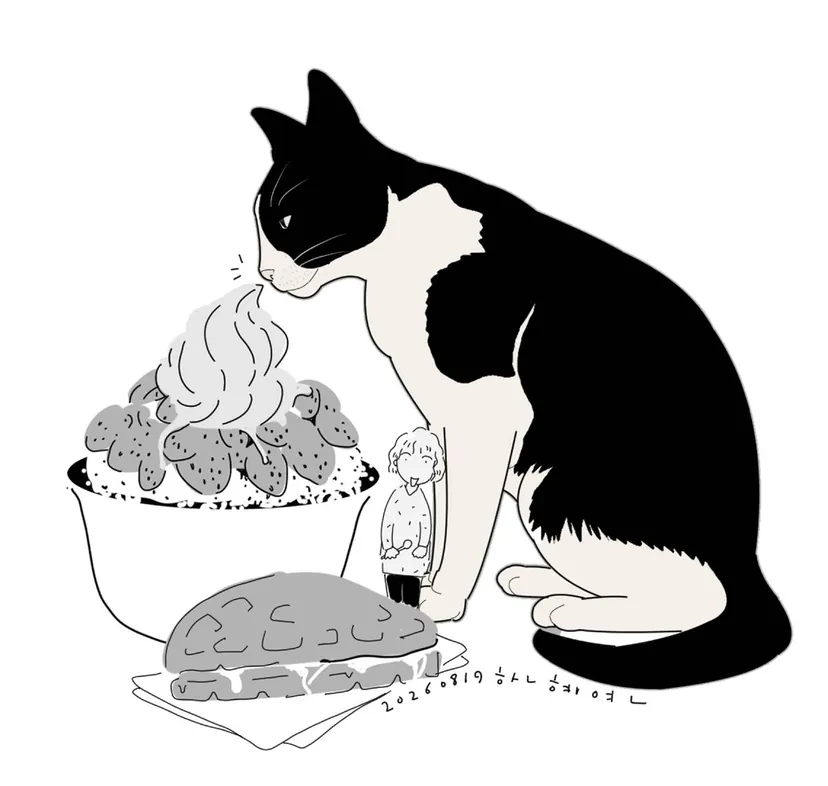
Unlike today, when bingsu is sold year-round, thirty years ago it was only sold in the summer. Though she lived in a small place without a refrigerator, the author, who loved iced coffee, said she would get strawberry bingsu to-go from this shop every time. Each time, the owner would shave ice with a blue Japanese ice shaver and pack the leftover ice separately, and the author would use that ice to make iced coffee to get through the summer.
In the early 2000s, when she was active as a publishing manga artist, she would visit the publishing house to hand over her manuscript—40 pages twice a month, totaling 80 pages—and then come here. She says there were times when she couldn’t come up with a plot and would put it off until two days before the deadline, only to scramble to finish in time; thus, the strawberry bingsu at that time was a celebration of having survived another month.
The strawberry bingsu, a companion to her arduous creative life, has also become a subject of her work. The sense of intimacy she felt when someone she met, who seemed entirely different from her, said they liked the strawberry bingsu at this shop, led to the characters Ju-yeong and Mi-ri from ‘Fruits Cocktail’ mentioned at the beginning.
Imagination rooted in daily life
Although the works Han Hye-yeon has published over the past 30 years are categorized into various genres, they all converge on a single foundation: realism. Describing herself as lacking imagination as an author, she sought materials for her manga by poring over newspapers and investigation notes in libraries. It seems she found the drive to push forward her own thematic consciousness in the “truth stranger than fiction” described by Byron and Mark Twain.
Her short social experience—graduating from an all-girls middle school, high school, and university before becoming an author—was filled by staying up all night listening to the complaints of her friends who had entered the workforce. The author’s exploration of human lives hidden behind structures took place during those nights. Because her works started from things she personally experienced, encountered, and empathized with in everyday life, readers were able to immerse themselves in unfamiliar topics without hesitation. This is precisely why she, currently a professor at Chungkang College of Cultural Industries, encourages her students to begin their creative process from the small things in daily life and their closest relationships.
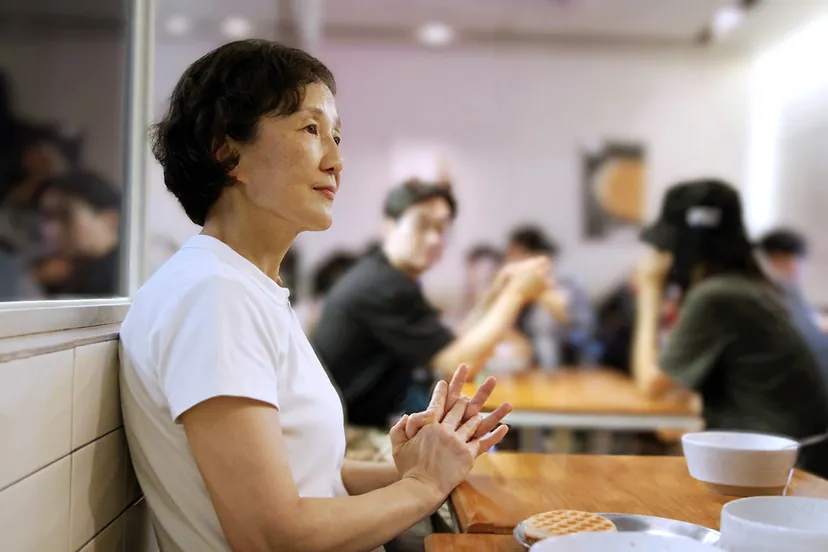
In fact, regarding the short stories in ‘Her Christmas’ and ‘Adults’ Christmas,’ which led to the author being called a “Christmas manga artist,” she stated in another interview that they emerged from the extension of the feeling that she is happiest when eating Christmas cake, lounging with her cats, and reading manga. As such, while Han Hye-yeon does not set out with clearly defined genre rules or goals, she weaves together the emotions she has carefully observed and stored in her memory through various media.
Just a manga artist
The author captured the stories within her grasp to depict the world beyond her reach. Like a certain poem, she sought to see the world in a grain of sand and heaven in a wild flower. Therefore, even though she drew upon subjects close and familiar to her as a woman, labeling her works as “women’s manga,” “feminist manga,” or “gender/queer manga” based only on a few visible characteristics might be a hasty attempt that restricts the possibilities of rich appreciation. In reality, the author says she did not consciously focus on themes or genres while working, nor had she ever received such instructions from publishers. Unlike the public perception that labels her a “representative artist of women’s/feminist manga,” the author herself plainly summarizes her identity as “just a manga artist.”
Of course, her works can be read from a feminist perspective in that her manga deeply observe hidden existences and insufficiently articulated topics, and discuss them as narratives. One could also infer the individuality and orientation of her manga from her intellectual experience studying at Ewha Womans University, the center of feminist discourse, and her experience in amateur manga clubs in the 1980s and 90s, which were free from gender distinctions. There is a need to deeply analyze the meaning left in the gutters (the space between panels) that she leaves behind.
‘Bread-Baking Cat,’ ‘Sehwa, on the Way,’ and what follows
Her recent work, ‘Sehwa, on the Way,’ which was selected for ‘Today’s Our Manga 2024,’ uses temple food as its subject matter. The manga depicts the lives and healing of various people exhausted by the world, centered around the temple’s kitchen. As can be seen in the meticulously described details, the author spent two years studying temple food and Buddhist culture after being proposed the project by a publisher. It is common for most artists to survive on delivery food and neglect their health once they begin a series, but she says she actually took care of her health by cooking a variety of temple food herself while serializing this work.
While preparing her previous work, ‘Bread-Baking Cat,’ she even obtained a baker’s certification, and she has utilized various foods as motifs in her work, including strawberry bingsu. When I asked if she had a special interest in food, she replied, “Food is the best subject for telling stories about daily life.”
As such, in Han Hye-yeon’s works, food is not an end in itself, but a medium for expressing a character’s daily life, playing a role in fully revealing the character’s background and relationships. In the ‘Han-seong Heredity’ episode of ‘Strange Biology,’ men who leave all holiday preparations to women and don’t even let them touch the food are wiped out by poison of unknown origin. Regarding the scenes in the ‘Food Chain’ episode, which was also published in the comic mook ‘BOB,’ the author stated (in the author’s afterword) that she drew them while “thinking about the act of devouring the corpses of other life forms and absorbing the energy they stored while they were alive during the one minute it takes to mix rice.”
When asked about her next project, the author said she is considering a “spicy” mystery subject—which is her specialty—for the first time in a while. She hinted that the subject is Christian eschatology; I am already looking forward to her work, which will be quite different from the “mild-flavored” ‘Sehwa, on the Way,’ which dealt with Buddhist (temple food) themes.
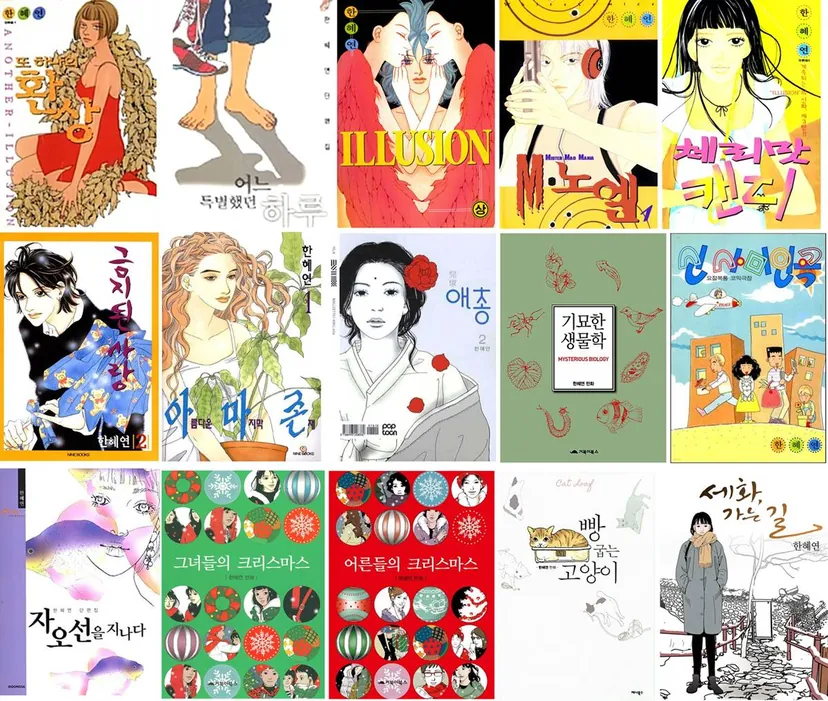
While she deals with unique subjects, such as ‘Strange Biology,’ which makes full use of her biology major, it is characteristic of her to prioritize realistic yet plain depictions of human relationships regardless of the genre or subject matter.
Her works can be broadly divided into “spicy flavors” and “mild flavors.” If ‘Strange Biology’ or ‘Aechong,’ which is based on the Baekbaekgyo cult incident that swept the Japanese colonial period, are representative “spicy flavors,” her Christmas short stories and the webtoon ‘Sehwa, on the Way’ (2023) and ‘Bread-Baking Cat’ can be classified as “mild flavors.”
At the end of the interview, the author mentioned that she recently felt the “ultimate” of manga while reading ‘Ah, I Left My Wallet’ and ‘Chickens Are Surprisingly Great’ by the artist Hyoyeon-ui-miyeok. She said she was impressed that they showed how a message can be clearly delivered to a reader “like telepathy,” even without elaborate drawings or many words, and that they showed that, unlike Kentaro Miura’s ‘Berserk,’ one can clearly communicate through manga without pushing drawings to an extreme level. Perhaps author Han Hye-yeon thought that her own creative style—delivering relationships and emotions through plain drawings, everyday conversations, and without long-winded explanations—resembled those works.
A born serial manga artist who says deadlines make her draw, she has been teaching at the Chungkang College of Cultural Industries’ School of Cartoon & Comics since 2011, passing on her experience and know-how as an artist to students.