

[BizHanKook] There are colorful stars in the sky. Light possesses different wavelengths and colors—red, orange, yellow, green, blue, indigo, and violet—depending on its temperature. Since each star has a different temperature, they shine in these various colors. However, if you look closely, something feels a bit odd. There is one color that definitely exists in the rainbow spectrum but cannot be found in the night sky: green. There are red stars, yellow stars, and blue stars, but green stars simply do not exist. Green is known as a color that cannot exist in the world of stars.
However, an interesting claim that breaks this conventional wisdom was recently announced. It suggests that there are stars that would appear sufficiently green to the human eye. Pink and purple stars are even possible. Why did astronomers previously say that green stars could not exist? And why have green stars suddenly appeared?

First, let’s look at why it is said there are no green stars. The color of a star like the Sun is generally determined by its surface temperature. Lukewarm stars look red or orange, while hotter ones become closer to white and eventually take on a blue hue. This is because stars emit light as nearly ideal black bodies, although they are not perfect.
The spectrum of light emitted by a black body is continuously distributed across a wide range of wavelengths. Although the wavelength that emits the most energy varies according to the temperature, it does not only emit light at that peak wavelength. It also emits light at shorter and longer wavelengths on either side.
In fact, if you plot how much intense energy the Sun emits across different wavelengths, the peak is located near the green wavelength. However, the Sun does not look green. This is because it emits a comparable amount of blue and red light, which have slightly shorter and longer wavelengths than green. Our eyes perceive the result of combining all this light as color. When green, red, and blue are all mixed, the result is not green but white. The three types of cone cells in our eyes perceive these three primary colors, and the brain combines them to create the overall color.
Therefore, when comparing colors as the star's temperature changes, it shifts from red to white—not green—and then to blue. For a star to appear green, it would need to emit no light in the red and blue wavelengths on either side and shine sharply only in the green wavelength. This would be possible if it were in the form of emission lines, where atoms release light. Oxygen molecules are a prime example, emitting only green-wavelength light, which is why we can see green auroras in polar regions. However, this is impossible for blackbody radiation, such as that from a star, which gently and evenly emits light across a broad range of wavelengths. That is what we have believed until now.
If a star's atmosphere strongly absorbs light of specific wavelengths, the story could change. Normally, red, blue, and green light would all mix to appear white, but if the red and blue light were selectively absorbed, the green light could remain. This special combination is possible in situations like white dwarfs—the remnants left after stars like the Sun finish their evolution.
The atmosphere of a white dwarf, subject to intense gravity, becomes extremely dense. In particular, in a sufficiently cooled helium atmosphere, particles are packed tightly, interacting strongly with other elements mixed within. Of course, in ordinary stars, elements in the atmosphere also absorb light at specific wavelengths, leaving dark absorption lines in the spectrum. However, if the absorption lines are relatively narrow, they do not have a major impact on the overall color of the star as seen by the human eye.
However, in some white dwarfs, these absorption lines spread across a wide range of wavelengths. This changes the overall color combination of the starlight, creating a unique hue that cannot be predicted by temperature alone.
This study analyzed the light leaking out of white dwarfs and the light absorbed, connecting these directly to human color perception. Researchers precisely calculated which wavelengths of light would emerge and analyzed how that light would appear to the human eye. Therefore, strictly speaking, they did not photograph an actual star emitting green light; this research simulated how that star would look if viewed up close by human eyes.
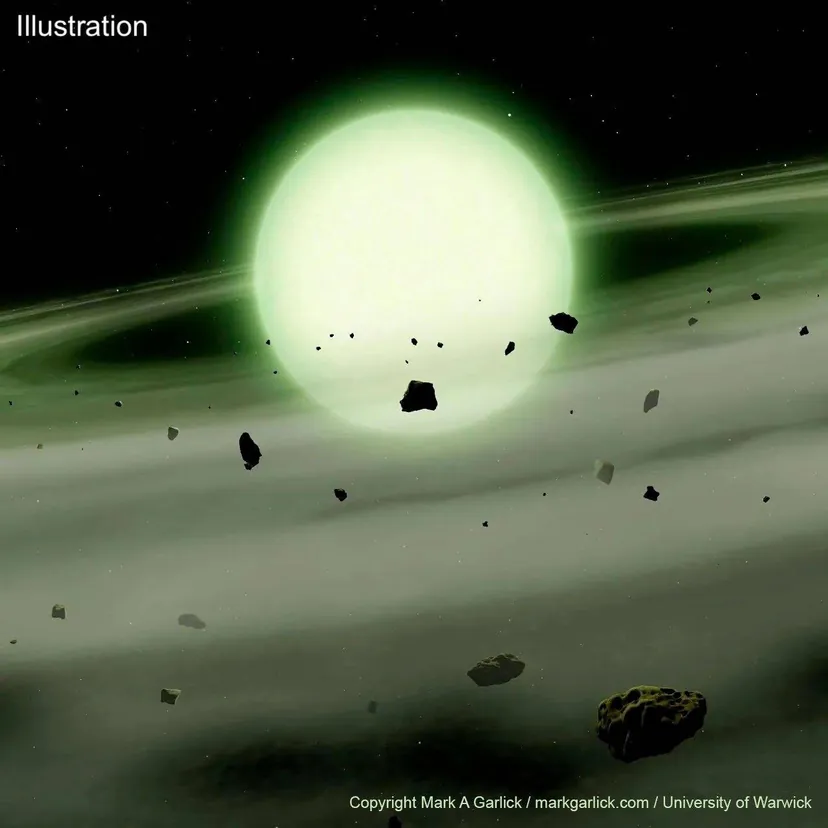
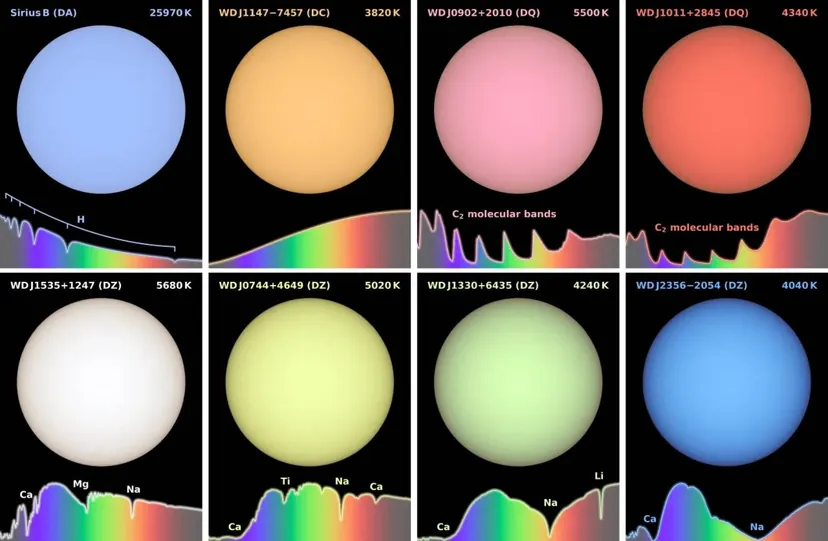
The protagonist is WD J1330+6435. Its effective surface temperature is approximately 4,240K (Kelvin). It is a white dwarf slightly cooler than the Sun. The helium atmosphere of this star is mixed with sodium and potassium. Such heavy elements found in white dwarf atmospheres are generally presumed to be traces left behind as rocky material remaining from surrounding planets was consumed by the star.
Usually, because of strong gravity, these heavy elements sink below the atmosphere. However, if the star is still "scraping up" the asteroid debris left in its vicinity, new material continues to flow in, allowing these heavy elements to remain in large quantities on the star's surface. Sodium typically absorbs yellow light near 589nm. In a dense atmosphere, as it interacts with surrounding particles, the absorption line widens, potentially absorbing strongly into the orange range as well. This is called pressure broadening. Calcium "eats away" at the purple light. As a result, the ratio of colors in the spectrum of this starlight changes, and it appears as a lime green color, similar to a tennis ball. It does not emit 100% pure green light; rather, as the orange and purple colors almost disappear and the remaining light mixes, it appears as a faint green, close to a lime-like hue.
A pink star is also possible in a similar way. In another white dwarf, WD J0902+2010, carbon plays an important role. As convection develops deeply in the helium layer of a cold white dwarf, the carbon that had sunk to the interior can mix and rise to the outer atmosphere. Some of that carbon becomes C₂ (two atoms bonded together) in the high density, and this molecule creates absorption lines spanning a wide wavelength, known as Swan bands. This is also a prominent feature in the spectra of carbon-rich comets. In particular, the high density of a white dwarf's atmosphere changes the position and shape of these absorption bands. As a result, the mixing ratio of the starlight changes, making it appear pale purple or pink.
Furthermore, another white dwarf, WD J1011+2845, may even appear as a deep salmon-pink color because the strong absorption lines of carbon molecules significantly reduce the shorter-wavelength light in the visible spectrum.
As such, the color of starlight varies greatly not only by surface temperature but also by the composition of the surface atmosphere. While the atmosphere of a common, average star is not dense enough for absorption lines to have a significant effect, the impact becomes substantial in extremely dense stars like white dwarfs. Therefore, not only the emitted light but also the "eaten away" absorbed light has a major impact on the overall color scheme. The cocktail color of light created changes completely depending on not just what light comes out, but what light has disappeared.
Surprisingly, white dwarfs are not just simply white. A single star can even have two faces. The most extreme example is the so-called "Janus star," discovered in 2023. This star, shining at 35,000K from 1,300 light-years away, was named after the two-faced god.
The brightness of this star changed very rapidly, and the aspect of its spectrum varied over time. At times, clear hydrogen absorption lines were visible, while at other times, helium absorption lines appeared. This change repeated rapidly in a cycle of just 15 minutes. This is because the atmosphere on the surface of the white dwarf rotates rapidly, alternately showing faces with different characteristics.
Through additional research, astronomers estimate that one side of the star's surface atmosphere is covered by a hydrogen layer thick enough to hide the underlying helium layer, while the other side lacks a hydrogen layer, exposing the helium underneath. Then why did the hydrogen layer become thick on only one side? It is presumed to be due to an asymmetric magnetic field. The magnetic field may have influenced the convection and movement patterns of the material, creating this Janus-like appearance with two distinct, different halves.
As such, the colors of starlight are very complex and diverse. We usually think that the color of starlight is determined solely by its temperature, but more detailed features such as atmospheric composition, density, and magnetic fields also influence its overall color. In this way, the color of starlight allows us to look into the more detailed stories of stars. The reason the universe is beautiful is perhaps because stars are not shining in just a single color, but are shining together in various colors. Even though the universe looks like endless blackness and darkness when viewed in its entirety, within it, stars strive not to forget their own colorfulness. Even in the process of dying after all their nuclear fusion has ended.
Reference
https://academic.oup.com/rasti/article/doi/10.1093/rasti/rzag069/8914458?login=true
Who is the author, Ji Woong-bae? He loves cats and the universe. After watching 'Galaxy Express 999' as a child, he dreamed of spreading the beauty of the universe. He currently serves as an assistant professor in the Division of Liberal Arts at Sejong University, participating in various science communication activities including lectures and writing. He has written books such as "On the Uselessness of Astronomers," "We Are All Born Astronomers," and "Strange Questions That Come to Mind When Looking at the Universe," and translated books including "How I Killed Pluto," "Quantum Life," and "UFO."