

[비즈한국] “Up to 500 million won for a single startup.”
This is the scale of support Google has pledged to early-stage startups. It is not provided in cash. Instead, Google offers credits that can be used to access its AI models and related services, such as Gemini and Gemma. It is a method of covering expenses so that startups, which often lack sufficient revenue and capital, can reduce the burden of AI model usage fees and focus on product development.
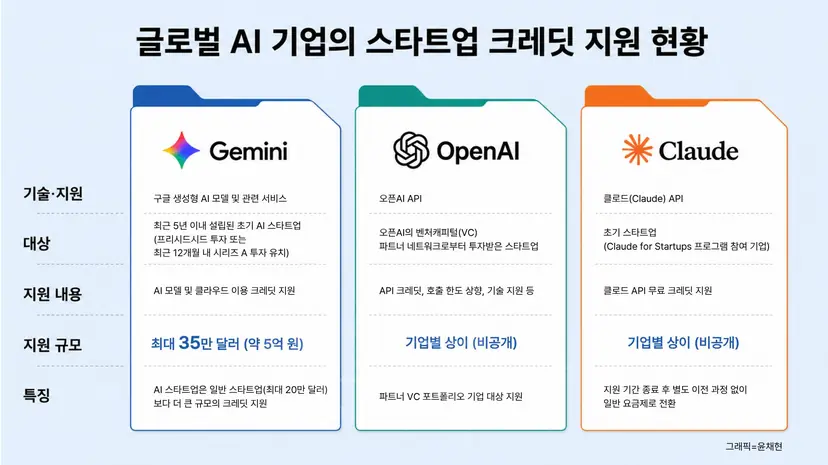
Global AI companies are competing to secure customers by offering hundreds of millions of won in credits and technical support to startups. The strategy is to preemptively secure high-growth companies, as it becomes difficult for early-stage startups to migrate to a different ecosystem once they have built their products based on a specific AI model.
Google, OpenAI, Anthropic… Big Tech Competing to Provide Credits
Google provides up to $350,000 (approximately 500 million won) in credits to startups utilizing its generative AI models. The program is aimed at early-stage AI startups founded within the last five years that have received pre-seed or seed funding, or those that have secured Series A funding within the last 12 months. Companies that use Google's AI technology, such as Gemini, in their main products or services can receive support after a review process.
The scale of support for AI startups is larger than that for general startups. While Google provides up to $200,000 (approximately 300 million won) in credits over two years to general early-stage startups, it offers up to $350,000 to companies with AI as their core business.
OpenAI has built a network of partnerships with venture capital (VC) firms to provide credits to startups funded by them. Microsoft also provides $150,000 (approximately 200 million won) in credits to use OpenAI’s GPT models to companies participating in the ‘Microsoft for Startups’ program.
Anthropic also operates a separate ‘Claude for Startups’ program. When early-stage startups participate, they can receive free Claude API credits. Once the support period ends, they are converted to a standard paid plan without needing a separate migration process.
This support for AI usage fees is also spreading throughout the domestic startup ecosystem. In March, the Korea Startup Forum collaborated with Anthropic to launch a ‘Claude Credit Support Program’ for its member companies. Participating companies are provided with $10,000 (approximately 14 million won) worth of Claude API credits each.
For startups, this allows them to save significantly on AI development costs without needing external investment. For companies building core services around generative AI, API costs account for a large portion of operating expenses because model call frequencies and token usage increase alongside user growth. Free credits serve as a form of development capital that reduces these cost burdens during the initial phase of user acquisition and business validation.
Preempting Future Corporate Customers
Why are big tech AI companies offering hundreds of millions of won in credits? The strategy lies in preempting future corporate customers. When a startup develops a service using a specific AI model's API, the prompt structure, data processing method, and application connection methods are all designed to fit that specific model. As the service scales and the user base grows, the development costs and time required to migrate to a different model increase.
The intention is to lower the cost barrier with free credits to attract developers initially, and then naturally convert them into paid corporate customers as the startup grows. This is the so-called ‘lock-in effect.’ The priority is on securing future AI model usage demand as the company grows, rather than the immediate revenue from a single early-stage firm. This credit-based support method also favors AI companies; unlike cash payouts, these credits can only be used within the company's own AI models and platforms.
The ‘token-maxing’ trend recently emerging in the AI industry illustrates this flow. Token-maxing refers to securing as many AI tokens as possible and actively exhausting them during work and product development. From the perspective of the AI provider, the faster a startup increases its AI usage through free credits, the higher the likelihood of it converting into paid usage later.
Investment and Customers Converging on AI… Increased Concentration
The competition to secure customers among startups is intertwined with the concentration of capital toward AI in the global venture investment market. According to KPMG, global VC investment in the first half of this year reached $560.4 billion (777 trillion won), the highest level in the last five years. In the second quarter alone, $227.4 billion (315 trillion won) was invested, with a significant portion of large-scale deals concentrated on AI companies.
U.S. AI company Anthropic secured $65 billion (90 trillion won), making it the largest investment case of the second quarter. U.S. AI startup Project Prometheus raised $12 billion (16.6 trillion won), and Chinese large language model (LLM) company DeepSeek raised $7.4 billion (10 trillion won). The top 10 global VC transactions in the second quarter alone totaled $105 billion (145 trillion won).
As massive capital flocks to the growth potential of AI companies, competition for customers is intensifying. Industry competition is now expanding beyond model performance to include attracting client companies into their own ecosystems from the initial development stage. This is the reason for the ‘money war,’ where companies are willing to cover hundreds of millions of won in development costs just to secure future demand for AI usage.