

[BizHanKook] There is a poem that has stolen the hearts of many in just three lines. Poet Na Tae-joo’s “Wildflower.” Made up of the lines, “It is pretty when you look at it closely / It is lovely when you look at it for a long time / You are the same,” I wonder if this is not also the perfect description for Gongju, a city with which Na Tae-joo shares a deep connection. While it may not stand out as a major tourist destination, anyone who visits Gongju once feels a sense of comfort and ease. I sought out the late autumn of Gongju, a city that is all the more lovely the closer and longer you look at it.
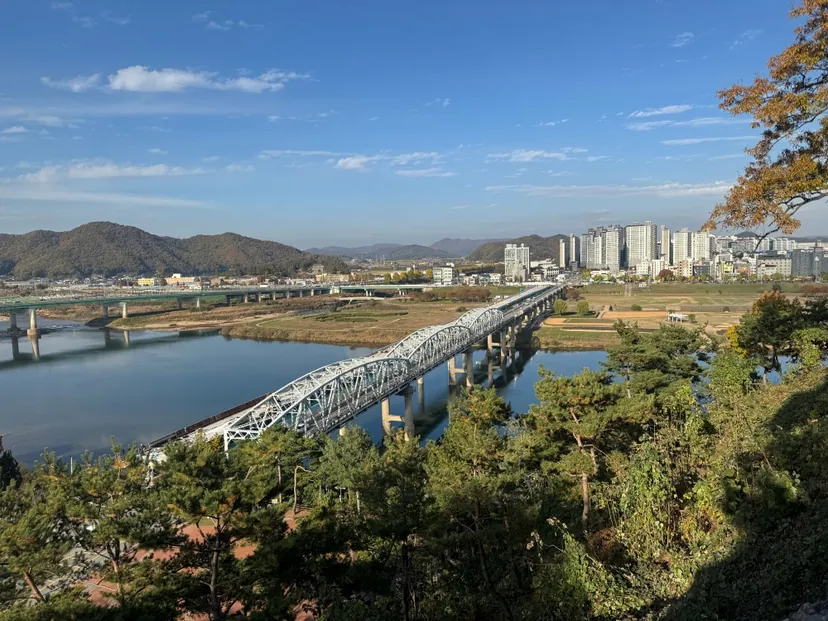
The first place you encounter when visiting Gongju is Gongsanseong Fortress. As a representative fortress of the Baekje era, it is an earthen mountain fortress built along ridges and valleys 110 meters above sea level where the Geumgang River flows. It once served as the royal palace where Baekje kings lived, and it is Gongju's landmark tourist spot where you can enjoy panoramic views of the city and the Geumgang River from the fortress walls. The full course around the fortress, which starts at Geumseoru Pavilion (the main gate) and passes through Ssangsujeong Pavilion, the Royal Palace site, Yeongeunsa Temple, and Gongbukru Pavilion, takes about 2 hours, making it perfect for a leisurely stroll to soak in the fading autumn. The night view of Gongsanseong is also excellent; try viewing it from the Geumgang Sin-gwan Park opposite or while staying at a nearby lodging.
The area around Jemincheon Stream, which flows through downtown Gongju below Gongsanseong, is also a great course for walking. It is lined with charming shops, cafes, and restaurants, including the Gongju Sanseong Market. If you are hungry, start by visiting ‘Buja Tteokjip’ in the Gongju Sanseong Market. It is a place that often has a ‘waiting line’ of people looking to buy popular rice cakes like chestnut mochi made with whole chestnuts (a local specialty), pumpkin seolgi, and mugwort chestnut siru. I recommend popping a chestnut mochi into your mouth and walking along the Jemincheon stream.
There are so many unique cafes that you might experience a moment of ‘choice overload,’ such as the direct-roasting cafe ‘Ajussi Coffee,’ the hanok cafe ‘Lucia’s Garden’ where you can enjoy black tea, milk tea, and scones while admiring a well-manicured garden, the cafe ‘House with a Deep Yard’ which features a spacious courtyard and a gallery, and ‘C’est Marron’ and ‘Chestnut Friends,’ which are packed with menus utilizing Gongju’s chestnut specialty. While cafes are great, for the romantic drinker who believes a trip isn't complete without alcohol, I strongly recommend the traditional liquor bottle shop ‘Chaos.’ It is wonderful to enjoy chestnut highballs paired with perilla oil pasta or gochujang ragu pasta while looking out at the night view of Jemincheon.
And what about the charming little shops hidden everywhere? At ‘Be My Neighbor,’ which sells various small items like cute postcards and cups, as well as liquor and wine brewed in Gongju, it’s hard not to open your wallet. You can receive one postcard if you show a receipt from a store in Gongju or near Jemincheon, so don’t forget to keep your receipts. Opposite is ‘Gaga Bookstore,’ the first neighborhood bookstore in Gongju, which opened in June 2019. It is an unmanned bookstore of about 5 pyeong (approx. 16.5 sqm) where visitors can sit freely at tables and leave their thoughts on Gongju in the provided pens, postcards, and guest book. It is quite fun to read the notes left by previous visitors. You also shouldn't miss the stationery & living accessory shops ‘Danpyunseon’ and ‘Gosari General Store,’ which feature cute chestnut keyrings.
The ‘Na Tae-joo Wildflower Literature House,’ where you can glimpse into the literary world of poet Na Tae-joo, who graduated from Gongju Normal School and taught in Gongju for a long time before retiring as a principal, is also located at the foot of Bonghwangsan Mountain nearby. It is closer to a complex cultural space where you can read, write, experience, and take a break, rather than just a simple literature museum. It is impressive to see how everyone enjoys the space with a relaxed heart, including people huddled together drawing at the wide windows of the special exhibition room. You can take time to enjoy the late autumn of Bonghwangsan Mountain from the ‘Sky Yard’ on the rooftop, and enjoy videos and music flowing from the ‘Wildflower Lounge.’
Outside of downtown Gongju, another place to fully enjoy late autumn is the cafe ‘En Hakore,’ located next to the Bulganggol Reservoir. Run by former oriental boxing champion Hwang Bok-soo, you can witness the sight of red and yellow autumn leaves and bright yellow ginkgo leaves fluttering along with the ripples on the surface of the reservoir deep in the mountains. There are spaces from the 1st to 3rd floors as well as an outdoor space, and because it is dog-friendly, many pet-owning families visit as well.
The last place to introduce is ‘Magoksa Temple,’ founded in 640 during the reign of King Mu of Baekje. Together with Tongdosa in Yangsan, Buseoksa in Yeongju, Bongjeongsa in Andong, Beopjusa in Boeun, Seonamsa in Suncheon, and Daeheungsa in Haenam, it has been designated as a UNESCO World Heritage ‘Sansa, Buddhist Mountain Monasteries in Korea.’ ‘Chun-Magok Chu-Gapsa’ (Spring Magok, Autumn Gapsa: Magoksa in the spring, Gapsa in the autumn...