

[비즈한국] This year has been like a rollercoaster for gold investors. International gold prices neared $5,600 per ounce at the end of January, but fell below $4,000 by the end of June. That is a sharp decline of about 28% in just five months. Prices have since rebounded, reaching the $4,400 range on the 4th, but they are still more than 20% lower than their peak. Investor behavior has tracked these price shifts. Individuals net sold 524 billion won worth of gold in the KRX gold market from May to July. Then, as prices began to rebound in August, they net bought 133 billion won by the 14th. The trend was to sell during the downturn and buy back once the rebound appeared.
The Bank of Korea’s (BOK) movements during the same period also drew attention. At the end of the second quarter, the Bank of Korea's holdings list showed 679,765 new shares of the SPDR Gold Shares (GLD), the world’s largest gold exchange-traded fund (ETF). The valuation at the time was approximately $250 million. This figure reflects the holdings as of the end of the second quarter and is not the exact purchase price. While this signifies that the BOK has resumed gold-related investments since 2013, it should be distinguished from directly purchasing physical gold as part of its foreign exchange reserves. Trying to figure out whether individuals or the central bank correctly predicted the direction of gold prices is not very meaningful. A more important question lies elsewhere: Why does the return on my account differ even though I invested in the same gold?
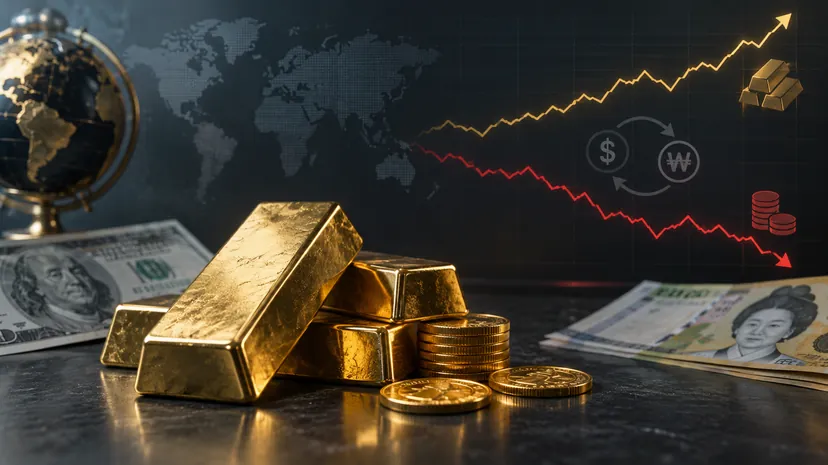
Gold is priced in U.S. dollars in the international market. Consequently, a South Korean investor's won-denominated return is determined by both gold prices and the exchange rate. This effect was most evident last July. International spot gold prices rose slightly in dollar terms over the month. However, the won-dollar exchange rate fell 8.1% from 1,549.4 won at the end of June to 1,424.0 won at the end of July. During the same period, the KRX gold price fell by 5.5%. This means that even if gold prices rise in dollar terms, the won-denominated return for domestic investors can turn negative if the value of the won rises even more sharply.
This is not just an issue specific to the KRX gold market. Even if you buy a U.S. gold ETF traded in dollars, you are subject to the same exchange rate effects if you calculate your eventual profits in won. The same applies to gold bank accounts and domestic gold ETFs that do not hedge against currency fluctuations. Whether a product is domestic or foreign is not what determines exposure to exchange rates; what matters is whether it is currency-hedged.
If you want to reduce the impact of exchange rates, you can choose a currency-hedged ETF, which usually has an 'H' at the end of its name. However, domestic-listed currency-hedged gold ETFs mainly invest in gold futures. Because of this, "rollover costs" can occur during the process of replacing futures contracts, and the return may deviate from the spot gold price in the long term. It is a structure where you trade off the currency risk for other costs.
Investment channels for gold are broadly divided into the KRX gold market, domestic gold ETFs, overseas gold ETFs, gold bank accounts, and gold bars. While gold prices move similarly across these products, the actual profit investors pocket varies.
In the KRX gold market, you can buy and sell gold in 1g increments through securities firms. Individual investors do not pay taxes on capital gains from market transactions, and value-added tax (VAT) is not charged while trading within the market. If your goal is to track gold prices in a general account, this is the most advantageous option in terms of taxes.
However, the situation changes if you withdraw the gold in physical form. A 10% VAT is charged when withdrawing in 100g or 1kg units, and you must also pay delivery and transport fees set by each brokerage. The saying "there is no VAT on KRX gold" only applies when buying and selling within the exchange.
Domestic-listed gold spot ETFs can be traded as easily as stocks and can be held in ISA (Individual Savings Accounts) and pension accounts. The total annual expense ratios for TIGER KRX Gold Spot and ACE KRX Gold Spot are 0.15% and 0.19%, respectively. In a general account, a 15.4% dividend income tax is applied to capital gains and distributions, but holding them in an ISA or pension account allows you to take advantage of tax exemptions, separate taxation, or tax deferral effects. For investors looking to allocate gold over the long term within a pension account, ETFs may be more convenient than direct trading in the KRX gold market.
For overseas gold ETFs like the U.S.-listed GLD, gains and losses are aggregated with other overseas stocks and ETFs, and after a 2.5 million won annual deduction, the remaining capital gains are taxed at 22%. A characteristic of this is that losses incurred from overseas stocks can be offset against gains from gold ETFs. This is suitable for investors who already hold dollar assets or want to allocate assets within an overseas stock account.
Gold bank accounts are convenient because they allow for small-amount trading at banks, but a 15.4% tax is applied to capital gains, and the price spread between buying and selling is relatively large. While accessibility is good, they can be less cost-effective than the KRX gold market.
The cost difference for physical gold bars is even more pronounced. On the 4th, the price for one "don" (3.75g) of pure gold posted by the Korea Gold Exchange was 870,000 won to buy and 730,000 won to sell. If you sell it back to the same place immediately after buying, you lose 140,000 won, or 16.1% of the purchase price. If you calculate that you need the selling price to reach 870,000 won just to break even, you need a 19.2% increase.
The 870,000 won already includes about 79,000 won in VAT. Added to this are gold bar production costs, distribution margins, and trading spreads, which widen the gap between the purchase and selling prices. It is a double-counting error to add VAT again and claim that "the gold price must rise 25% to break even."
This price is the retail listing of one specific company, the Korea Gold Exchange. It does not mean that the physical withdrawal costs for all gold bars, banks, and brokerage firms are the same. Even so, it is clear that if you buy physical gold solely for investment purposes, you start off by shouldering significant costs. Unless you value storage, gifting, or direct ownership, it is difficult to consider gold bars an efficient investment vehicle.
No one can be certain whether gold prices will rise or fall in the future. This is because interest rates, the dollar, inflation, geopolitical risks, and central bank purchases move prices in different directions. A trend like this year, where prices fell 28% from a peak and then rebounded, could happen at any time.
Therefore, instead of buying blindly based on a short-term rally, you should first determine the purpose of holding gold. If you want to track gold prices while minimizing taxes in a general account, the KRX gold market is the place to look; for long-term management in an ISA or pension account, domestic gold spot ETFs are a good starting point. If you want to adjust the balance between stocks and gold within your dollar assets, overseas gold ETFs are convenient. Only when physical ownership is your actual goal is there a reason to bear the costs of gold bars.
You should also avoid buying all at once based solely on exchange rate forecasts. If it is difficult to predict exchange rates, it is more realistic to set a target allocation, buy in installments, and rebalance to your original target when gold prices or exchange rates shift significantly. Even with the same gold, results vary depending on which account and which product you use. While gold price news determines your "paper" return, what determines the money that actually stays in your pocket are exchange rates, taxes, and costs. That is why you should consider the investment method before the gold price forecast.