

[비즈한국] The idea of supplying electricity for artificial intelligence (AI) and semiconductor factories through nuclear power is gaining global attention. The key, however, is time. While electricity demand is growing rapidly, how long does it take for a new nuclear power plant to actually generate power?
According to the "World Nuclear Industry Status Report (WNISR) 2026," released on the 30th of last month, all 16 nuclear reactors that began operations over the past three years exceeded their original construction schedules, taking an average of 10.9 years to complete. Meanwhile, solar power surpassed nuclear power generation for the first time last year. This signifies that we must weigh not just how much we should expand nuclear power, but also whether we can supply electricity at the necessary time.
This report, organized by the French independent energy and nuclear policy research institute "Mycle Schneider Consulting," analyzed the operational status, construction performance, and policy trends of nuclear power plants worldwide. While interest in nuclear power is rising again due to greenhouse gas reduction and increasing power demand, the report diagnoses that the actual growth rate of the industry falls short of expectations. Excluding China, power generation is stagnant, and while new plants are being built, existing ones are aging.
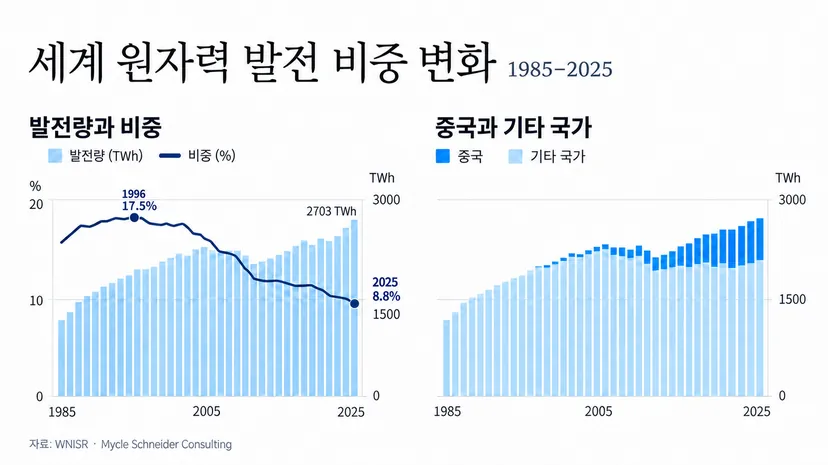
Excluding China, generation is declining, back to mid-1990s levels
In 2025, global nuclear power generation reached 2,703 TWh (terawatt-hours), a 1.1% increase from the previous year. However, the growth was driven by China. While China's nuclear generation grew by 7.6%, the combined generation of all other countries actually fell by 0.2%.
Excluding China, global nuclear power generation remains at the level of the mid-1990s. Compared to the peak in 2006, it is 14% lower, or 369 TWh less in terms of actual volume. In essence, China's rapid expansion of nuclear power is masking the stagnation in other regions.
The share of nuclear power in global electricity production has also declined. In 2025, the share was 8.8%, which is half of the record high of 17.5% in 1996. This is the lowest level in the last 45 years.
Last year, more nuclear plants closed than opened. A total of four units began supplying electricity: two in China, and one each in India and Russia. Conversely, a total of seven units were permanently shut down: three each in Belgium and Russia, and one in Taiwan. It was the first time since 2021 that closures exceeded new operations.
The situation remains similar when looking back over the last 20 years. Between 2006 and 2025, 104 new nuclear units began operating globally, while 106 were closed. More than half of the new units, 53 in total, were built in China. During this period, no nuclear plants were closed in China, meaning that outside of China, there was a net reduction of 55 units. As of July 1, 2026, there are 411 operating nuclear reactors in 31 countries worldwide—27 fewer than the peak of 438 in 2002.
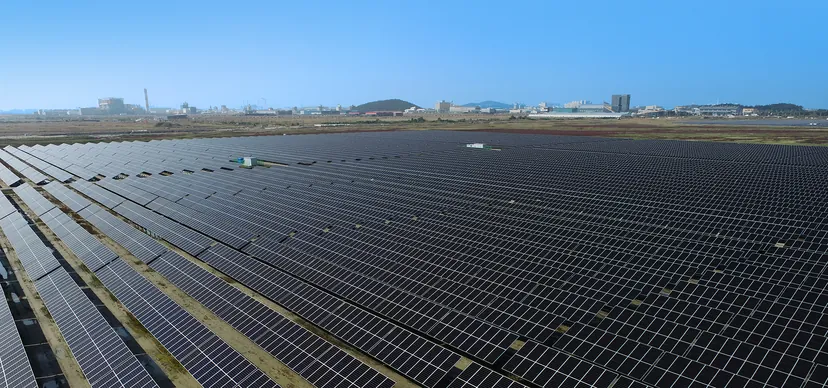
Conversely, solar and wind power have grown rapidly. In 2025, global solar power generation reached 2,783 TWh, an increase of about 30% from the previous year. This is the first time solar power alone has exceeded the total nuclear power generation of 2,703 TWh. If wind power is added, total renewable generation is approximately double that of nuclear power.
In China and India, the combined generation of solar and wind power is more than five times that of nuclear power. Notably, the growth in solar power generation in China last year alone was about 330 TWh, which is about 10 times the increase in nuclear power generation over the same period.
The speed of facility expansion also showed a difference. Last year, global solar capacity increased by 510 GW (gigawatts), and wind power by 159 GW, representing increases of 27% and 14%, respectively. During the same period, the total operating capacity of nuclear power actually decreased by 0.5 GW after accounting for new operations and closures.
Using daytime power at night... Batteries are changing power supply
The weakness of solar and wind power is that generation fluctuates depending on the weather and time of day. A rapidly growing solution to this is the large-scale Battery Energy Storage System (BESS), which charges when electricity production is high and discharges it when needed.
According to the report, about 78% of the large-scale battery facilities installed in global power grids were added within the last three years. Batteries newly connected in 2025 alone have a total output of 104 GW and a storage capacity of 257 GWh (gigawatt-hours). GW refers to the amount of power that can be supplied at once, while GWh refers to the amount of electricity that can be stored.
As battery prices fall and installations increase, cases of using solar power generated during the day after sunset are spreading. In California, USA, solar power covers more than 60–70% of electricity demand during the day, and batteries provide up to 44% of demand in the evening. Texas also increased its grid-connected battery capacity from 5 GW in 2023 to 17 GW by the end of 2025.
These figures alone do not mean that renewable energy and batteries can handle all electricity demand. However, as batteries fill the gap between the time electricity is generated and used, the scope of renewable energy utilization is expanding.
All 16 recently opened nuclear plants faced construction delays... SMRs also require time
One of the obstacles to nuclear expansion is the long construction period. As of July 1, 2026, 73 reactors are under construction in 14 countries globally, but more than half—37 units—are concentrated in China. In the international construction market, the Russian state-owned enterprise Rosatom holds a significant share. Aside from 7 units within Russia, Rosatom is overseeing the construction of 22 units in 9 other countries.
Whether construction ends on schedule is also an issue. All 16 nuclear plants connected to the power grid for the first time in 9 countries between 2023 and 2025 were delayed beyond their original schedules. It took an average of 10.9 years from the time the foundation concrete was poured to the connection to the power grid. Expanding the window to 2016–2025, the average construction time for 63 nuclear plants was 9.5 years.
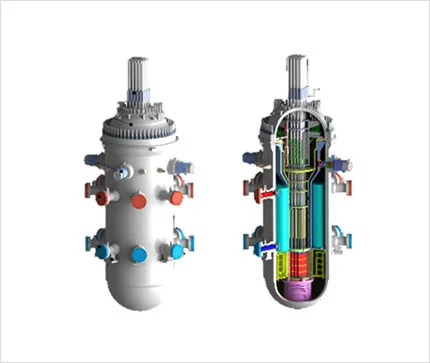
The report also assesses that Small Modular Reactors (SMRs), which are garnering attention as next-generation nuclear power, also need time before they can actually supply power. The report points to the BWRX-300 unit in Darlington, Ontario, Canada, as the first instance in the Western world of entering full-scale commercial reactor construction.
Many models pushed by the U.S., U.K., and others are still in the design certification or business feasibility review stage. The report predicts that commercial mass production and full-scale power supply will be possible, at the earliest, after the mid-2030s. This means government support and corporate development plans do not immediately translate into operational power plants.
While new construction is slow, existing nuclear plants are aging. As of mid-2026, the average operating age of nuclear reactors worldwide is 32.9 years. Of the 411 units in operation, 269 have been running for 31 years or more, and 169 have been running for 41 years or more. Among the 31 nuclear-using countries, 20 have an average reactor age exceeding 30 years.
To keep older plants running, major piping and equipment must be inspected and renovated to meet stricter safety standards. During this process, periods of halted power generation occur. An analysis of the 2021–2025 operational performance of France's 56 reactors showed an average downtime of 18.5 months per reactor, equivalent to about 31% of the five-year period.
Heatwaves and droughts also place a burden on nuclear operations. If river levels drop or water temperatures rise due to their use as coolant, output must be lowered or operations halted. According to the French state-owned utility EDF, as of August 2026, annual power generation losses due to cooling water discharge temperature limits and decreased river flow exceeded 9 TWh. This has already far surpassed the annual climate-related losses of 5.6 TWh originally projected by French power authorities for 2050.
Instances of lowering nuclear output to match the increasing power generation from solar and wind are also rising. The report pointed out that such load-following operations can stress equipment and increase maintenance costs.
Korea, too, must weigh "how much to build" and "when we can use it" together
The question this report poses to Korea is ultimately about the timing of power supply. Korea is pursuing the construction of large-scale nuclear plants and the introduction of SMRs as major measures to secure the electricity needed for AI data centers and the Yongin semiconductor mega-cluster.
However, looking at recent global nuclear construction records, Korea must carefully assess whether new nuclear plants can be operational by the time they are actually needed. Nuclear plants that began operations in the last three years took an average of over 10 years to build, and SMRs also require time for full-scale commercialization. To respond to the peak electricity demand from high-tech industries around the 2030s, counter-measures are needed in case construction or commercialization schedules are delayed.
Continued operation of existing nuclear plants must also be reviewed in terms of both cost and safety. Verification of the cost of continued operation for domestic nuclear plants whose design life ends before 2030, as well as the task of securing sites for high-level radioactive waste disposal facilities, remains.
Power plant construction plans must be established to ensure actual supply when electricity is needed. This is why, along with deciding the role of nuclear power, it is necessary to materialize a schedule that combines renewable energy, storage devices, and power grid expansion.