

[BizHanKook] While Germany's summer this year was hot, it is not much of a concern compared to the winter. Germany's summers are short, and the winters feel exceptionally long. Meteorological winter aside, the days are so short that it gets dark by 4 p.m., and with the frequent overcast and damp weather, it is common to consider six to seven months of the year as winter. In actual rental practices, the heating period (Heizperiode) is often set to a total of seven months, from October 1 to April 30. There are even court precedents ruling that landlords must guarantee heating to maintain indoor temperatures of 20–22 degrees Celsius during this time.
The most common heating unit in Germany is the radiator, referred to as 'Heizung'. While 'Heizung' literally means heating, it has become synonymous with the radiator itself.
Heizung began to spread in earnest throughout German homes in the 1960s and 70s. By the 1970s, it became the standard for new housing, and the central heating penetration rate in West German homes, which stood at just 30% in the late 1960s, climbed to three-quarters by the late 1980s. It has been responsible for keeping Germany warm for about half a century since then.
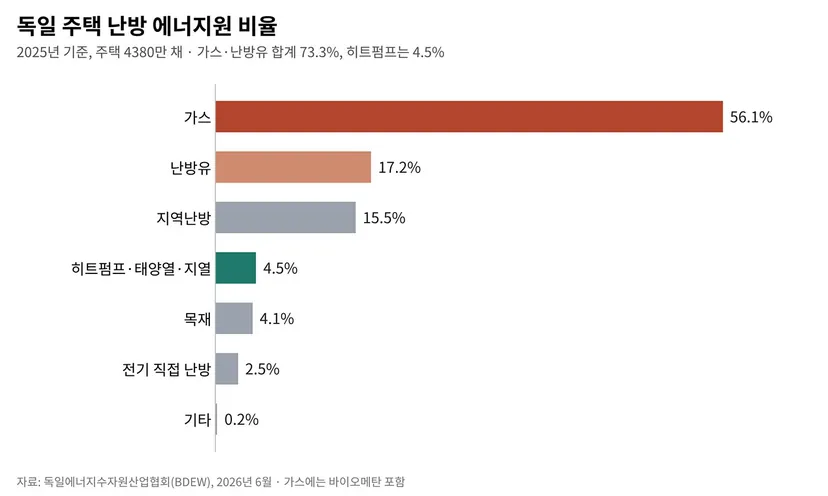
The principle is similar to heating systems in Korea. It involves heating a boiler with gas or oil and sending hot water to metal radiators installed on the walls of each room to warm the air. Recently, many newly built homes are being equipped with underfloor heating, much like in Korea. According to the German Association of Energy and Water Industries (BDEW), houses heated by gas and oil accounted for 73.3% of the total as of last year.
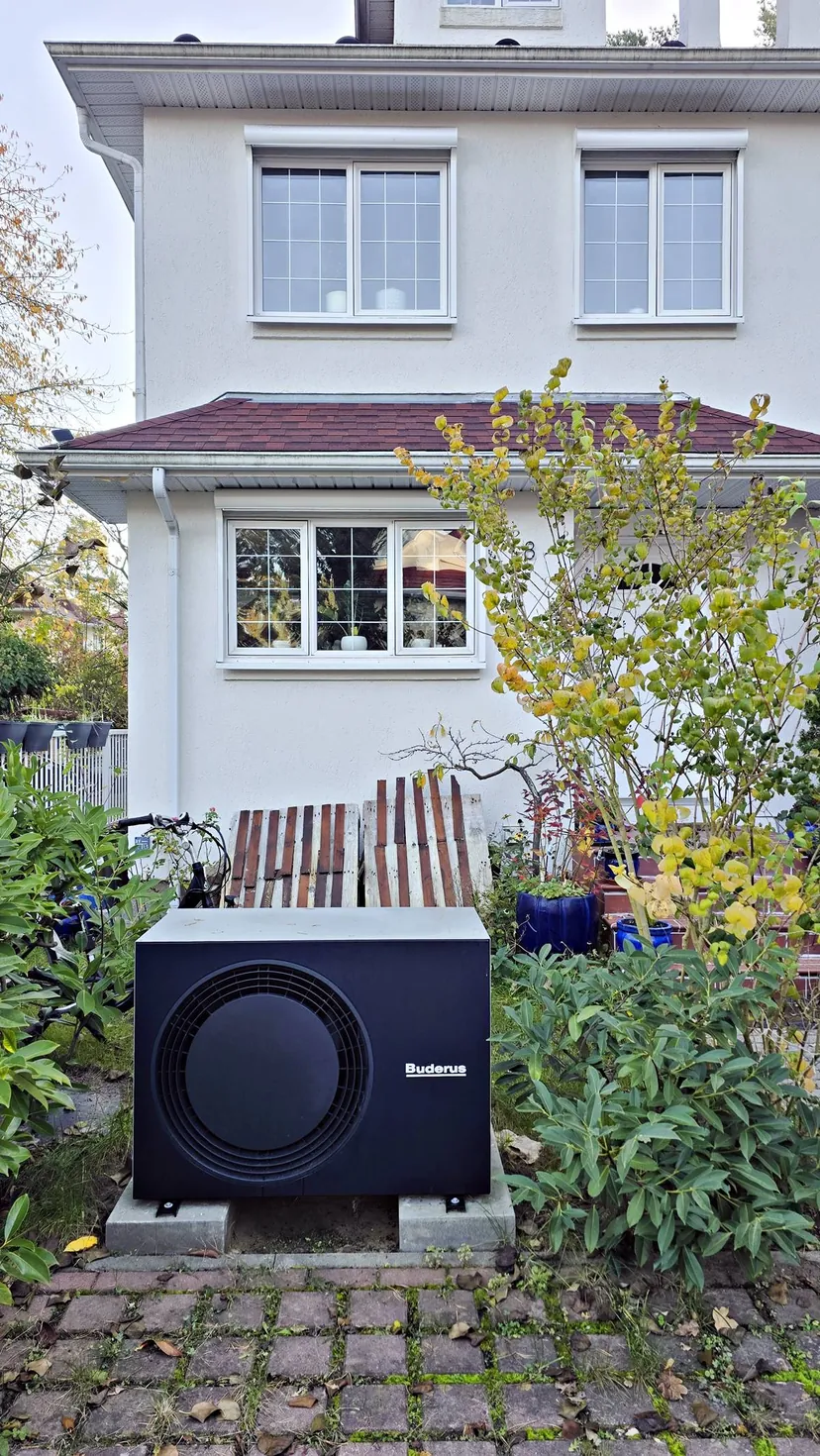
Heat Pumps: 3 to 4 Times More Efficient Than Gas Boilers
As the movement to reduce reliance on fossil fuels intensifies amid the climate crisis, heat pumps have emerged as a viable alternative to oil and gas boilers.
Unlike conventional boilers that generate heat directly from fossil fuels or electricity, a heat pump is an eco-friendly heating device that captures thermal energy from the air and transfers it to where it is needed. It is easy to understand if you think of it as the indoor and outdoor units of an air conditioner swapped. It absorbs subtle heat from the outside air, raises the temperature using a compressor, and supplies it for indoor heating and hot water. Though limited, it can also function similarly to an air conditioner by discharging indoor heat to the outside during the summer.
Even putting the environmental aspect aside, efficiency is a major advantage. While an electric heater creates 1 unit of heat from 1 unit of electricity, and a gas boiler yields about 0.9 units of heat from 1 unit of gas, a heat pump extracts 2 to 3 units of heat from the outside air using 1 unit of electricity, producing a total of 3 to 4 units of heat. In other words, its efficiency reaches 300–400%.
Christoph Schill, a neighbor who installed a heat pump two months ago, said, "I installed a heat pump because my old gas boiler was due for replacement, and I was told it offers higher energy efficiency and can even reduce costs. I'll have to wait until the heart of winter to see, but so far, I'm satisfied."
Sales Rise Despite Removal of Mandatory Requirements
Subsidies first ignited the German heat pump market. In 2019, the Merkel administration released a climate protection package and, in December of that same year, enshrined the 2050 carbon neutrality goal into law. Starting in January 2020, up to 45% of installation costs were subsidized if citizens replaced old oil boilers with renewable energy heating systems like heat pumps. From the following year, the government began putting a national carbon price on fossil fuels used for heating and transportation.
The real trigger was the 2022 gas crisis. As gas prices skyrocketed due to Russia’s invasion of Ukraine, heat pump sales that year increased by 53% compared to the previous year.
The political battle over the Heating Law (Heizungsgesetz) also had an impact. In 2023, the so-called "Traffic Light Coalition" (SPD, Greens, and FDP) led by Chancellor Olaf Scholz amended the Building Energy Act. The regulation stated that 65% of the heat in newly installed heating systems must come from renewable energy starting in 2024. In effect, this made heat pumps mandatory. However, there was intense backlash, with people asking, "Is the government going to decide which boiler goes in my house?" This became a major point of conflict that rocked the coalition government.
Amidst the controversy, demand surged as people rushed to install units before the law took effect, pushing 2023 sales to a record high of 356,000 units. However, sales were halved to 193,000 units the following year as more landlords delayed decisions due to uncertainty.
The coalition government of Chancellor Friedrich Merz’s CDU/CSU and the SPD, which took office in May 2025, scrapped this regulation. As the new "Building Modernization Act" (GModG) was promulgated and enacted in July of this year, the 65% mandate disappeared. Landlords are now free to choose the heating system they want, including gas and oil boilers.
Did heat pump sales drop now that the mandate is gone? In the first half of this year, 195,000 heat pumps were sold in Germany, a 40% increase from a year ago. Based on first-half figures, this is the highest after 2023. Last year, heat pumps officially overtook gas boilers for the first time as the best-selling heating system in Germany, with sales reaching 299,000 units, accounting for 48% of the total.
The heat pump craze appears set to continue for a while. This is because international gas prices are rising again due to factors such as the prolonged war in Iran.
Even at the beginning of this year, German household gas prices were at their lowest level since the energy crisis. According to BDEW, in January this year, the gas price for a single-family home (based on 20,000 kWh annual usage) was about 11.1 cents per kWh, totaling around 2,200 euros per year. However, as the Iran war broke out in February, international gas prices soared again. At the end of last month, Dutch TTF futures, the benchmark for European gas prices, exceeded 100 euros per MWh for the first time since December 2022. This is a jump of over 30% in one month and is three times the January average (33.64 euros per MWh). While it has since dipped to around 90 euros, it remains significantly higher than at the start of the year.
The costs felt by households are also rising with a time lag. As of late October, new gas contracts were priced around 14 cents per kWh, up more than 20% from January. The price comparison site Verivox expects rates to rise by another 10–20% by the turn of the year. The German Federal Network Agency stated that supply itself is stable. This is read to mean that while there is no worry about gas being cut off, it may become more expensive.
Not Making Heat Pumps, But Growing Through Them
As the burden of heating costs grows, landlords will more actively consider alternatives. However, the barriers of cost and construction remain until a new heating system is decided upon and installed. Berlin-based startups Enpal and Thermondo are lowering these barriers in different ways.
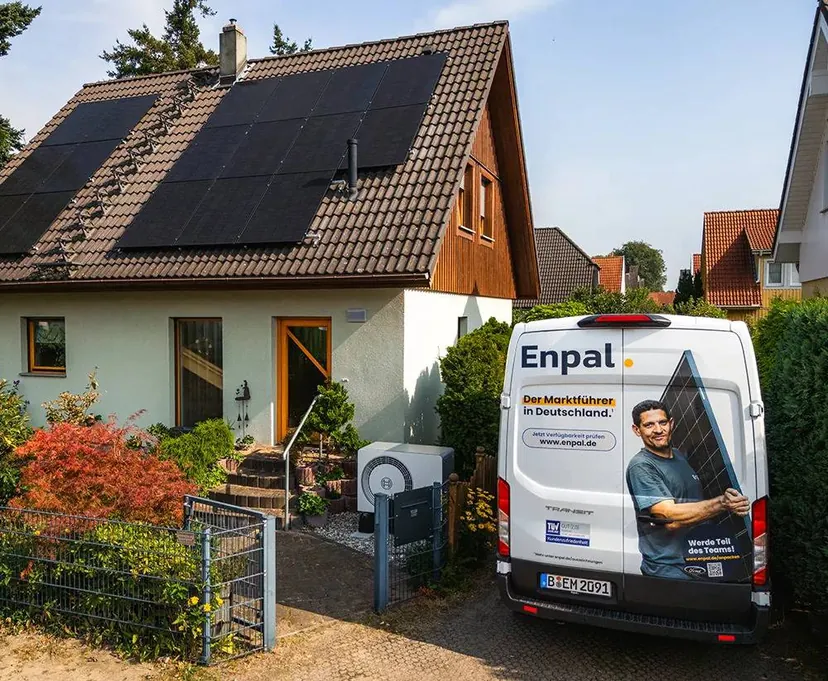
Enpal is a startup that started in 2017 with solar panel leasing. Landlords install panels on their roofs without a large upfront payment and pay a fixed monthly fee. With this model, Enpal became the largest residential solar power company in Europe.
As the heat pump market grew, Enpal entered the sector in 2023, and it grew so rapidly that it accounted for one-third of the core business revenue last year. Thanks to this, the company posted its highest revenue ever, 1.1 billion euros. Furthermore, for the first time, the sales division responsible for installations achieved a positive annual free cash flow. This means that, looking at the installation business alone, the company covered its costs with the money it earned.
Instead of manufacturing and selling heat pumps, Enpal is growing its business model through purchase consultations for third-party heat pumps (like Bosch), installation, subsidy applications, and long-term interest-free installment plans. They add batteries, EV chargers, and heat pumps sequentially to the homes of customers who already have their solar panels, and use their own platform, 'Enpal.One+', to manage when to use, store, and sell electricity. Instead of hunting for new customers, targeting the 115,000 households that already trust them has proven to be a winning strategy.
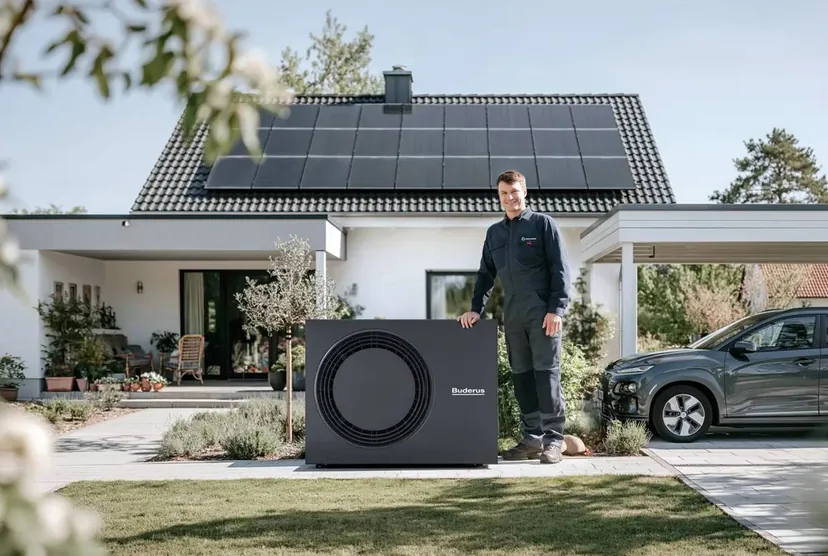
Thermondo, founded in 2013, has a different starting point. While Enpal started with customer relationships, Thermondo started on the construction site. It is a "digital heating installer" that standardizes the heating installation process, which differs for every house, like a factory assembly line. When a customer enters their home size, year of construction, and existing heating method online, they receive a fixed-price quote including installation after a site consultation. The company handles subsidy applications on behalf of the customer, and installation usually takes three to four days.
Keeping this promise is possible because of their directly hired technicians. Out of about 1,200 employees, over 600 are full-time technicians. In a country like Germany where it is difficult to even book one technician, they have kept their installation workforce in-house. In 2024, they stopped selling gas and oil boilers entirely to focus on heat pumps. Last year, they enjoyed a boom, installing 5,456 units. After 13 years of losses, the company is finally seeing signs of profitability. Thermondo CEO Felix Ploog said in August this year, "2026 will be the first profitable year in Thermondo's history."
Climate Tech: From Invention to Distribution
Just as much as laws, energy prices have a significant impact on changing the landscape of German residential areas. While politicians debated the Heating Law, landlords were calculating whether it was time to change their old boilers and how much they would have to pay for heating in the future. If gas prices rise again, the number of people considering heat pumps is likely to increase.
However, choosing a good machine and actually installing it are different problems. Heat pumps require tens of thousands of euros in initial costs, and it is not easy to find reliable installation personnel on time. Enpal reduces the initial burden by offering financing, and Thermondo reduces the hassle for landlords by standardizing the process from estimation to installation. Both companies are lowering the barriers to adopting heat pumps in their own ways.
The Schill family didn't choose a heat pump because they were environmental activists. It was time to replace their old boiler, and the explanation that they could save money influenced their choice. This is also where the opportunity for climate tech, as shown by the two Berlin startups, lies. It is not just about inventing new technology, but making existing technology lead to actual consumer choices and installations.
The author, Lee Jung-woo, has worked as a journalist for 17 years, covering a wide range of fields including major industries such as automobiles, secondary batteries, and heavy industry, as well as defense, diplomacy, environment, education, and health and welfare. In particular, he has covered industrial structural changes centered on mobility, energy transition, and sustainability from the field. He currently resides in Berlin, Germany, and serves as a partner at the startup accelerator '123 Factory'.