

[비즈한국] GC Biopharma is seeking a ruling from the Constitutional Court of Korea to cancel the Supreme Court's decision to dismiss its appeal without a full hearing regarding a bid-rigging case for the National Immunization Program (NIP) human papillomavirus (HPV) vaccine. While the company was acquitted in a criminal trial after the court found no restriction of competition, the administrative court reached the opposite conclusion and upheld a fine of approximately 2 billion KRW. GC Biopharma argues that by dismissing the appeal without explaining this discrepancy, the Supreme Court infringed upon its constitutional right to a fair trial.
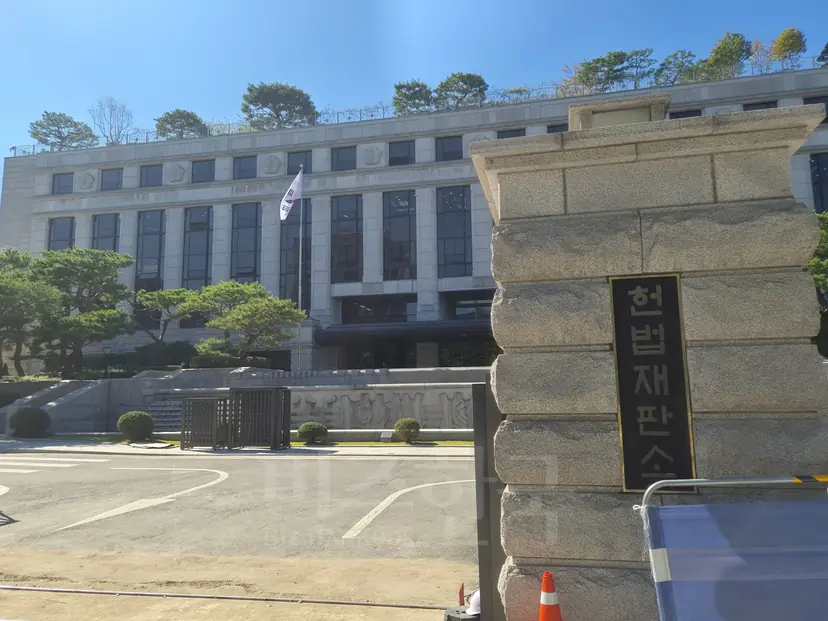
The Constitutional Court held a public hearing on the 23rd at its main courtroom in Jongno-gu, Seoul, regarding GC Biopharma's constitutional complaint seeking to overturn the court's dismissal. This is the first case to be referred to the full bench since the constitutional complaint system for judicial decisions was implemented in March. During the hearing, legal representatives from Yulchon, representing the claimant GC Biopharma, and the Fair Trade Commission (FTC), the interested party, clashed over three key issues.
Is "Restriction of Competition" a Legal or Factual Issue?
The first issue concerns the nature of determining "restriction of competition," a prerequisite for collusion. This refers to whether joint actions by businesses limit or risk limiting market competition.
In the criminal appeals court, GC Biopharma was acquitted on the grounds that other wholesalers were unlikely to compete with the company even if they held supply commitments, and that it was difficult to conclude that "decoy" bids influenced the winning price. Conversely, the administrative court upheld the fine, reasoning that third parties could have obtained supply commitments and that price competition was possible during the bidding and private contract processes.
GC Biopharma argued, "If criminal and administrative courts reach diametrically opposed conclusions based on the same evidence and facts, this is not merely a difference in factual evaluation, but a contradiction in normative interpretation and the application of law." They assert that "restriction of competition" is a legal judgment.
The FTC countered, "The essence of this case is not the fact that the conclusions of the criminal and administrative rulings differ, but whether such a discrepancy constitutes a constitutional or legal flaw that warrants overturning the original judgment." The FTC argued that criminal and administrative courts have different standards of proof and factual evaluations, so their conclusions do not necessarily have to align.
Justice Oh Young-jun asked whether, if criminal, civil, and administrative outcomes could differ in cases such as medical malpractice or disciplinary actions against public officials, one should consider it impossible for any such cases to be dismissed without a full hearing. GC Biopharma responded that this case is different because there was not even a minimal explanation provided for the conflicting judgments.
Was the Supreme Court's Administrative Case Dismissal Lawful?
The second issue is the legality of dismissing the case without a full hearing. Under this system, the Supreme Court reviews the grounds for appeal and, if it determines there are no grounds for further review as prescribed by law, dismisses the appeal without a full hearing. However, Article 4 of the Act on Special Cases Concerning Procedure for Appeal to the Supreme Court stipulates "serious violations of law" as an exception.
GC Biopharma argued that the conflict between the criminal and administrative rulings constitutes a "serious violation of law" under Article 4, Paragraph 1, Item 5 of the Act. They asserted that since "'existence' and 'non-existence' cannot both be true," the Supreme Court should have reviewed the legal contradiction.
The FTC countered that "the dismissal system is not one that skips review, but a screening procedure where the Supreme Court, after reviewing all grounds for appeal, rightly determines there is no reason to continue." The FTC also explained that under Article 4, Paragraph 3, Item 2, dismissal is permissible if the grounds for appeal do not affect the conclusion of the original ruling.
The FTC also emphasized that the administrative court's ruling was delivered in October 2025, prior to the Supreme Court's confirmation of the criminal acquittal in December of that same year. "A subsequently issued criminal ruling by the Supreme Court cannot retroactively create a flaw in an earlier administrative ruling," they claimed. However, the criminal appeals court's acquittal already existed at the time of the administrative court's initial ruling.
Justice Cho Han-chang asked both parties specifically about the relationship between the exceptions to dismissal and the regulations allowing for dismissal even when such exceptions are claimed. GC Biopharma argued that if rulings conflict, the hearing must continue, while the FTC maintained that dismissal is lawful if the outcome of the original ruling remains unaffected.
Does Omitting Reasons for Rulings Infringe on the Right to a Fair Trial?
The third issue concerns the duty to provide reasons for a ruling. GC Biopharma argued that the "right to a legal hearing"—the requirement that courts recognize and consider the arguments of the parties—is included in the right to a fair trial.
GC Biopharma emphasized that "the parties and their legal counsel have no way of knowing why the Supreme Court reached a conclusion completely opposite to the previous final criminal ruling," and asserted that in exceptional situations where such conflicting rulings exist, the court must provide reasoning.
Conversely, the FTC argued that GC Biopharma had ample opportunity to present its case through its appeal documents and submitted materials, stating, "The fact that individual reasons are not written in the ruling is separate from whether their arguments were considered in the decision-making process." Current law permits the omission of reasons for dismissals without a hearing.
Justice Kim Bok-hyeong asked whether a party could reasonably accept a situation where an appeal in an administrative case is dismissed without explanation following a final criminal acquittal. GC Biopharma requested that the Constitutional Court define the constitutional limits of the duty to provide reasons.
From Vaccine Bid-Rigging to Constitutional Complaint
This case originated from the purchase bid for the HPV vaccine "Gardasil," for which GC Biopharma held a joint sales agreement with MSD Korea. The FTC imposed a corrective order and a fine of 2.035 billion KRW in August 2023, alleging that GC Biopharma had involved wholesalers as "decoys" in three bids between April 2017 and January 2019.
GC Biopharma was fined 70 million KRW in the first criminal trial, but was acquitted in the appellate court in July 2024, a decision confirmed by the Supreme Court in December 2025. However, the company lost its administrative lawsuit to cancel the fine at the Seoul High Court in October 2025, and the Supreme Court dismissed the appeal without a hearing this past February.
The subject of this constitutional review is not the fine itself, but the Supreme Court's dismissal ruling. Even if the Constitutional Court accepts GC Biopharma's petition, the fine will not be automatically canceled; the court would have to retry the case in accordance with the Constitutional Court's decision.
As the first case referred to the full bench since the implementation of the constitutional complaint system for judicial decisions, this ruling is expected to serve as a benchmark for how far constitutional control can extend over the Supreme Court's dismissals without hearings.