

[BizHanKook] After serving the Hwagok-dong area for 49 years, the Gangseo-gu Office has brought the "Hwagok-dong Era" to an end by relocating to the new integrated government complex in Magok. While Gangseo-gu expects the centralization of scattered administrative functions to enhance resident convenience and work efficiency, merchants in Hwagok-dong are concerned about the potential decline of the local commercial district following the relocation.
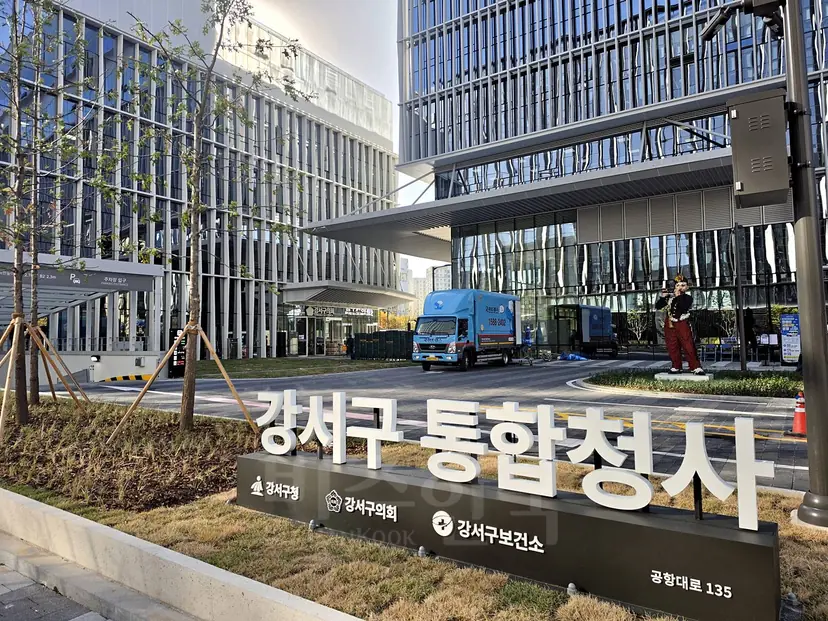
Since this month, the Gangseo-gu Office has been moving departments to the new Magok integrated complex in sequence. Departments previously located in the Gayang-dong and Hwagok-dong annexes completed their moves on the 6th, followed by the main office and welfare and administrative support departments. The relocation process is set to conclude with the move of the District Council on the 29th.
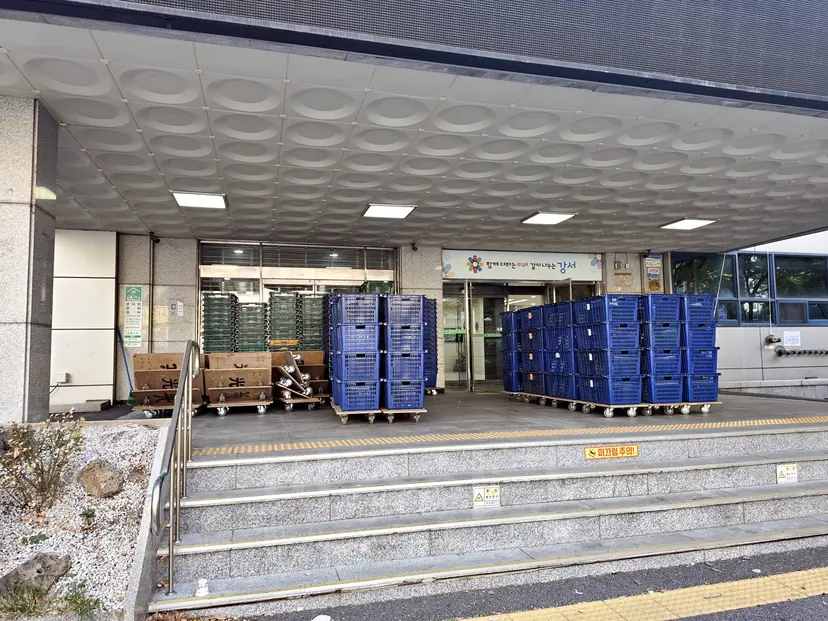
When visited on the morning of the 27th, the former Gangseo-gu main building in Hwagok-dong was busy with relocation work. In front of the main entrance, several blue baskets filled with belongings were loaded onto carts. As lunchtime approached, trucks arrived one after another to load baskets and various items before departing the site. Banners announcing "parking lot unavailability due to office relocation" and notices about the suspension of on-site facilities like the smart library and automated collection machines were posted throughout the building.
The physical reality of the relocation could also be felt as the name "Gangseo-gu Office" gradually disappeared around Hwagok-dong. According to Gangseo-gu, as of the 24th, the "Gangseo-gu Office Intersection/Seoul Digital University" bus stop was renamed "Seoul Digital University," and the "Gangseo-gu Office/Korea Association of Health Promotion" stop was renamed "Gangseo Police Station/Korea Association of Health Promotion." Conversely, the "Gangseo-gu Integrated Government Complex" name was newly added to the "Gangseo Tax Office" bus stop near the new Magok complex.
The new integrated complex, located at 135 Gonghang-daero, Magok-dong, houses the district office, district council, and public health center. The core of this move is to centralize administrative functions that were previously spread across several buildings. Gangseo-gu anticipates that this integration will strengthen inter-departmental cooperation and reduce the inconvenience residents faced by having to visit multiple locations. The new complex is also slated to feature resident-accessible facilities such as a Gangseo history and culture hall, a Magok open library, and a public wedding hall.
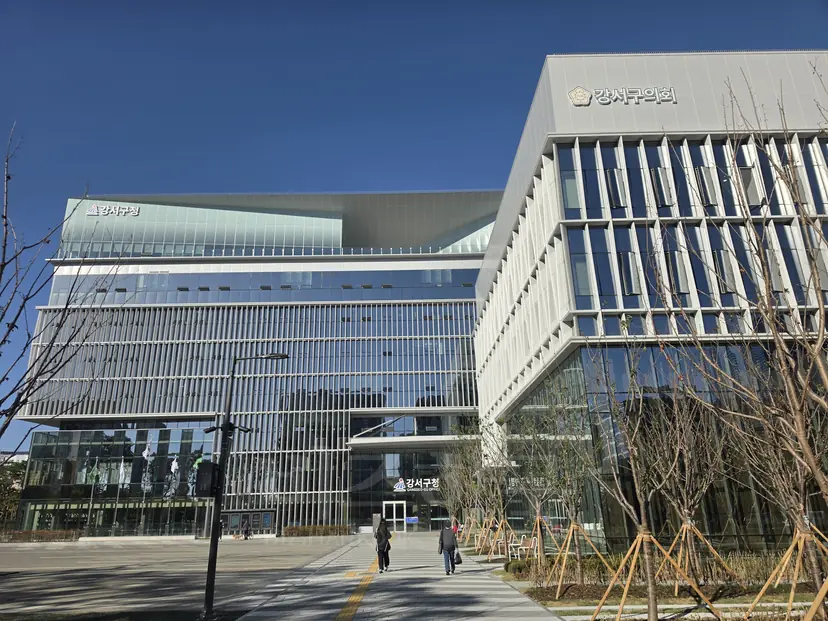
On the other hand, voices of concern regarding a shrinking commercial district are growing in Hwagok-dong. With the relocation in full swing, foot traffic from district employees and civil petitioners has dwindled, and merchants say their sales have dropped compared to the past. Merchants met on this day said they are feeling the decline in floating population and sales.
A resident who has run a coffee shop near the Gangseo-gu Office for a long time said, "Previously, many district officials frequented the shop, but now, compared to when business was good, sales are at about 30%," adding, "I didn't expect the number of people to drop this much."
B, who runs a convenience store near the main building, also said, "In the past, many employees stopped by on their way to work in the morning, but now those people are gone. Sales are about one-third of what they used to be." He added, "At least we get customers passing by, but I've heard restaurants are taking an even harder hit."
C, who has operated a Korean restaurant near the office for six years, stated that customer numbers have halved since the relocation began. "The relocation isn't finished yet, so remaining employees still come, but you can feel the number of people decreasing," he said. "In the past, it wasn't just staff but also petitioners and visitors. Now, there are almost no such customers." C explained, "My shop is on the street side, so it's a bit better, but the situation for shops located deeper inside is more serious."
The problem is that there is no obvious demand to replace the void left by the district office in the short term. Ultimately, how much new floating population can be secured after the relocation is considered the key variable for the restructuring of the Hwagok-dong commercial district.
Shin Bo-yeon, a professor at Sejong University's Department of Real Estate AI Convergence, commented, "The area around a district office is structured such that administrative-related businesses like judicial and tax scriveners support the commercial district alongside officials and petitioners. Once the office moves, the floating population and sales drop first, and then related businesses move out as well, which can exacerbate the decline." However, she added, "Because Hwagok-dong has a solid residential base and public functions like the Gangseo Police Station remain, it is likely to be restructured into a lifestyle-oriented commercial district where the average transaction price is lower, but turnover is maintained, rather than experiencing sudden hollowing out."
Professor Shin suggested, "For a commercial district to remain vibrant, it is important to create demand from people who visit the area repeatedly two to three times a week rather than one-time visitors. Facilities that encourage purposeful revisits, such as lifelong education or vocational training centers, nursing and care personnel training institutions, or outpatient-centered medical facilities, are effective."
Meanwhile, Gangseo-gu is pursuing plans to demolish the old Hwagok-dong main building and build a new composite cultural facility. During the business report at the 322nd extraordinary session of the Gangseo-gu Council on July 15th, the district revealed that research into utilizing the old site led to a proposal for a composite facility equipped with a performance hall, library, and sports facilities. The district plans to finalize the specific composition of facilities and the project schedule after establishing a basic plan. Until the new facility is built following the demolition, the site will be used as a temporary parking lot.