

[비즈한국] At the center of our galaxy lies Sagittarius A*, a supermassive black hole approximately 4 million times heavier than the Sun. Compared to its immense mass, its activity is surprisingly quiet. It does not vigorously pull in surrounding matter, nor does it brightly illuminate the galactic center. This is why it has long been considered a virtually dormant black hole. However, precise observations have revealed traces suggesting that even this quiet black hole emits winds into its surroundings, altering the nearby cosmic space.

Supermassive black holes actively pull in matter, influencing their entire galaxy. The energy pouring out from around a black hole illuminates the galactic nucleus and heats or pushes away surrounding gas. If the impact is strong enough, it can suppress star formation by reducing the supply of cold gas needed to create stars. Compared to such active galactic nuclei, Sagittarius A* is in a much calmer state. That does not mean, however, that all interaction with its surroundings has ceased.
Gas, dust, and stars are gathered around the black hole. Gas loses energy through collisions and friction, exchanging angular momentum. In this process, some of the gas that loses angular momentum moves toward the black hole. As it approaches the center, part of the gravitational potential energy turns into heat, raising the temperature of the gas. This heated matter emits light, and some flows outward, creating a wind around the black hole. This wind is not matter that has escaped from within the event horizon, but rather a stream of material that was heading toward the black hole but is re-emitted from the surroundings.
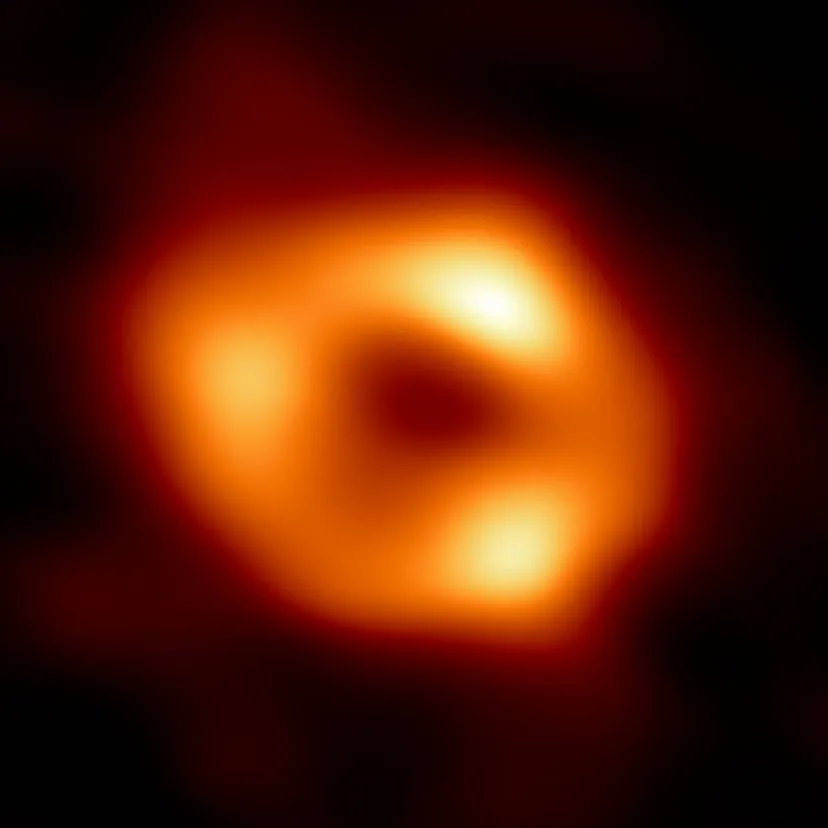
Even if not much matter is flowing into the black hole, the energy transferred to the surroundings can be significant. To give an example of the energy scale suggested by the researchers, the energy released as just 1g of gas—roughly the weight of a paperclip—flows into a black hole is enough to free about 100kg of gas much further away from gravitational bondage. Applied to Sagittarius A*, that distance corresponds to the distance light travels in about 12 days, a scale exceeding 50 times the distance between the Sun and Neptune. This is why the impact a black hole has on its surroundings cannot be ignored, even if only a small amount of material flows in.
Traces suggesting that Sagittarius A* may have been much more violently active in the past were already known. A prime example is the Fermi Bubbles that extend massively above and below the plane of our galaxy. One leading hypothesis explaining the origin of this structure, which is observed via gamma rays, is past activity of the galactic center black hole. However, it is difficult to tell if Sagittarius A* is still emitting winds today based solely on traces left in the distant past. To confirm recent activity, one must look for traces left near the black hole.
The center of our galaxy is about 26,000 light-years away from Earth. Thick dust and gas lie in between, making it difficult to peer into the center with visible light. This is why astronomers use radio, infrared, and X-ray observations. This study utilized observational data collected by the Atacama Large Millimeter/submillimeter Array (ALMA) in 2017, 2018, and 2021.
The researchers focused on the radio signals of carbon monoxide emitted at approximately 230GHz. This emission line is useful for tracking cold molecular gas at around 100K. They precisely examined where and how much cold gas is distributed around the black hole, rather than just the light coming from the black hole itself. By combining data over several years, they created an observational map measuring 2,700 pixels in both width and height.
In this process, handling the rapid brightness fluctuations of Sagittarius A* was crucial. The radio intensity of Sagittarius A* changes over short time intervals. Without accurately correcting for the bright and fickle signals at the center, it is difficult to distinguish the faint structures around it. The researchers modeled these changes and removed the influence of the central radio source to reveal the subtle structures of the gas spread throughout the surroundings.
There is a ring of molecular gas around Sagittarius A* that is on a much larger scale than the region where matter flows in immediately near the black hole. This structure is called the Circumnuclear Disk, or CND. Previously, the inner boundary of this ring was thought to be about 0.5 parsecs away from the black hole. It was believed that the interior was mostly filled with hot ionized gas, and that cold molecular gas was rare.
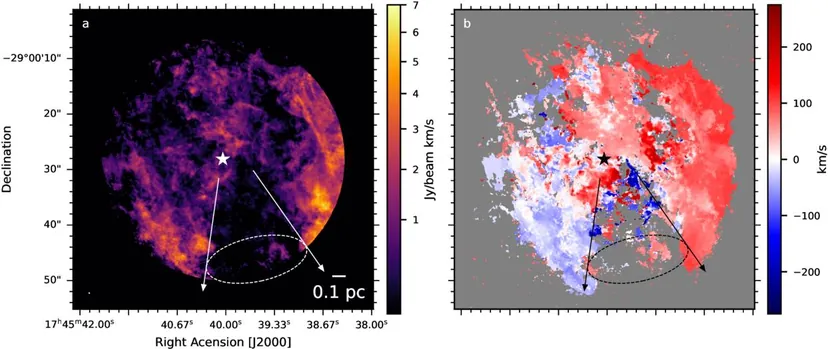
The new ALMA observation map showed that complex molecular gas structures are also abundant within that inner region. The velocity distribution of the gas revealed patterns consistent with motion rotating around or flowing into the center of Sagittarius A*. This is evidence that can be interpreted as gas participating in the material flow of the galactic center, rather than background clouds coincidentally overlapping in the same line of sight.
The most important discovery was a cone-shaped empty section appearing in the midst of this cold molecular gas distribution. This structure started near Sagittarius A* and extended to a length of at least 1 parsec, or over 3 light-years. The opening angle of the cone is about 45 degrees. The signals of cold molecular gas observed in the surroundings were significantly weaker within this corridor.
The researchers interpreted this cone-shaped structure as a trace left by hot winds flowing out from the vicinity of the black hole. If winds pass through and push away or heat up the cold gas, the emission of carbon monoxide can weaken. Therefore, appearing empty on the observation map does not mean it is a vacuum where all matter has disappeared; it means there is a lack of signals tracking cold molecular gas, and hot gas may exist within it.
Such winds are distinct from the commonly known black hole jets. Jets are flows where matter and energy are concentrated in a narrow direction and extend far out. In contrast, winds spread out at relatively wider angles. You can think of the difference between a stream of water from a narrow hose and a showerhead spraying widely. The structure discovered this time was spread wide enough for the researchers to describe it as a flow closer to a wind than a jet.
Observations from the Chandra X-ray Observatory also support this interpretation. The cold molecular gas captured by ALMA and the X-ray emissions captured by Chandra showed opposite distributions. Where cold gas was scarce, X-rays were strong, and where cold gas was abundant, X-rays were relatively weak. This is exactly what one would expect if cold gas were being pushed away or heated in a space occupied by hot gas.
The fact that the boundaries of the cone remain distinct is also important. In the surroundings, molecular gas continues to flow toward the center. If a strong wind had blown once in the past and stopped completely, that trace could be filled back in with gas over time. For the empty section to be maintained, the action of pushing away or heating the gas must be ongoing.
The duration of the wind can also be estimated. The researchers assumed this wind is the primary cause of the surrounding ionized gas structure and calculated the time using the rotation of the gas and the size of the structure. As a result, they suggested the possibility that the wind in the observed direction has been active for at least about 20,000 years. Unlike confirming the existence of the cone itself, this time estimation includes assumptions about the cause of gas heating and ionization.
There is also evidence that Sagittarius A* was much brighter until relatively recently. It is the light echo of X-rays observed in the surrounding molecular clouds. If X-rays emitted from around the black hole in the past reach a distant cloud and are scattered before reaching Earth, they are observed later because they travel a longer path than light coming directly. By analyzing this reflected signal, one can trace back past activity that was not seen directly. This is a phenomenon distinct from X-ray emission generated when winds collide with clouds.
These observations show that Sagittarius A* may have emitted much stronger X-rays hundreds of years ago than it does today. Hundreds of years is a time frame that touches upon the era when Galileo was observing the sky with his telescope. If there had been X-ray observation technology at the time, we might have recorded a different appearance of the galactic center than we see today. It was difficult to notice changes occurring behind thick dust with visible light telescopes alone. If humanity’s scientific progress had been just 400 years faster, we might have been able to see the Milky Way spewing out even more dazzling X-rays.
Reference
https://iopscience.iop.org/article/10.3847/2041-8213/ae63cf
About the author Ji Woong-bae? He loves cats and the universe. After watching 'Galaxy Express 999' as a child, he dreamed of spreading the beauty of the universe. He is currently an assistant professor in the Faculty of Liberal Arts at Sejong University, participating in various science communication activities such as lectures and writing. He has written books including "On the Uselessness of Astronomers," "We Are All Born Astronomers," and "Strange Questions That Come to Mind When Looking at the Universe," and translated books such as "How I Killed Pluto," "Quantum Life," and "UFO."