

[비즈한국] On September 29, at a Cabinet meeting, the Ministry of Climate, Energy, and Environment reported a ‘Power Grid Innovation Plan’ aimed at redesigning the power grid system to supply over 100GW of renewable energy by 2030. The core of the plan is to change connection regulations and operational methods to make more efficient use of existing power grids, rather than waiting for the completion of new transmission lines.
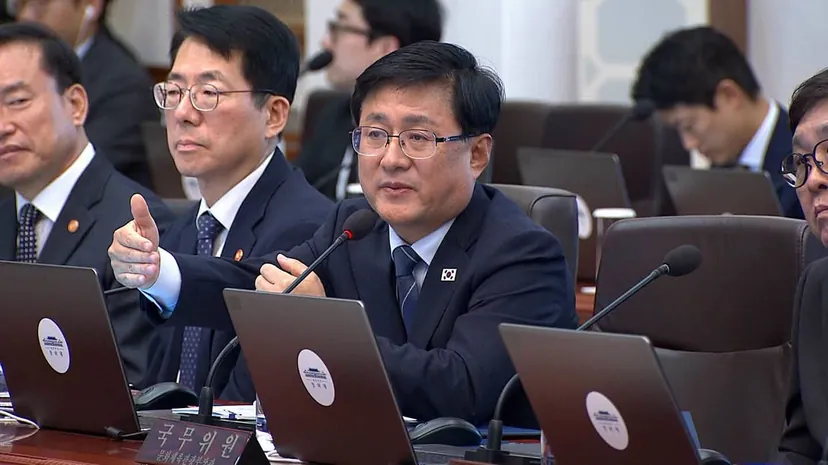
Reducing Output Curtailment, Increasing Supply Capacity
The government and Korea Electric Power Corporation (KEPCO) will pursue 9 key tasks under 5 major strategies. The first is "flexible connection." Previously, connection eligibility was determined based on the rated capacity of power generation facilities, i.e., maximum output. Since solar power rarely generates at maximum capacity throughout the year, this standard restricted new connections even when lines had spare capacity most of the time, keeping the utilization rate of solar-centered distribution lines at around 15%.
‘Flexible connection’ is a method that allows connection on the condition that output is controlled only when grid capacity is temporarily exceeded. By raising the connection limit for distribution lines from 14MW to 16MW and substations from 50MW to 60MW, the government explains that an additional 2.6GW of solar power can be accommodated in the Honam region alone. The change in connection limits will be implemented for distribution lines starting next January, and for substations, it will be fully implemented in the first half of next year following a trial operation starting this December. If the grid becomes saturated while waiting for a connection, flexible connection facilities will be the first to be curtailed.
‘Autonomous connection,’ which allows operators to install renewable energy facilities beyond the connection capacity while keeping actual supply within permitted limits using ESS (Energy Storage Systems), will be promoted in full next year after a trial project this year. It will be possible to install up to 2 to 3 times the grid rated capacity. The project will first be demonstrated at 2 to 4 dedicated distribution lines, and based on the results, the rules for using public grids will be amended in the first half of next year. However, it is conditional upon the economic feasibility of the ESS installed by the power generation operator.
There is also a ‘non-expansion alternative’ using energy storage systems (ESS). The plan is to add 3GW of solar power at the distribution level and 1.6GW at substations by 2030 by storing power produced during the day and discharging it at night. For the transmission grid, the government plans to use spare capacity—which was previously kept empty for emergencies—by installing ESS for fault backup, allowing the capacity to be used for actual transmission.
These alternatives were proposed because building new lines takes time. New distribution lines usually take 1–2 years, 154kV substations take 6 years, and 345kV transmission lines take over 9 years. Connecting solar power requires spare capacity across distribution networks, substations, and transmission lines, leaving the Honam region—which has favorable conditions for renewable energy—in a situation where new projects were only possible after 2034.
The government is also working on clearing out dormant and delayed projects. Previously, "land grabbing," where operators held onto connection rights allocated on a first-come, first-served basis for free while projects were long delayed, was a major issue. While Honam offshore wind power secured 15.8GW of connection rights by 2030, only about 3GW is expected to enter the market. The government has already reclaimed about 9GW of connection rights and expects to secure over 10GW in Honam by 2030 by adjusting the connection schedules of long-delayed projects. For projects entering after 2031, connection rights will be allocated based on the actual project implementation rate (67.2%).
Connection criteria are also changing. The government is revising the connection review process to assume that renewable energy generates power first, reflecting actual grid operations, rather than assuming coal and LNG plants take precedence. The government expects this to accommodate an additional 20GW nationwide.
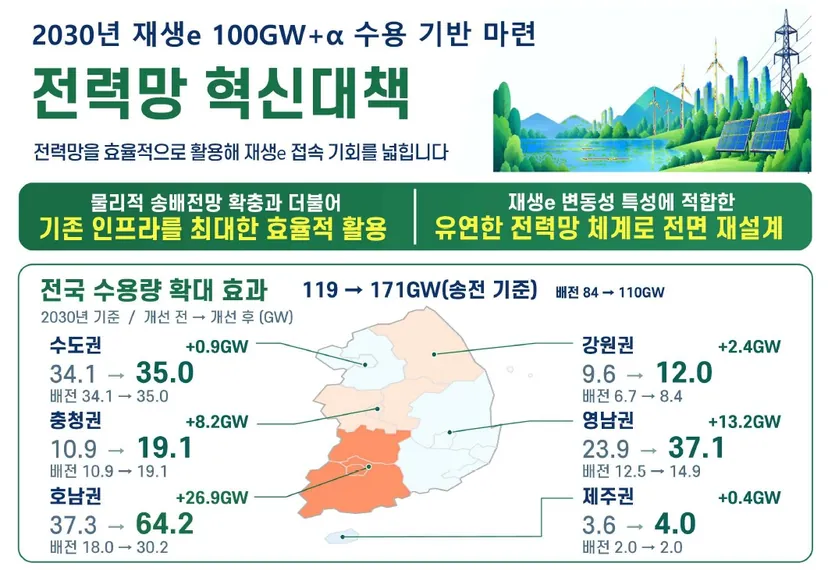
Starting January 2027, connection rights will also be granted to successful bidders of competitive auctions. Previously, if reinforcement of a public distribution grid was needed, the first operator to connect bore the full cost, while subsequent operators used it for free. Moving forward, KEPCO will invest first, and a system will be established for subsequent users to share the costs based on their facility capacity. With these measures, the government stated that renewable energy capacity by 2030 will increase from 119GW to 171GW for transmission, and from 84GW to 110GW for distribution.
Lifting Grid Management Substation Restrictions, Allowing New Connections in Honam and Chungcheong
Grid management substations refer to those that restrict new power generation facility connections due to a lack of power grid capacity. As of October 1, this designation will be lifted in the Honam region due to these measures, and new connections are expected to become possible in some parts of the Chungcheong region where entry was previously restricted. Spare capacity has been confirmed in 46 out of 87 substations in Honam and 105 out of 108 in Chungcheong.
The remaining 41 substations in Honam and 3 in Chungcheong are still saturated, so connections will be possible in stages between 2028 and 2030, in line with the installation of ESS and the construction of new substations. The government explained that these areas can also connect using distribution-level ESS and flexible connections. The government projects that by 2030, Honam’s capacity will increase from 37GW to 64GW for transmission and from 18GW to 30GW for distribution.
The secured capacity will be allocated to existing applicants first. After the allocation notice in October and the review of existing applications by December, new project applications will begin in January 2027. The designation for the East Coast will be lifted in the first half of 2027, when the first phase of the High Voltage Direct Current (HVDC) line is completed. Minister of Climate, Energy, and Environment Kim Seong-hwan stated, “The goal is to use the existing power grid as efficiently as possible.”
“The Direction is Correct, But It Needs to be Specific”
Lee Soon-hyung, a professor at Dongshin University and an expert in power systems, positively evaluated the government’s policy shift from a focus on physical grid expansion to a flexible operational system based on actual power output, but raised concerns regarding specific implementation plans.
On his blog, Professor Lee stated, “In a situation where the existing distribution line utilization rate is barely over 15%, introducing flexible and autonomous connections—which control actual transmission without being bound by the nameplate capacity of power generation facilities—is welcome as it officially adopts the operational efficiency measures that academia and the field have long demanded.”
However, he pointed out that the capacity projections announced by the government do not mean physical line expansion or actual additional transmission volume and annual generation. He also warned that since flexible and autonomous connections are premised on output curtailment—forcing power plants to reduce or stop generation—the loss from output restrictions will inevitably increase as connection facilities increase.
Professor Lee further noted that detailed regulations and evidence from demonstrations are still needed, such as principles for compensating operators for losses due to increased output curtailment, verification results for power grid stability following priority dispatch of renewable energy, and financing plans for KEPCO’s upfront investments.