

[비즈한국] There are supermassive black holes at the centers of galaxies. Wouldn't it make sense, then, for smaller clusters of stars—which are essentially mini-galaxies—to also house smaller black holes? It is a very natural thought. Of course, a star cluster is not merely a scaled-down version of a galaxy. However, given that hundreds of thousands to millions of stars are bound together by gravity, star clusters are quite plausible places to search for black holes.
In particular, the larger and heavier a star cluster is, the more stars it likely birthed, and therefore, the higher the possibility that more black holes were formed. What about Omega Centauri, the heaviest star cluster in our Milky Way?
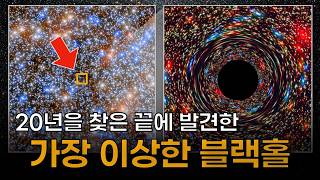
Omega Centauri is located approximately 17,900 light-years away from Earth. It contains roughly 10 million stars, and its total mass is about 4 million times that of the Sun. In the dark night sky of the Southern Hemisphere, it is bright enough to be seen faintly with the naked eye under good conditions.
It is also over 12 billion years old. This means the massive stars born in Omega Centauri have long since finished their life cycles. While low-mass red dwarfs can survive for tens of billions of years, high-mass stars would have already burned through their fuel and exploded as supernovae. Among them, sufficiently massive stars inevitably leave behind stellar-mass black holes at the end of their lives.
Therefore, numerous black holes should exist in Omega Centauri. Some dynamic models even estimate that there could be around 10,000 stellar-mass black holes at the center of this cluster. However, this number might be an overestimate, as it may fail to clearly distinguish between intermediate-mass black holes and stellar-mass black holes.
In any case, it is clear that Omega Centauri is a cluster capable of holding onto black holes. Because this cluster is so massive, its gravity is also strong. Its escape velocity is about 62 km/s, which is nearly double the typical 20–30 km/s escape velocity of globular clusters in the Milky Way. In its early days, when the cluster was even heavier, the escape velocity would have exceeded 100 km/s. While a "kick" can occur—where a black hole is launched in one direction due to the asymmetry of the explosion that creates it—in a cluster with such a high escape velocity as Omega Centauri, the black hole eventually fails to escape and remains trapped.
Yet, strangely, not a single stellar-mass black hole has been confirmed in Omega Centauri until now. This is not because there are no black holes, but because they are actually difficult to find in such an environment.
Black holes do not shine on their own. They reveal themselves by emitting strong X-rays and radio waves when they feed on surrounding gas or material from a companion star. However, in a "hungry" state with nothing to eat, a black hole remains almost perfectly hidden in the dark. Deep X-ray and radio observations of Omega Centauri have been conducted several times, but no black hole candidates emerged. This is because, being such an old and desolate place where fresh gas material has nearly run out, it is an environment where even if a black hole exists, there is nothing particular for it to feed on.
There was once a claim that black holes might have been abundant but were all kicked out through violent and complex gravitational interactions within the cluster. It is possible for heavy black holes to sink to the center of the cluster, form pairs, and act like a slingshot, ejecting another star or black hole when they get too close. However, recent star cluster evolution models show that black holes cannot be efficiently ejected in such a manner. Therefore, it is highly likely that a significant number of stellar-mass black holes are still quietly hiding in the darkness of Omega Centauri.
Recently, there was an attempt to solve this puzzle using a completely different method: instead of looking for light leaking from a black hole, astronomers looked for the motion of a star pulled by the black hole's gravity. Astronomers focused on an ordinary star located just 1 light-year from the center of the cluster. This star has only 78% of the Sun's mass. On the surface, it looks unremarkable; its brightness is stable, and it does not vary. However, tracking this star for a long time revealed something strange.
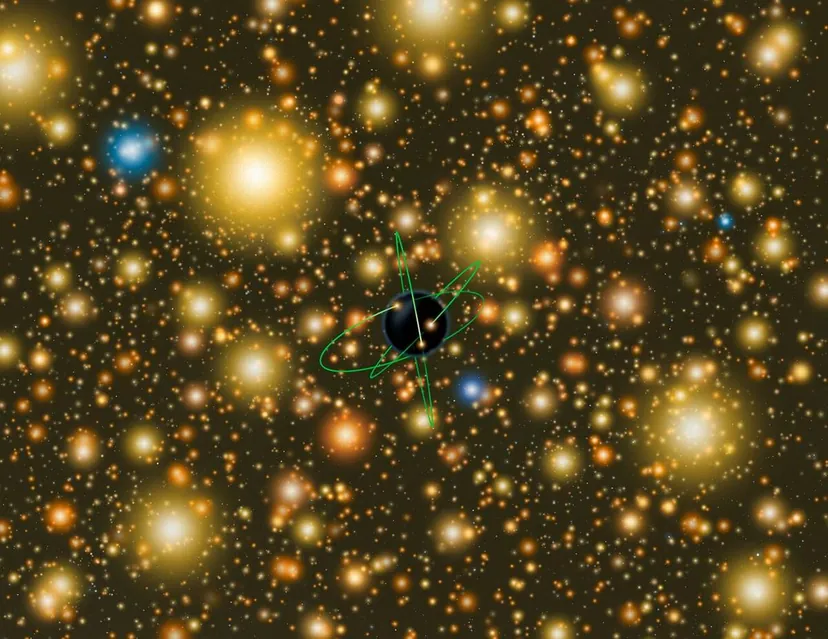
If it were a star wandering through space on its own, it should show a simple, nearly straight proper motion in the sky. However, the path of this star was clearly curved, as if it were orbiting something invisible. To analyze the motion of stars in Omega Centauri closely, astronomers tracked 350 stars for over 20 years using the Hubble Space Telescope. This project is called oMEGACat. By adding the latest results observed by the James Webb Space Telescope in 2024 and 2025, they tracked the movement of the stars over a total of 23 years.
The minute movements of the stars in the center of Omega Centauri are smaller than a single pixel on the Hubble and James Webb detectors. Therefore, it is difficult to know the movement of the stars with just a single snapshot. By comparing hundreds of photos taken over a very long period and using multiple stars as reference points, the true, pure motion of the target star can be determined. The analysis revealed that the star seems to be orbiting something invisible with a period of about 94 years. The radius of the orbit it traces is about 31 AU, and it follows a highly elongated elliptical orbit with an eccentricity of 0.72.
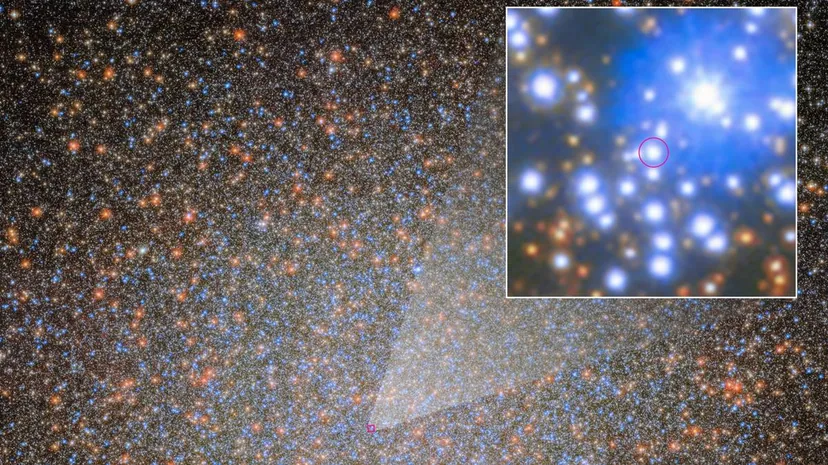
But a question suddenly arises: how could they know the orbital period is 94 years after observing it for only 23 years? After all, the star did not complete a full orbit during the observation period. In fact, it was a matter of luck. Around 2012, while Hubble was observing, the star was passing through the "near-black hole point," where it moves fastest in its elliptical orbit.
Although the actual observation period covered only 40% of the star's entire elliptical orbit, researchers were fortunate enough to capture the segment where the black hole's gravity was strongest. Thanks to this, they were able to calculate the mass of this companion object—the black hole—quite well. The mass of this black hole, estimated using Kepler's laws, is about 4.46 times that of the Sun. If it is this heavy and yet emits no light, the only possible answer is a black hole. Thus, this black hole has been named oMEGACat BH-2.
The reason it is called BH-2 rather than BH-1, despite being the first to be discovered, is that a candidate for an intermediate-mass black hole, estimated to be about 8,000 times the Sun's mass, was actually discovered earlier in 2024 using the same oMEGACat data. However, that was an intermediate-mass black hole, while this is a lighter stellar-mass black hole. Therefore, the recently discovered BH-2 is officially the first stellar-mass black hole found in Omega Centauri.
Although they scanned the area around BH-2 extensively with the Chandra X-ray Observatory, no significant X-rays were detected. This is because the companion star is orbiting in such a large orbit and is far away, so it is not currently feeding on the star's material.
However, the problem is that the newly discovered BH-2 is much lighter than expected. The star orbiting it has very low metallicity. Stars with such low metallicity have clean, transparent outer layers. Even if light leaks from the inside, there are no ionized particles to block or collide with it. Therefore, the power of its stellar wind is weak, and its mass does not decrease significantly. Consequently, it was expected that black holes created by such low-metallicity stars should be at least 20–40 times the mass of the Sun. Yet, the confirmed mass of BH-2 is only 4–5 times that of the Sun, which is much lighter.
This suggests a new possibility: even in environments like old globular clusters with very low metallicity, very small stellar-mass black holes can be formed. It means the mass distribution function of black holes could be much broader and more diverse than we thought. There might be a mechanism that efficiently blows away a star's outer material even without many metal ion particles on the surface. Or, we should also consider the possibility that while heavy black holes were originally abundant, they may have failed to withstand complex gravitational interactions and were the first to be ejected from the cluster.
Although we have discovered only one so far, there is no telling how many more black holes will be found inside in the future. The James Webb Space Telescope is scheduled to observe this star again in 2027 and 2028. Once two more years of observational data are added, the star's orbit will become more precise, and we will be able to determine the black hole's mass more accurately. It will be interesting to see whether the black hole appears heavier then, or if it maintains its current light mass.
Finding the darkness hidden within bright things—this is what astronomy does. And that darkness is eventually revealed. Darkness does not exist alone. Even if it hides in the shadows, it interacts with surrounding bright things and leaves behind indirect traces of its existence.
Reference
https://omegacatalog.github.io/
https://iopscience.iop.org/article/10.3847/2041-8213/ae7a5c
About the author Ji Woong-bae? He loves cats and the universe. After watching 'Galaxy Express 999' as a child, he dreamed of sharing the beauty of the cosmos. He is currently an assistant professor at Sejong University's College of Liberal Arts, engaging in various science communication activities including lectures and writing. He has authored books such as 'On the Uselessness of Astronomers,' 'We Are All Born Astronomers,' and 'Strange Questions That Come to Mind When Looking at the Universe,' and translated books including 'How I Killed Pluto,' 'Quantum Life,' and 'UFO.'