

[BizHanKook] Failure is unavoidable in new drug development. The problem lies in the enormous costs associated with that failure. Every company must build a financial structure capable of handling the astronomical costs that follow failure. Although the government is expanding the supply of policy funds, critics argue that it is difficult to bridge the investment gap unless a financial system is established that accounts for the biotech industry's uniquely long development cycles and high level of uncertainty.
Industry experts have suggested alternatives such as "success-contingent loans," where the government and private sector share the risks of new drug development, alongside financial support centered on technological value, long-term investment, and the revitalization of venture investments by pharmaceutical companies.
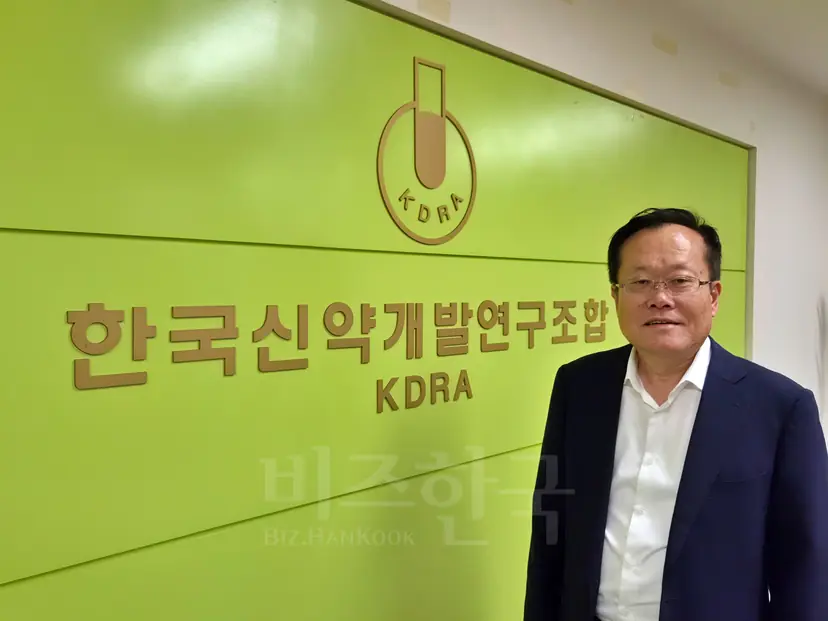
Cho Heon-je, Executive Director of the Korea Research Institute of Bioscience and Biotechnology (KRIBB), pointed out in an interview with this reporter: "Ultimately, it is a problem of how to balance the two tracks of policy and the private sector. It won't work if only the government does it, but if we leave it entirely to the private sector, they will ultimately only chase profitable opportunities."
Debt Forgiveness for Failure, Returns for Success… Eyeing Success-Contingent Loans
One of the alternatives currently gaining attention in the bio industry is the "success-contingent loan." In this model, the government lends funds for new drug development; if the research is conducted in good faith but fails, a portion of the principal and interest is forgiven. If the business succeeds, the principal, interest, and additional profits are recovered and reinvested into follow-up research.
This differs from existing financial models in that it provides funding based on the technical value of individual drug development projects rather than the company's financial status or collateral strength.
Director Cho explained, "It is a model that evaluates the excellence of individual new drug projects rather than the company’s size or collateral, providing unsecured loans, forgiving the principal in case of clinical failure, and recouping a portion of technical fee revenue for reinvestment upon success."
However, implementing such a system requires clear criteria to distinguish between "good-faith failure" and mismanagement. This is because a clinical trial result failing to meet expectations cannot be treated the same as the misuse of funds.
A specialized evaluation system to select recipients and legal grounds for the exoneration of public fund managers must also be established. The method of fund recovery will also depend on which stage is defined as the "success" milestone—completion of Phase 3 clinical trials, product approval, technology export, or actual revenue generation.
A circular investment structure, where a portion of the profits from successful projects is redirected back into the fund, should also be considered. The intent is to ensure that success does not just end with providing funds to one company, but that the fruits of that success serve as resources for the next round of drug development.
Mook Hyun-sang, CEO of NewPathBio (former head of the Korea Drug Development Fund), also suggested, "We must establish a system where investors and executors reasonably share the fruits of success. We need to secure self-sustaining resources through a 'Rolling Fund' method, where a portion of the profits from successes is mandatorily reinvested into the fund."
Government R&D Budget Increased, But Some Programs Cut… Support Methods Need Improvement
Critics also point out that the way policy finance is delivered must change. Instead of the government selecting research topics for open calls, it should reflect the needs of the actual development field and consider the long-term commercialization potential.
Disparities exist across different sectors in the government's R&D budget allocation. The 2027 R&D budget proposed by the government last September was 39.5 trillion won, an 11.2% increase from the previous year. Within the national strategic technology sectors, the budget for advanced bio was also increased by 15.2% to approximately 2.2 trillion won.
Conversely, the Ministry of Health and Welfare's health and medical R&D budget was reduced from 939.9 billion won this year to 894.3 billion won next year, a cut of 45.6 billion won. The budget for promoting the health industry also decreased from 294.1 billion won to 203.5 billion won, a reduction of 90.6 billion won. The Ministry of Trade, Industry and Energy's bio-health technology development budget also shrank from 297.4 billion won to 279.1 billion won, a reduction of 18.3 billion won.
Regarding this, CEO Mook pointed out at the "Korea Next Engine: Bio Great Innovation" joint forum held on the 5th that while government R&D investment is concentrated on basic research, platforms, and AI, the funding gap for Phase 2 and 3 clinical trials remains unresolved. His point is that expanded government R&D investment must connect to the supply of funds actually needed for drug development and commercialization stages.
Director Cho also noted, "Because the government unilaterally sets research themes and distributes budgets mainly to large-scale project groups, the majority of small and medium-sized venture companies are complaining that there are no government support programs suitable for their promising pipelines."
To improve this, he proposed a "two-track approach" to the government’s R&D support system.
The first is "Market Demand-Driven R&D," which supports promising drug pipelines in development by linking them with private investment to ensure they are not halted due to lack of funds. The second is "Future Market Demand-Pull R&D," which supports long-term joint research by industry, academia, research institutes, and companies on essential core technologies that are not immediately profitable but are necessary for the future.
Director Cho pointed out, "Currently, there are countless basic and foundational research projects related to new drug development in the country, but because there is no corporate participation, they often fail to lead to practical commercialization and end up as 'research for the sake of research'."
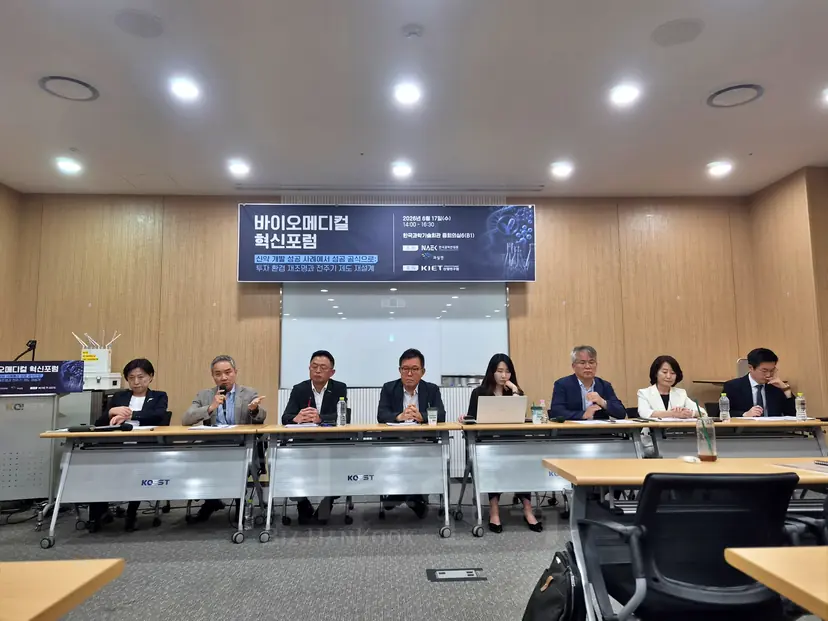
Utilizing the expertise of private investment in policy finance is also being discussed. Hwang Man-soon, CEO of Korea Investment Partners, suggested at a biomedical innovation forum in June that rather than the government unilaterally selecting projects to support, companies and investors should present the necessary funding structures and development goals first, and then professional evaluation agencies should verify feasibility.
However, if private investment is made a mandatory condition for support, early-stage biotech companies that struggle to attract private capital might be excluded. Since the risks and funding requirements for candidate substance discovery versus late-stage clinical trials differ, support methods must also be differentiated.
New Drug Development Takes Over 10 Years with 7-8 Year Funds… Long-term Capital Needed
The mismatch in investment duration is another challenge to solve. While the typical lifespan of a venture capital (VC) fund is 7–8 years, new drug development often takes over 10 years. This means the deadline for investment recovery may arrive before the time required for clinical trials and product approval.
Accordingly, proposals have been made to extend the lifespan of bio-specialized funds and evaluate fund managers not only on short-term returns but also on long-term technological development and commercialization outcomes. It is also important to secure long-term capital that can sustain follow-up investments while research and development are ongoing.
Especially in stages requiring large-scale funding, such as Phase 2 and 3 clinical trials, a Project Financing (PF) method—where pharmaceutical companies with capital and global development experience join hands with bio-ventures to develop new drugs—is being discussed as an alternative.
Director Cho emphasized, "When a pharmaceutical company adopts a pipeline developed by a domestic venture, it has to invest tens of billions of won and shoulder the risks from pre-clinical through Phase 1, 2, and 3 clinical trials, and building mass production processes. The government should not just be a simple supporter like in the past, but act as a partner and investor to preemptively provide tax benefits and matching investments."
Incentives to induce the participation of large pharmaceutical companies are also necessary. Ideas being considered include recognizing the funds pharmaceutical companies invest in bio-ventures or joint research as R&D achievements for innovative pharmaceutical companies, and expanding tax benefits for technology transfers and M&A.
Director Cho argued, "There are almost no tax benefits given other than for R&D expenses directly performed within a company's own laboratory." He urged for expanded tax support for technology adoption, joint investment, and M&A by pharmaceutical companies.
The CEO of one biotech company also suggested, "The total amount that a pharmaceutical company invests in a bio-venture or acquires in equity through open innovation should be recognized as the company’s R&D investment expense. Pharmaceutical companies with a record of venture joint research and M&A should be granted additional points as 'innovative pharmaceutical companies' and receive preferential pricing for their new drugs."
Improving Listing Systems and Revitalizing M&A… Widening Investment Recovery Channels
Beyond funding supply, activating the market for recovering investments is also crucial. VCs need to be able to recover their investments through various means beyond IPOs, such as M&A, and biotech companies need to be able to secure development funds through technology exports to create a virtuous cycle that leads to new investments.
Improving the technology-specialized listing system is another task. Opinions suggest that regulations related to "losses before corporate tax deductions" should be rationally reorganized to reflect the nature of biotech companies, for whom R&D deficits are inevitable for a long period, while maintaining post-listing management for investor protection.
While CEO Hwang Man-soon acknowledged the contribution of technology-specialized listings to the growth of the domestic bio-industry, he argued that problems such as long-term deficits and the dilution of founder equity due to repeated funding must be addressed.
Director Cho emphasized the need to revitalize the recovery market through M&A, in addition to listings.
He pointed out, "We have encouraged the establishment of startups and ventures, but we have blocked the M&A market—the intermediate recovery channel where large companies or mid-sized pharmaceutical firms can acquire them and exit—with regulations."
He continued, "Tax benefits must be provided when large or mid-sized companies acquire ventures so that the retained earnings of large corporations can flow into the venture ecosystem as seed money."
However, the expansion of M&A and tax support must not lead to an unconditional bailout of failing companies. While funds should be supplied to companies with technological potential, evaluation and recovery systems that allow for uncompetitive companies to be cleared from the market must be implemented in parallel.
Lee Young-mi, Chairperson of the Bio Investment Strategy Subcommittee of the National Bio Innovation Committee, emphasized that beyond the introduction of individual financial systems, a support system that connects the entire process of new drug development is necessary.
At the Biomedical Innovation Forum, Chairwoman Lee stated, "We should not be satisfied with creating a single financial system, whether it is success-contingent loans or a mega-fund. Universities doing basic research, biotechs discovering innovative substances, traditional pharmaceutical companies with capital and late-stage development capabilities, and the government must merge into a single organic platform."
She added, "The core strategy envisioned by the National Bio Innovation Committee is the design of a 'highway'," explaining that support systems must be connected so that early research results are not buried due to funding gaps, from clinical trials all the way to global commercialization.
Ultimately, reforming the bio-financial ecosystem is not just about increasing the scale of policy funds. It requires success-contingent loans, long-term investment, technology evaluation finance, tax support, and listing and M&A systems to operate organically. Establishing a financial system where the government and the private sector share risks and connect from R&D to commercialization and investment recovery remains the key task for the sustainable growth of the domestic bio-industry.