

[BizHanKook] On the morning of October 28, 2026, at Jeju International Airport. An FA-50M, a South Korean light attack aircraft destined for the Royal Malaysian Air Force, took off from Sacheon Airport and landed at Jeju Airport. According to confirmation by the author, this aircraft stayed in Jeju briefly that day and is scheduled to arrive in Malaysia by the 30th after making several stopovers. This marks the start of the journey across the South China Sea for the first FA-50M produced by Korea Aerospace Industries (KAI). This comes just two days after the Malaysian Minister of Defence announced in the federal parliament on the 26th that they would “receive the first two FA-50M aircraft on October 30.” Given that the first units have actually begun their transit, this delivery has moved beyond a "plan" and become a "result."
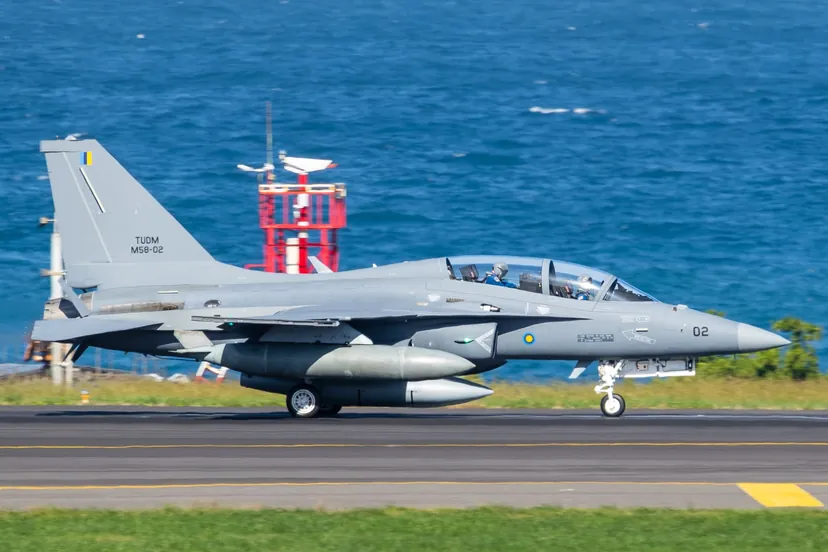
First, we must highlight why this aircraft is special. Even though the FA-50M shares the same name as the existing FA-50, it is an entirely different machine inside. The original FA-50 (Block 10) used by the Republic of Korea Air Force and the air forces of the Philippines, Thailand, and Iraq is equipped with an upgraded Elta (EL/M-2032) mechanical radar. In contrast, the Malaysian FA-50M is fitted with the PhantomStrike Active Electronically Scanned Array (AESA) radar from RTX of the U.S. This radar, utilizing gallium nitride (GaN) semiconductors, offers a detection range that is tens of percent longer than the existing EL/M-2032.
Furthermore, it is equipped with Lockheed Martin’s Sniper Advanced Targeting Pod for precision strikes on enemy ground targets and a Link 16 datalink; the Philippines and Poland are also scheduled to receive the same version soon.
Next is the expansion of armament. While the primary air-to-air weapon of the original FA-50 was limited to the older short-range Sidewinder (AIM-9M), the FA-50M can carry the AIM-9X Super Sidewinder. It can engage highly maneuverable targets, is resistant to countermeasures, and has a longer range than the existing Sidewinder. Essential advanced Identification Friend or Foe (IFF) equipment required for long-range air combat has also been added behind the radar in the nose. However, it is reported that while the Malaysian Air Force has kept the door open for the AIM-120 AMRAAM, its introduction will be discussed at a later date. Plans for ground target engagement include the GBU-12 laser-guided bomb, GBU-38 JDAM, and the AGM-65 Maverick missile.
Finally, an aerial refueling capability and a new fuel tank have been added. The original FA-50 could only carry a 150-gallon auxiliary fuel tank, but now it can be fitted with a new 300-gallon tank, significantly extending its range. With the addition of an aerial refueling probe, it is technically capable of flying to the other side of the globe. However, since the A330 MRTT Cygnus aerial tankers operated by the ROK Air Force are not yet configured to support this, the aircraft is making the journey from Sacheon to Malaysia via multiple airports this time.
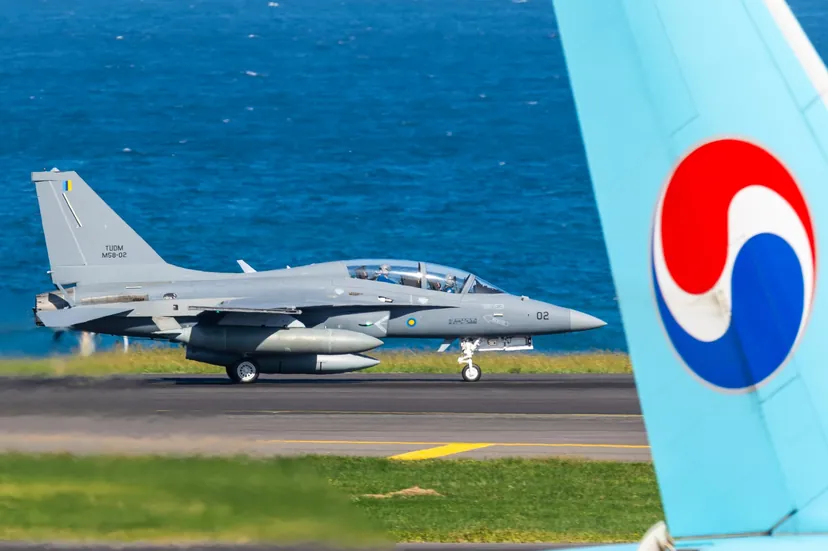
Malaysia signed the purchase contract for the FA-50M in May 2023, valued at approximately 920 million dollars (about 1.2 trillion Korean won) for 18 aircraft. The two aircraft currently in transit are the first batch, with the remaining 16 to be delivered sequentially by March 2028. The local deployment will be centered at the Kuantan Air Base in the state of Pahang, with some units assigned to the Labuan base in the state of Sabah. The plan is to station aircraft on both the peninsula and Borneo, flanking the South China Sea. Malaysia already signed an Intermediate Level Maintenance (ILM) support contract with KAI in July and has sent 6 pilots and 56 maintenance personnel to Korea for training.
According to forecasts by Malaysian media, the Malaysian Ministry of Defence plans to purchase an additional 18 FA-50Ms under a Phase 2 FLIT-LCA program to establish a 36-aircraft fleet. Once the first contract progresses smoothly and deliveries begin, momentum for the second contract will inevitably grow. More importantly, there is the "reference effect." As a "top-tier specification" FA-50 equipped with an AESA radar, targeting pod, Link 16, and refueling probe is actually deployed in Southeast Asia, it could stimulate demand for upgrades and additional acquisitions from existing FA-50 operators like the Philippines and Thailand. The fact that it uses the same Sniper pod as Malaysia’s existing F/A-18D Hornets also provides a clue for future cooperation in terms of maintenance interoperability.
This first export flight of the FA-50M marks a clear turning point for the Korean aerospace industry. We are witnessing the shift from light attack aircraft exports, which were once synonymous with low-cost sales, to the sale of the latest integrated systems equipped with AESA radars. On the 30th, the landing of the first unit in Kuantan, overlooking the South China Sea, will provide a glimpse into the next decade of K-Defense.