

[BizHanKook] The top scorer of this year's certified tax accountant exam admitted to cheating on the 15th and turned himself into the police. He revealed that he used a micro-camera, a smartphone, and generative AI during both the first and second rounds of the exam. The initial suspicion raised in the test-prep community regarding the use of AI glasses was not confirmed. Meanwhile, online suspicions have even spread to a test-taker who achieved a perfect score on all 70 questions of the Legal Education Eligibility Test (LEET) for language and reasoning. The individual has announced that they will solve the College Scholastic Ability Test (CSAT) Korean language section live on the 19th.
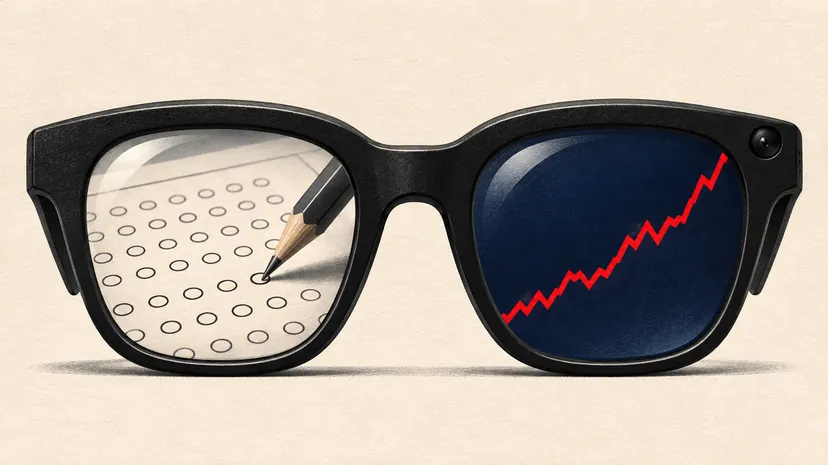
Amid this, the Gentle Monster model of the AI glasses that Samsung Electronics and Google are launching in Korea next month is priced between 650,000 and 700,000 KRW. Users can ask the AI about what they see in front of them or take photos without pulling out a mobile phone. Samsung Electronics stated that they designed the glasses so that a light turns on the outside when taking photos or videos, and the camera is disabled if this indicator light is covered. The extent to which camera-equipped glasses should be permitted is becoming a point of contention even outside of exam halls. According to Reuters, a major pub chain in the UK has already restricted the use of smart glasses, and in Australia, measures are being considered to restrict camera-equipped smart glasses in government workplaces.
Even if they are convenient enough to justify spending 650,000 KRW, it might be hard to open one’s wallet if there aren't many places to actually wear them. However, EssilorLuxottica, which partnered with Meta to release Ray-Ban AI glasses, already sold over 7 million units last year. According to market research firm Omdia, global AI glasses shipments in the first half of this year more than doubled compared to a year ago. Now, Samsung Electronics and Google have jumped in by partnering with Gentle Monster and Warby Parker. The interest now lies in whether Samsung and Google can capture the demand confirmed by Meta's products.
So, which company's performance will change when AI glasses sell well? Samsung Electronics co-developed the device, and Alphabet's Google provides the AI, "Gemini," embedded in the glasses. For Google, it means gaining another device where users can call upon Gemini without opening a phone app. Samsung Electronics gets the opportunity to sell a new device. Additionally, the specifications released by Samsung Electronics show that it includes Qualcomm's "Snapdragon AR1." Expectations for AI glasses have begun to be reflected in stock prices within the domestic market as well.
In early trading on the 16th, camera module companies Namuga and MCNEX rose by approximately 25% and 3%, respectively, from the previous trading day. The material released by Samsung Electronics regarding these AI glasses does not mention the name of the camera module supplier. Even after stock prices rise, it is necessary to verify which company's glasses the parts are being supplied to, and if mass production has begun, whether the orders are significant enough to increase the company's revenue.
On the eyewear company side, the U.S.-listed Warby Parker has provided relatively concrete figures. In the U.S., the company’s regular prescription glasses start at $95, while the AI glasses start at $395. Although the final price varies depending on lens options, they have become able to sell higher-priced products by launching AI glasses. Warby Parker management projected that this new product would boost the fourth-quarter revenue growth rate by a few percentage points. At the same time, they anticipated spending money on stores and lens processing facilities ahead of the launch, and that advertising costs would increase.
Warby Parker reduced its third-quarter selling, general, and administrative expenses by $12.7 million, reflecting costs that could be recovered from Google. The cumulative amount actually received from Google by the end of September was $9.8 million. Google's support eased the burden of launch preparations. Once the glasses begin to sell, it is necessary to look at how much product revenue increases—separate from the support—and whether profits have grown after deducting the costs of sales.
In its earnings announcement last year, EssilorLuxottica cited AI glasses as a factor weighing on the group's adjusted operating margin, along with U.S. tariffs. This doesn't mean that the AI glasses business itself was in the red, but it may take time for sales volumes, even in the millions, to generate profit margins as high as their existing business.
The first buyers of the 650,000 KRW AI glasses are likely people who have been waiting for new devices. For the market to grow further, the number of people willing to pay extra for AI features when replacing their regular glasses must increase. Therefore, investors looking at related stocks should focus on the sales trend after the launch fever dies down rather than news of the first day's sell-out. One must observe whether a product bought out of curiosity can truly replace the glasses people wear every day.