

[BizHanKook] Keigo Higashino, a representative Japanese mystery novelist, passed away from colon cancer in the early hours of July 23. He was 68. The Japanese publisher Kodansha officially announced his passing on July 27. The funeral was held privately for family members, and it has not yet been decided whether a separate memorial service will be held in the future.
Including his final full-length novel, "Memory of Eternity," scheduled for publication on August 5, 2026, Higashino authored 106 standalone works. His cumulative circulation in Japan reached approximately 109 million copies, and his works have been published in 41 countries and regions worldwide. He is credited with broadening the scope of the mystery genre by combining meticulous tricks with profound insights into human nature.
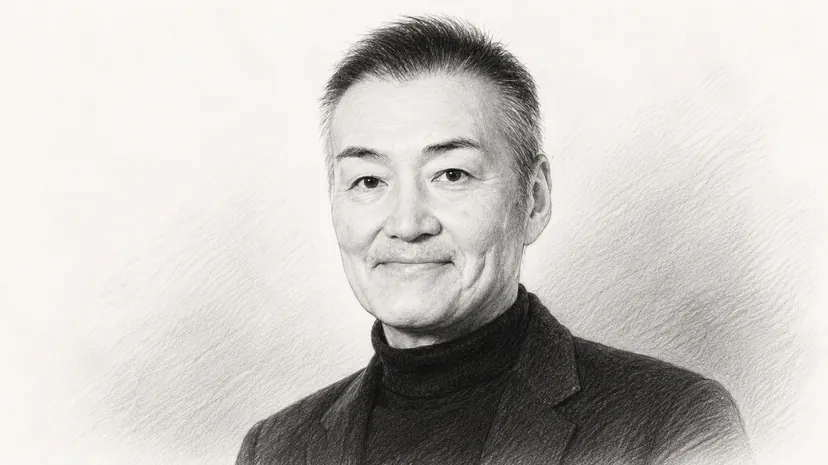
From designing automotive electronics to becoming a novelist...
Higashino was born on February 4, 1958, in Ikuno-ku, Osaka, Japan. After graduating from Osaka Prefecture University with a degree in electrical engineering, he joined the automotive parts company Nippon Denso (now Denso) and worked as an engineer. He designed circuits and electronic components at the office and wrote novels after getting off work. An engineer's logical way of thinking became the foundation for his later meticulous tricks and seamless plot structures.
In 1983, he submitted "The House of the Dolls" to the Edogawa Rampo Prize, passing the second round of judging, and the following year, "Magical" became a finalist. His third novel, "After School," was selected as the winner. "After School" was based on Higashino's experience as the captain of his university's archery club. Set in a girls' high school archery club, the story deals with a murder case occurring within a confined school space and won the 31st Edogawa Rampo Prize in 1985.
After balancing his job and writing for about a year, he quit his company in 1986, moved to Tokyo, and embarked on a path as a full-time writer. He began to gain mainstream recognition after winning the Mystery Writers of Japan Award for "The Secret" in 1998.
Published the following year, "Journey Under the Midnight Sun" (Byakuyako) was a turning point that transformed his literary world. While centering on two characters entangled by a murder case from their childhood, he opted for a style that traced their long journey through the eyes of a detective and surrounding characters, rather than directly explaining their inner states. The work was highly regarded for moving beyond the formulas of traditional mystery novels by portraying the long lives of people living with crime.
From this period on, Higashino placed greater weight on so-called "social mysteries." While conventional mystery novels focus on the process of solving a puzzle, social mysteries delve into both the society that breeds crime and the motives of the individuals. He expanded the breadth of the genre by incorporating realistic social issues into his mystery novels.
Rejected five times for the Naoki Prize, finally winning with "The Devotion of Suspect X"
Although Higashino consistently published works after his debut, he struggled to connect with the Naoki Prize, the most prestigious literary award in the Japanese literary scene. "The Secret," "Journey Under the Midnight Sun," "Unrequited Love," "The Letter," and "Into the White Night" were all nominated one after another, but he failed to win every time.

The work that finally earned him the Naoki Prize after a long series of challenges was "The Devotion of Suspect X." It is a story about a genius mathematician, Ishigami, who designs a perfect alibi to protect the woman he loves, while his college friend, the physicist Yukawa, tracks the truth. Combining intricate deduction with human sacrifice and love, this work cemented itself as Higashino's signature masterpiece.
With this work, Higashino took the number one spot in all major mystery rankings, including the Naoki Prize, the Honkaku Mystery Award, "Bungeishunju Mystery Best 10," "Kono Mystery ga Sugoi!", and "Honkaku Mystery Best 10." The English edition was nominated for the Edgar Award for Best Novel by the Mystery Writers of America (MWA) in 2012, and in 2019, "Newcomer" was selected as a finalist for the Crime Writers' Association (CWA) International Dagger Award. Higashino was recorded as the first Japanese author to be nominated for both the American Edgar Award and the British Dagger Award.
He later served as the chairman of the Mystery Writers of Japan from 2009 to 2013 and served as a judge for the Naoki Prize starting in 2014. In 2023, he received the 71st Kikuchi Kan Prize in recognition of his contribution to the development of Japanese literature and publishing culture, and was awarded the Medal with Purple Ribbon by the Japanese government.
More interested in "Why do people make such choices" than "Who is the culprit"
Higashino's works are difficult to define as a single genre. The "Galileo series" showed the charm of authentic mysteries based on scientific thinking, while the "Kyoichiro Kaga series" delved deep into the families and communities behind the cases. "Journey Under the Midnight Sun" and "Into the White Night" are considered social crime novels that portray human desire, class mobility, and the shadows of Japanese society.
The 2012 publication of "The Miracles of the Namiya General Store" greatly expanded his readership beyond mystery novel fans. The novel is a story about three young men hiding in a closed-down general store who reply to letters seeking advice from the past, connecting people across different eras.
In "The Miracles of the Namiya General Store," there is neither a master detective nor a central murder case. Instead, it follows a mystery structure where scattered characters and incidents connect at the end, yet it evolves into a story that ultimately heals people. The work won the Chuo Koron Literary Prize in Japan and was adapted into films in Japan and China. It also remained a long-term bestseller in Korea, showing a different side of his literary world to readers who only knew him as a crime novelist.
The 2026 animated adaptation of "The Guardian of the Camphor Tree" follows the same trend. He once remarked during his lifetime, "When you only write stories about killing people, you start to want to write stories about saving them." As he grew older, his works placed greater emphasis on the process of wounded people connecting with others and living again, rather than on solving crimes.
Because of this, every reader had a different favorite work. Readers who enjoyed the thrill of deduction cited "The Devotion of Suspect X," those who liked mysteries that reflect society chose "Journey Under the Midnight Sun" and "The Letter," and those seeking warm comfort picked "The Miracles of the Namiya General Store." By attracting diverse readers, Higashino expanded mystery novels from a niche genre into stories read by the general public.
"I didn't write because I wanted to write a lot; I had to keep writing, or I wouldn't survive as a writer." Keigo Higashino reflected on his debut days with these words when his 100th book was published. The more than 100 works were not a number for the sake of records, but the result of time spent writing manuscripts without rest to make a living—and to remain a writer.
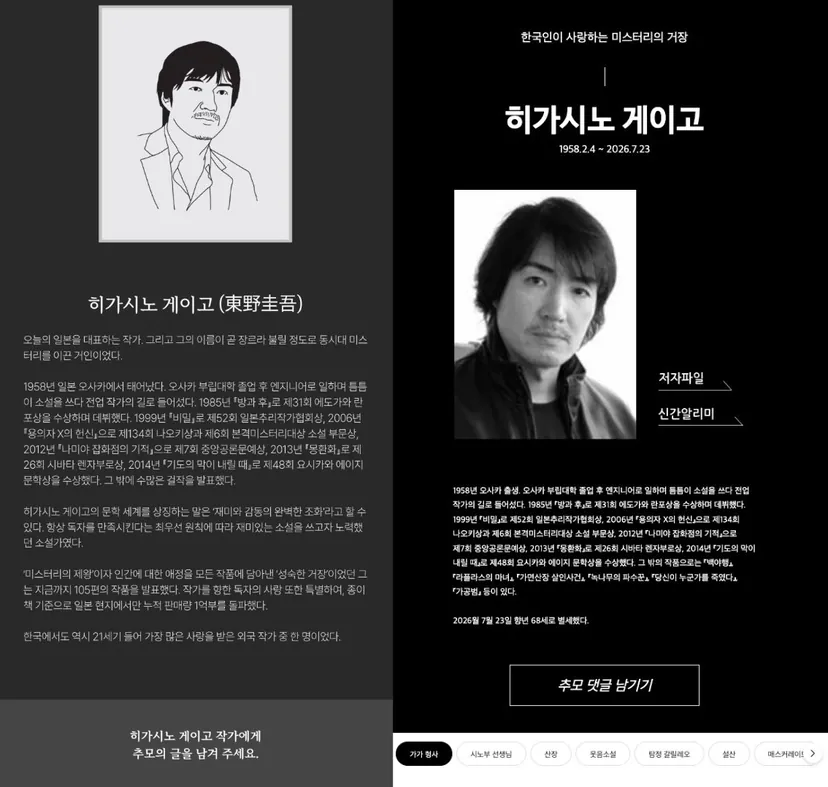
An author loved by Korean readers as well... A wave of mourning in bookstores
Since Keigo Higashino's departure, the publishing industry and readers have been remembering him in their own ways. Major Japanese bookstores set up memorial corners featuring his representative works, and readers have been flocking back to his books.
Movements to honor his work also continued in Korea. Aladin held a special exhibition titled "In Memory of Author Keigo Higashino" and provided a space for readers to leave farewell messages. Kyobo Book Centre also introduced his major works through a memorial exhibition to reflect on his literary world. His novels, published just a short while ago, immediately hit the bestseller lists.
For 40 years, the question Higashino posed to his readers was not simply "Who is the culprit?" He constantly asked why people made such choices, whether sin and forgiveness were possible, and if one could live again while carrying wounds. We can no longer meet his new works, but those questions remain in his 106 books, still waiting for his readers.