

[비즈한국] As the escalating war between the U.S. and Iran pushes international oil prices back above $100 per barrel, concerns over inflation are mounting. Consumer prices, which had maintained a low 2% range earlier this year, have climbed to the 3% range depending on the intensity of the U.S.-Iran conflict. In particular, there are forecasts that inflation, which surpassed 3% again in August, could rise further as the war between the U.S. and Iran intensifies.
The problem is that the shock of this inflation is concentrated on low-income households. In fact, during the second quarter of this year, when the conflict between the U.S. and Iran flared up, the Engel coefficient—the proportion of food-related expenditures within a low-income household's consumption spending—hit its highest level since the relevant statistics were revised in 2019.
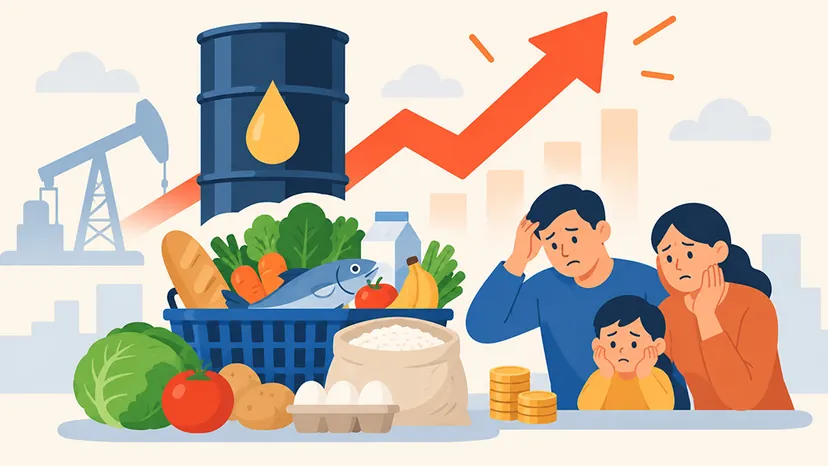
This year, South Korea's consumer prices have shown a direct correlation with the volatility of the U.S.-Iran war. The consumer price inflation rate remained stable, recording 2.0% in January and February, and 2.2% in March. However, as the U.S.-Iran war broke out in April, it jumped to 2.6%, followed by an upward trend, breaking through the 3% barrier to reach 3.1% in May and rising further to 3.2% in June. When signs of a ceasefire between the U.S. and Iran appeared in July, inflation seemed to stabilize as it fell to 2.8%, but as conflicts resumed, it hit 3.1% in August, surpassing the 3% mark once again.
Entering September, with conflicts spreading not only between the U.S. and Iran but also between Saudi Arabia and Houthi rebels, international oil prices are surging, which is expected to further exacerbate the consumer price inflation rate. These concerns are further weighted by the producer price index—which typically affects consumer prices with a one-to-two-month lag—rising from 7.7% in July to 7.9% in August.
With the possibility of inflation rising and the Chuseok holiday approaching, the government appears focused on curbing food prices. First, the government lifted the per-person weekly discount limit of 20,000 won for agricultural and livestock products, which was previously in effect during Chuseok, and extended the discount period from September 23 to the end of September. The supply of seafood has also been increased. The government added 2,000 tons—including 1,300 tons of pollock, 300 tons of squid, 300 tons of yellow croaker, and 100 tons of dried anchovies—to the initial 20,000-ton government reserve supply.
The reason the government is working hard to control food prices is that inflation is hitting low-income households the hardest. According to the Korean Statistical Information Service (KOSIS), during the second quarter of this year, at the height of the U.S.-Iran war, the average monthly household spending on food consisted of 434,477 won for groceries and non-alcoholic beverages, and 456,940 won for dining out, totaling 891,417 won. This is a 3.3% increase compared to the same period last year. As food expenses increased, the Engel coefficient, which represents the share of food spending in total household consumption, was measured at 30.4%.
Looking at the data by income bracket, the first-quintile households, representing the bottom 20% in income, saw their average monthly food-related spending reach 473,148 won in the second quarter of this year, an increase of 6.1% compared to the same period last year (446,053 won). This is nearly double the growth rate of food-related spending for all households. The Engel coefficient for the first-quintile households was 34.5%, up 0.3 percentage points from the same period last year (34.2%), marking the highest level (based on Q2 figures) since the statistics were revised in 2019. The situation was similar for the second-quintile households, which represent the bottom 20–40% in income. Their average monthly food-related spending in the second quarter was 656,530 won, a 6.9% increase compared to the same period last year (614,074 won), which is more than double the total average increase. The Engel coefficient for the second-quintile households also reached an all-time high since 2019 at 33.6%, an increase of 1.3 percentage points from 32.3% in the same period last year.
In contrast, the fifth-quintile households, which belong to the top 20% in income, actually saw a decrease in the share of food-related spending within their total consumption expenditure. The average monthly food-related spending for the fifth-quintile in the second quarter of this year was 1,378,312 won, a modest increase of 1.8% from the same period last year (1,354,417 won). This is half the level of the total average growth rate. The Engel coefficient for the fifth-quintile households was 26.5%, a 0.9 percentage point decrease from the same period last year (27.4%).
Journalist Lee Seung-hyun