

[비즈한국] Criticism is mounting regarding the long-term power demand projections in the government's '12th Basic Plan for Electricity Supply and Demand,' with many arguing that the forecasts are excessively inflated. This is because the potential additional power demand for the high-tech industrial sector by 2040 has surged approximately 6-fold in just four months. While the government explains this as proactive infrastructure expansion to support future national growth engines, critics argue that it has uncritically accepted unverified, rosy investment intentions from corporations. Experts warn that if future demand falls short, these hastily constructed large-scale power plants and transmission grids will inevitably become stranded assets.
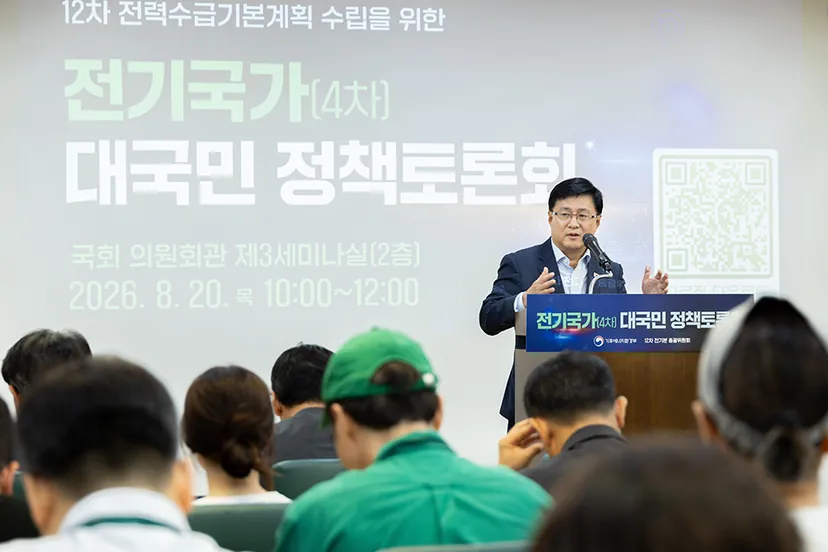
2040 Target Demand Soars Due to Inclusion of Mega-Projects
The core catalyst for the revisions in this 12th Basic Plan for Electricity Supply and Demand is the 'Three Major Mega-Projects for Korea's Great Leap,' announced by the government on June 29. Power authorities have incorporated these plans into long-term demand forecasts, following the materialization of plans for large-scale semiconductor fabrication clusters, such as those in the Honam region, and the construction of gigawatt (GW)-class AI data centers across the country.
As a result, the projections presented during the third forum in April were significantly revised after just four months. The target scenario for power consumption in 2040 was finalized at 847.3TWh, a 28.8% increase from the initial proposal, while peak power demand also surged by 20.2% (26.6GW), from 131.8GW to 158.4GW.
In particular, the net increase (additional demand) in consumption for the high-tech industrial sector skyrocketed nearly 6-fold, from 29.3TWh in the April preliminary announcement to 170.5TWh. Semiconductor demand alone accounted for a 20.6GW increase in peak power, while AI data center consumption more than tripled from 26.5TWh to 84.9TWh, adding another 7.9GW to peak power demand.
Looking at the breakdown, the increase resulting from the Korea Development Institute (KDI)'s adjusted gross domestic product (GDP) growth forecast is only about 1GW in terms of 2040 peak power. Most of the 26.6GW net increase in peak power is not a result of natural demand growth driven by national economic expansion, but rather the result of layering on the investment intentions for semiconductors (20.6GW) and AI data centers (7.9GW) surveyed after the announcement of the three major mega-projects under the guise of 'additional demand.'
Uncertainties Like Economic Downturns Ignored
The aspects that concern experts most are the 'upward-biased calculation method' that ignores realistic economic volatility and the possibility of 'double counting.' Power authorities have presented only two scenarios—a base scenario and an upward (accelerated) scenario—but have failed to provide a 'downward (pessimistic) scenario' that accounts for global economic downturns, semiconductor downcycles, the collapse of AI investment bubbles, or the cancellation and delay of individual corporate investments.
Critics also point out that the government's calculation method involves 'double counting,' where power demand is tallied twice. Power authorities explain that they calculated final demand by adding corporate investment plans separately to the electricity demand that naturally grows as the national economy expands. However, since high-tech industries like semiconductors are already key drivers of GDP growth, they may already be substantially included in the base power demand calculated based on total economic growth rates. Consequently, critics argue that by piling large-scale corporate investment plans on top of the baseline growth, the authorities have redundantly reflected the same power demand, excessively inflating the overall forecast.
Kim Byung-kwon, director of the Reform Platform for a Green Future, noted, "The three major mega-projects reflect the business expectations and will of a handful of companies buoyed by the AI boom and semiconductor super-cycle at face value, rather than cold-headed national policy planning," adding, "There is absolutely no guarantee that the semiconductor industry will continue its super-cycle indefinitely or that the capacity expansion will proceed as corporations expect."
Regarding data center demand, he emphasized, "The plan to add 8.4GW within three years and another 10GW in a second phase by 2035 is extremely uncertain. Although the government claims to be considering the uncertainty of the second phase, even the first phase volume they’ve already reflected must be thoroughly re-evaluated to see if it can actually be built and operated at 100% capacity."
Fears of Excess Facilities Becoming 'Tax-Eating Hippos'
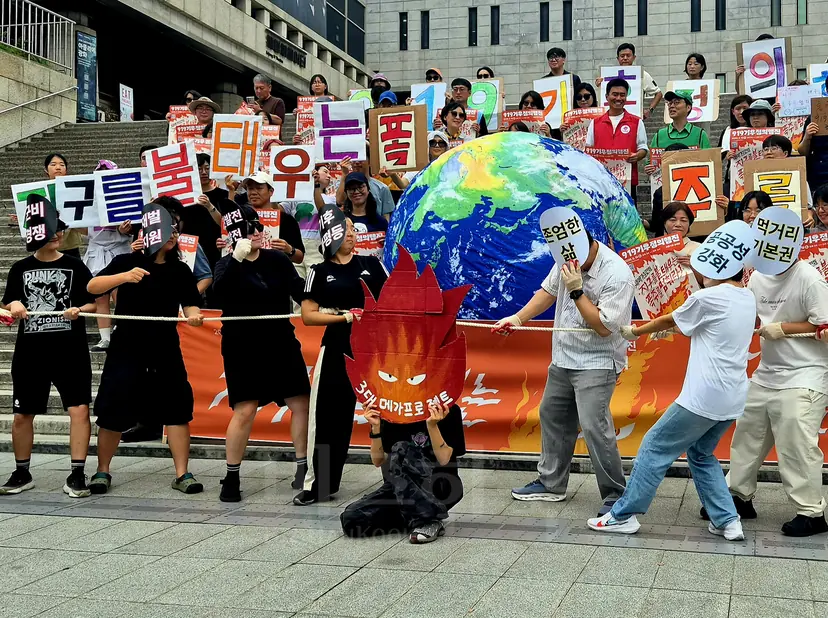
Power generation facilities built based on excessive demand forecasts risk becoming stranded assets if actual demand falls short of expectations, leading to a sharp drop in utilization rates.
According to Solutions for Our Climate, new LNG power plants reflected in the 11th Basic Plan are projected to have a utilization rate of only about 11% by 2038. Forcibly adding facilities that only operate for two to three hours a day increases electricity supply costs because capacity payments—which act as fixed costs—must be paid to operators even when the generators are idle. The case of the East Coast private coal-fired power plants, which are facing over 1 trillion won in unsettled payments due to transmission constraints and demand mismatches, is cited as a prime example of the side effects caused by overinvestment.
Han Ga-hee, an energy market policy lead at Solutions for Our Climate, explained, "If we forcibly build power plants that will only operate at 10% utilization, KEPCO will have to compensate for the costs even if the investment fails or utilization rates plummet. This inevitably aggravates the financial burden on KEPCO, which is already carrying 200 trillion won in debt, and will eventually return as a burden on the public through electricity rate hikes or taxes." She further warned, "If KEPCO issues large-scale bonds to cover its deficits, it could absorb funds from the financial market, leading to a credit crunch in the private capital market."
Critics also point out that excessively inflated demand forecasts can be used as justification for the construction of large power generation facilities. Analysis suggests that by setting the 2040 target demand high, the government is creating a pretext for building new nuclear power plants and large-scale LNG plants.
Since the rolling blackout incident in 2011, the Basic Plan has consistently failed to forecast demand accurately, often over-reflecting power generation facility plans. In this situation, critics argue that large-scale power facilities like nuclear and LNG plants included in the plan are built as scheduled, serving only the interests of large-scale power stakeholders.
Director Kim Byung-kwon stated, "The three major mega-projects themselves are highly excessive plans, and the current demand forecast is a scenario leaning on the recent AI boom. Naturally, this can work to the advantage of stakeholders, such as by extending the operation of existing nuclear plants, or pushing for new nuclear plants, new gas plants, and new SMRs."
Another issue is that it is not a lack of power supply, but a 'surplus of power supply' that could undermine the physical stability of the power grid. Solar and nuclear power plants are 'inflexible power sources' that are difficult to adjust in real-time. If solar power generation surges during the low-demand daylight hours of spring and autumn, and nuclear plants continue to operate at a fixed output on top of that, power supply will exceed demand, causing grid frequency and voltage fluctuations and increasing the risk of large-scale blackouts.
Currently, power authorities are implementing 'curtailment,' which forces the shutdown of renewable energy generators in regions like Honam, to prevent grid collapse. However, concerns are emerging that if large base-load generators are added, curtailment will become even more frequent, deteriorating the profitability of domestic renewable energy operators and hindering the expansion of these resources.
Professor Emeritus Sung Won-ki of Kangwon National University emphasized, "It is difficult to maintain the stability of the power grid in spring and autumn when inflexible sources like solar and nuclear conflict. We must stop the focus on large-scale generator plans and reorganize in a way that grows the domestic renewable energy industry, such as through energy storage systems (ESS)."
Calls for Transparency and Cross-Verification
Experts suggest that to prevent these risks, the transparency of the process for establishing the Basic Plan must be significantly increased, and the government must move away from a plan focused solely on state responsibility.
First, there are demands for the transparent disclosure of demand forecasting models and data to external parties to enable social cross-verification. Han Ga-hee pointed out, "A serious problem in the government's process of establishing the Basic Plan is that transparency is severely lacking. Information that would allow external experts to reasonably evaluate whether the currently announced figures are overestimated or underestimated is not being disclosed."
Furthermore, there is a strong call to move away from a system where the state takes full responsibility for building 100% of the public infrastructure for the massive power demands of large corporations. Kim Eun-seong, Vice Representative of NEXT, suggested, "When the state builds power generation facilities by treating corporate business plans as absolute demand, and that demand fails to materialize when the supply is ready, the risks and costs are borne entirely by the public. Like in advanced countries such as the U.S., we should induce hyperscaler companies that require massive amounts of power to build their own power plants and grid infrastructure, while the government provides institutional support such as expediting permits to reduce national risk."