

[비즈한국] Doosan has finalized its acquisition of SK Siltron, the only semiconductor wafer manufacturer in Korea. This comes seven months after the company was selected as the preferred bidder late last year. Although negotiations were prolonged as the semiconductor industry experienced a dramatic turnaround from a slump to a major boom, both sides have reached an agreement valued at 2.3 trillion won.
Doosan Corporation, the business holding company of Doosan Group, announced on the 31st of last month that its board of directors had approved a stock purchase agreement (SPA) to acquire a 70.6% stake in SK Siltron held by SK Inc., the holding company of SK Group. On the same day, SK also approved the sale agenda at its own board meeting. The acquisition price is set at 2.3 trillion won and will be finalized following a price adjustment procedure.
Upon signing the agreement, Doosan will pay 10% of the purchase price as a down payment, with the remaining 90% to be paid on the closing date. The acquisition funds will be raised through internal cash and loans, and the company plans to close the deal by January 31 of next year, subject to regulatory approvals.
SK Compromises with ‘Performance-Linked’ Terms Instead of Raising Price
It was widely expected that this deal would be concluded in the first half of this year. However, unlike at the end of last year when SK selected Doosan as the preferred bidder, the semiconductor market began to recover in the fourth quarter, driving up the valuation of SK Siltron. Criticism arose within and outside SK that they were selling a valuable subsidiary too hastily, and some in the capital market even speculated that the sale might fall through.
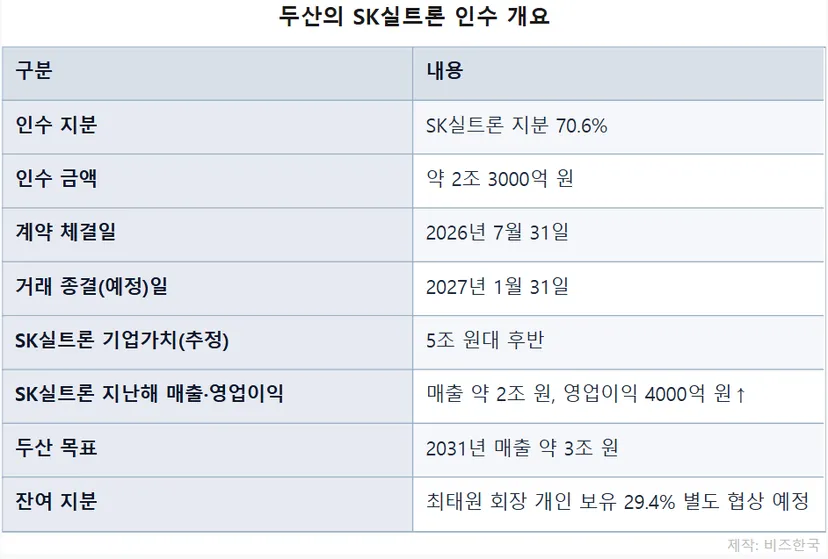
In this agreement, SK Siltron’s enterprise value was estimated in the high 5 trillion won range. As a result, the value is reportedly not significantly different from what was discussed at the beginning of the negotiations last year. Instead of raising the sale price, SK found a compromise by including a clause that allows them to share in additional profits based on future performance.
If SK Siltron's earnings before interest, taxes, depreciation, and amortization (EBITDA) exceed the contractual threshold for eight years from 2027 to 2034, SK will receive an additional amount equivalent to 40% of the excess multiplied by the 70.6% stake. The annual threshold will increase in stages from 8900 billion won in 2027 to 1.7 trillion won in 2034. In addition, mechanisms have been put in place to ensure SK can share a significant portion of the fruits of Siltron's growth after the sale, such as receiving additional settlements based on their share for asset disposal gains or the completion of quality certifications for specific products.
Regarding the purpose of the sale, SK stated it was to "enhance financial stability and secure funding for future growth engines." SK Group has been working on asset efficiency optimization since 2024. They have sold stakes in SK Specialty to Hahn & Company and portions of their SK Biopharmaceuticals stake, and SK Innovation has also secured liquidity by selling affiliate assets. As a result, the number of SK Group affiliates has decreased from 219 to 198, and net debt has been nearly halved.
Industry experts believe that the funds secured will also be reinvested into the 'AI Full Stack' strategy that SK has been pursuing, covering AI data centers and power. However, some point out that since the supply chain for wafers, a raw material for semiconductors, is being transferred to another group, the vertical integration strategy centered on SK Hynix may be somewhat weakened.
Doosan Expands Into Semiconductor Front-End Process
From Doosan's perspective, this acquisition is seen as the final piece to complete its semiconductor business portfolio. Doosan entered the back-end business in 2022 by acquiring the semiconductor test company Doosan Tesna, and has been boosting performance by supplying copper-clad laminates (CCL) for AI accelerators to global big tech companies through its Electronics BG. With the addition of SK Siltron, a wafer manufacturer that is the starting point of the semiconductor front-end process, the company has further strengthened its "semiconductor and advanced materials" business area, spanning from wafer production to semiconductor testing.
Doosan Group’s business portfolio consists of three main pillars: Energy (Doosan Enerbility, Doosan Fuel Cell), Smart Machines (Doosan Bobcat, Doosan Robotics), and Semiconductor & Advanced Materials (Electronics BG, Doosan Tesna). This acquisition is seen as significantly increasing the weight of the third pillar.
Established in 1983, SK Siltron is the only company in Korea with technology for manufacturing silicon (Si) wafers for semiconductors. Last year’s revenue exceeded approximately 2 trillion won, with operating profits surpassing 400 billion won. It produces 300mm (12-inch) and 200mm (8-inch) wafers and is particularly competitive in the 12-inch wafer sector, ranking within the top 3 globally.
Wafers are the foundation for the entire semiconductor front-end process, and the business is considered to have very high barriers to entry because quality directly dictates production yield. In fact, the global silicon wafer market is an oligopoly where five companies—including SK Siltron, Shin-Etsu Chemical, Sumco, GlobalWafers, and Siltronic—hold over 90% of the market share. Shares of Doosan hit the daily upper limit on the day of the announcement, driven by expectations of a semiconductor boom.
Doosan expects the wafer business to maintain an average annual growth of 7% and has set a goal to increase SK Siltron’s revenue to approximately 3 trillion won by 2031. The plan is to achieve the number two spot globally for memory wafers and to increase market share in the non-memory wafer market—which has been effectively dominated by Japanese companies—through technology development and securing new customers. The company also stated that it has no plans to list SK Siltron separately. After the acquisition, it will operate an integration team to review organizational and business consolidation, as well as structural reorganization plans including a potential merger.
While the stake held by SK Inc. was settled through this contract, the remaining 29.4% stake held by SK Group Chairman Chey Tae-won in his personal capacity was excluded from the sale. Doosan announced that it would continue separate negotiations with Chairman Chey’s side regarding the acquisition of the remaining stake.
A Doosan official stated, "With this acquisition agreement, Doosan has secured future growth engines while establishing a sustainable profit base," adding, "Based on a stable business portfolio, we will strive even harder to enhance shareholder value for Doosan."