

[비즈한국] “It’s not a very funny joke, but to run a transformer, you need a transformer.” This was a remark made by Tesla CEO Elon Musk at an event hosted by Bosch in Germany in 2024. What does it mean?
The first "transformer" refers to the architectural foundation of generative AI, such as ChatGPT. The ‘T’ in ChatGPT stands for Transformer. The latter "transformer" refers to the electrical device used to step up or step down voltage. Although he was using a pun on the same word, the message was serious. It was a forecast that the AI bottleneck would shift from semiconductor chips to transformers, and eventually to electricity itself.
In fact, the market research firm Sightline Climate predicted that of the large-scale data center capacity announced for operation this year (approximately 16GW), 30-50% will struggle to launch within the year due to power and equipment shortages. According to a Bloomberg report from last November, a data center project in Santa Clara, where Nvidia is headquartered, for which the large data center leasing firm Digital Realty had applied for construction in 2019, remained empty after six years because it could not be supplied with sufficient power.
The situation in South Korea is no different. A study by the global commercial real estate services firm CBRE Korea, based on data from Korea Electric Power Corporation (KEPCO), showed that as of March this year, there were 522 data center projects that had applied for the first technical review of power grid impact in the metropolitan area. Of these, only 10 projects received final approval for power supply, accounting for just 1.9% of the total applications. The saying that the most precious resource in the AI era is not semiconductors, but electricity, is no longer an exaggeration.
Consequently, the mindset is shifting. Instead of waiting for electricity to arrive, power plants are being placed directly next to data centers. Industry insiders call this "on-site power." As the power demand of AI data centers grows, on-site power generation is increasingly leading to actual orders.
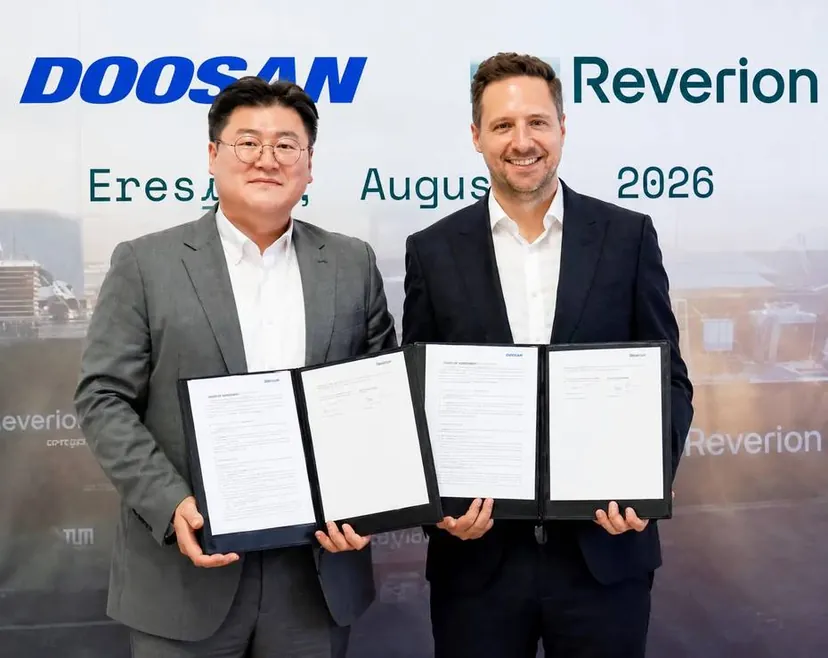
Amid this trend, a startup in Bavaria, Germany, is garnering attention. It is Reverion, which attracted 154.2 million euros (approximately 230 billion won) in Series B funding on the 29th of last month. This is the largest funding round in the company's history. Reverion also gained recognition in Korea last August by signing a contract with the Korean company Doosan Fuel Cell to supply stacks, the core component of SOFC (Solid Oxide Fuel Cell).
A Power Plant Without Engines or Turbines?
Is it possible to build a power plant right next to a data center?
Small generators using gas engines or turbines are already being deployed at data center sites. Companies like Caterpillar in the U.S. and Wärtsilä in Finland are prime examples, and GE Vernova, Siemens Energy, and Rolls-Royce have also entered this market. These generators burn gas to turn engines or turbines, creating electricity through rotational force. Significant energy is lost as heat while the fuel’s energy undergoes thermodynamic and mechanical conversion into electricity. Small on-site gas generators convert only about 40% of the fuel's energy into electricity.
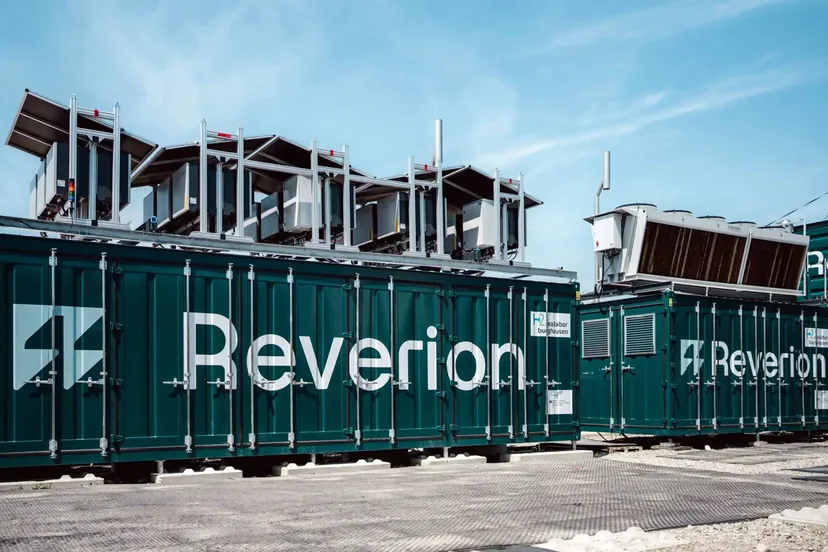
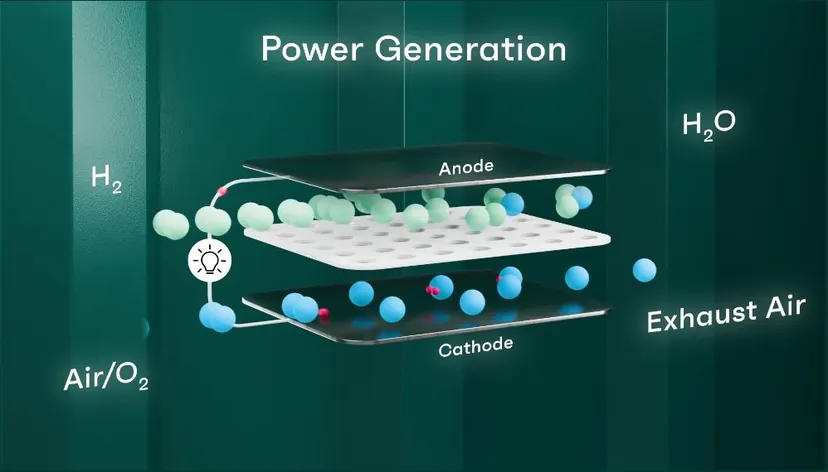
In contrast, Reverion's power plants have no engines or turbines. Externally, it looks like a single steel box resembling a shipping container. Inside, it contains SOFC stacks and various equipment to operate them. In this fuel cell, air and fuel are supplied separately with a thin ceramic electrolyte in between. At high temperatures, oxygen from the air passes through the electrolyte in ion form and reacts electrochemically with the fuel at the electrode to generate electricity. Since it does not burn fuel, very little energy is wasted. Reverion stated that its pre-production facility at a biogas plant in Müllacker, Germany, achieved an electrical efficiency of 74.2%, a figure significantly higher than that of typical gas cogeneration plants.
This device also operates in reverse. Just as an electric vehicle uses its motor to drive wheels and then generates electricity through regenerative braking when the brakes are applied, when there is surplus electricity, the same fuel cell switches to an electrolysis mode to produce hydrogen. Depending on the system configuration, methane can also be produced. On windy or sunny days, surplus electricity is converted into gas for storage, and on days when electricity is scarce, that gas is used to generate electricity again. Because it does not burn fuel by mixing it with air, it is easy to separate and capture carbon dioxide at high concentrations. The company explains that if operated with biogas and the captured carbon is utilized or stored, it can actually reduce carbon in the atmosphere.
Installation is also simple. Instead of building a power plant on-site, fully completed power modules are transported from the factory to the site and connected to gas supply facilities. If more electricity is needed, more modules can be added. Instead of pulling electricity from far away via power lines that may take years to complete, the method involves bringing in fuel and generating electricity right on the spot.
After Technology Comes Production Capacity
Of course, it is not a cure-all. Currently, the output of one unit is 500kW. Based on this, it would arithmetically require 200 units to meet the power demand of a 100MW data center. The annual production capacity of the new factory planned by Reverion is 250MW, which is equivalent to about two and a half 100MW data centers in terms of simple equipment capacity. The actual number of units required may increase depending on reserve power and operating conditions. Data centers are still a growth market the company is targeting. The units currently in operation are installed at biogas facilities, factories, and hospitals.
Nevertheless, investors opened their wallets because the technology has been proven in the field, and the remaining challenge is production capacity. According to Reverion, seven commercial units are currently operating at customer sites, and the company has secured a project pipeline with potential revenue exceeding $2 billion. CEO Stephan Herrmann said in an interview with German media, "The demand is so high that it is on a different order of magnitude from what we can produce now." The company plans to invest most of its funding into a new factory in Germany to increase production capacity tenfold and scale the output of a single unit to the megawatt level.
To secure production capacity, Reverion signed an SOFC stack supply contract with Doosan Fuel Cell last August worth approximately 108.7 billion won. The intent is to stably source key fuel cell components to increase output. For Doosan Fuel Cell, this marks the beginning of a new business of supplying SOFC stacks to overseas companies in bulk.
Reverion’s case demonstrates that the technology to increase power generation efficiency and the ability to implement it on an industrial scale are separate challenges. Even if an electrical efficiency of 74.2% has been proven, it is difficult to grow the business if equipment cannot be supplied when the customer wants it. This is why Reverion is investing in a new factory and signing large-scale supply contracts with Korean companies.
The power crisis of the AI era cannot be solved by power generation technology alone. It requires the ability to supply equipment to the necessary locations at the necessary time. In an era where waiting for electricity is not an option, the ability to mass-produce and install technology on-site is becoming as important as the technology that creates the electricity itself.
The author Lee Jung-woo spent 17 years as a newspaper reporter covering major industries including automobiles, secondary batteries, and heavy industry, as well as various fields such as national defense, diplomacy, environment, education, and health and welfare. In particular, he covered the structural changes in industry centered on mobility, energy transition, and sustainability from the field. He currently resides in Berlin, Germany, and serves as a partner at the startup accelerator ‘123 Factory’.